
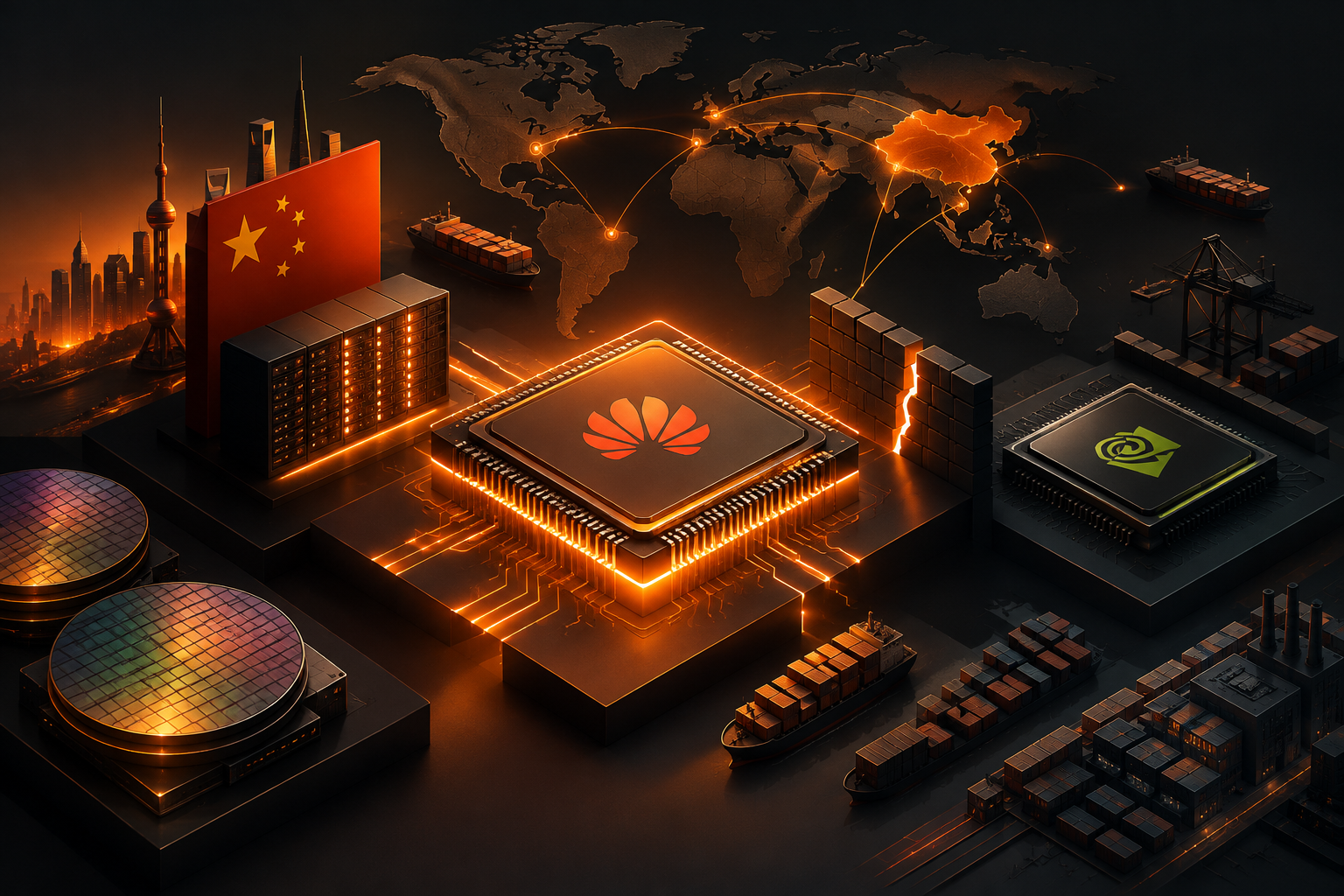
Huawei has announced the market launch of new AI chips for 2027, according to Reuters. The Chinese conglomerate is responding to ongoing US export restrictions and positioning itself as an alternative to Nvidia, the global leader in artificial intelligence processors.
The essentials
- Huawei plans to launch custom AI chips in 2027
- Goal is to reduce dependence on Nvidia and US technology
- The move underscores China's strategy for technological self-sufficiency
- Background: US export controls restrict access to advanced semiconductors
China's chip push under pressure
US sanctions against China have accelerated domestic chip development over recent years. Huawei is one of the most active players. With the announcement of a concrete 2027 roadmap, Huawei signals that development is progressing.
The new AI chips are designed to enable Chinese companies to build their AI infrastructure with less dependence on US vendors. This has not only economic but also geopolitical implications: whoever controls the chips controls access to AI technology.
Nvidia remains dominant for now
Despite Huawei's ambitions, Nvidia maintains an overwhelming market position. The US conglomerate dominates the market for specialized AI accelerators globally. Huawei's announcement shows technological ambition but also the challenge of competing with established players.
The 2027 roadmap means Huawei still has at least two to three years of development ahead. During this period, the global AI hardware landscape could shift significantly – both through technological advances and further political measures.
What this means for European companies
The development has relevance for German and European firms on multiple levels: First, a functioning Chinese alternative to Nvidia could intensify global competition for AI hardware and create price pressure. Second, this illustrates a geopolitical pattern – the fragmentation of global supply chains into US-dominated and China-dominated spheres. European companies must prepare for a scenario where they may need to choose between different technological ecosystems. Third, Huawei's push underscores how critical it is for Europe to build its own capacities in chip and AI development – not only for economic reasons but also for sovereignty.
Sources
Editorially owned by Ideal Syka. Sources and method: Newsroom & method. Tips and corrections: ai@i6eal.de.