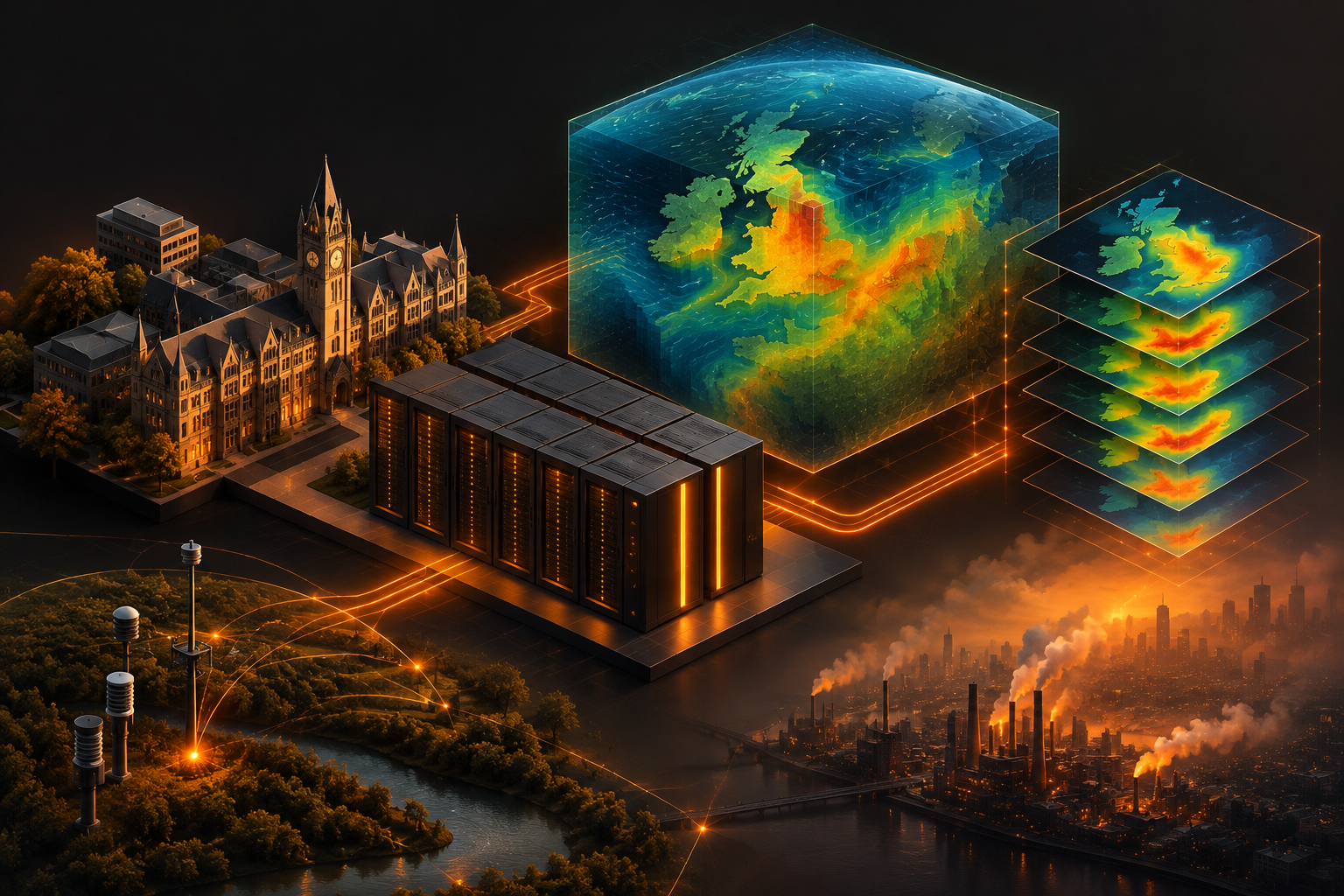
The University of Manchester has partnered with Nvidia to build a system that forecasts air pollution across the entire United Kingdom—replacing traditional chemistry-based models with generative AI frameworks. The approach cuts compute time dramatically and opens new possibilities for health alerts and emergency response.
Key Facts
- David Topping, professor at University of Manchester, trained Earth-2 CorrDiff and Earth-2 StormCast on Isambard-AI, the UK's national AI supercomputer in Bristol
- The model was trained on one year of UK air pollution data (hourly intervals) and achieves spatial resolution of 2–3 square kilometers
- Training time: two days on a single 8-GPU node; the model now runs on a DGX Spark (desktop AI supercomputer)
- Context: Air pollution causes an estimated 30,000 deaths annually in the UK—traditional chemistry models are too slow and expensive for frequent, detailed forecasts
Why Generative Frameworks Win on Speed
Conventional air quality models couple weather and chemistry equations. The bottleneck: "Once you put chemistry into weather models, they get really, really slow," Topping explains. Nvidia Earth-2 uses generative downscaling techniques already proven for weather forecasting—and they work for pollution fields too.
The team trained Earth-2 CorrDiff (a generative downscaling model) on Isambard-AI, then combined it with Earth-2 StormCast, which derives time-dependent forecasts directly from air quality observations. The model worked on the first attempt.
From National Supercomputer to Desktop
The striking part: what trained on a national supercomputer now runs on a DGX Spark—a personal AI supercomputer that fits on a desk. This democratizes deployment significantly. Hao Zhang, a doctoral student at University of Manchester who trained StormCast on Isambard-AI, highlights the flexibility: "The ability to switch from one Nvidia framework to another was really impressive."
Real-World Use Cases: Health to Emergency Response
Topping envisions multiple deployment scenarios:
| Application | Benefit |
|---|---|
| Healthcare | National and regional health services could proactively alert asthma patients when air pollution rises in their area |
| Policy Modeling | The model enables forecasts of how different environmental policies would affect pollution |
| Real-Time Response | Combined with edge AI sensors, the system could process live air quality data during wildfires or industrial accidents |
"To improve human health, it's essential that we understand the impact of environmental stressors in the air we breathe. Our U.K.-wide pollution model allows us to model potential future scenarios, such as predicting what would happen if different pollution-related government policy changes went into effect."
— David Topping, University of Manchester
Niall Robinson, Developer Relations Manager for Weather and Climate at Nvidia, captures the significance: "The fact that this model trained in two days on Isambard-AI—and can now run on a DGX Spark sitting on a desk—changes who can do this science and how quickly."
What This Means for Organizations Globally
This project demonstrates a pattern with broad relevance: specialized AI models for environmental monitoring and health protection are becoming practical. Public health agencies, environmental ministries, and hospitals worldwide could build similar systems for regional air quality, pollen forecasts, or particulate matter tracking—without requiring national supercomputers. The combination of frameworks like Earth-2 and affordable hardware makes this realistic. The key questions now are how institutions access training infrastructure and how models are calibrated with local data.
Sources
Editorially owned by Ideal Syka. Sources and method: Newsroom & method. Tips and corrections: ai@i6eal.de.