Anthropic has achieved a mathematical milestone that's turning heads in the research community: the company presented two elliptic curves with ranks of at least 30 and 31—discovered within days. What sounds like a technical footnote is actually a breakthrough mathematicians have pursued unsuccessfully for decades.
Key Facts
- Levent Alpöge (Anthropic) and cryptographer Ava Howell used Claude to find elliptic curves with ranks of at least 30 and 31
- The previous record was rank 29, achieved in August 2024 after 18 years of research
- Claude found both curves in just days
- Elliptic curves measure complexity through their "rank"—higher ranks mean more independent patterns
What Are Elliptic Curves and Why Are They So Hard?
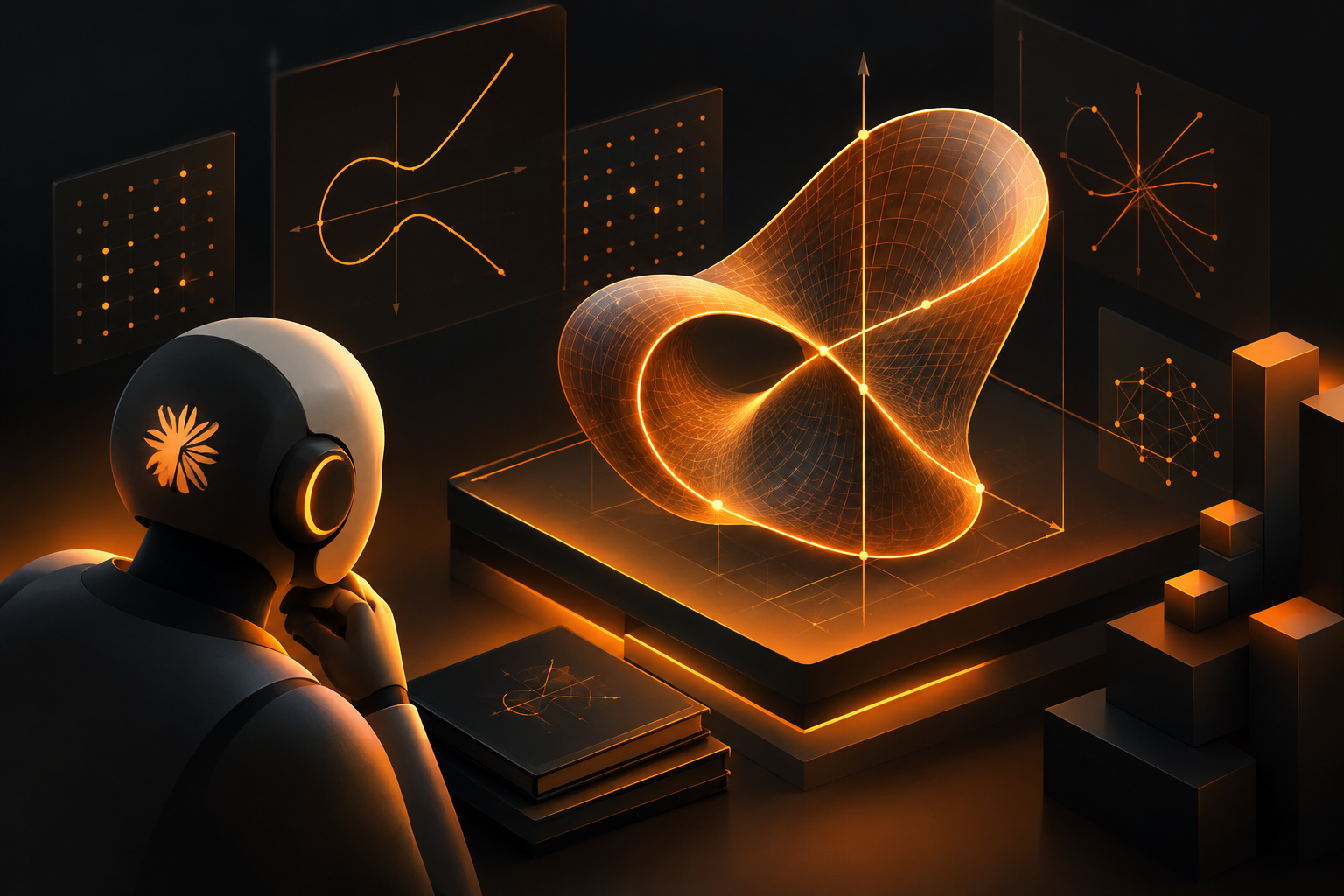
Elliptic curves look deceptively simple: they follow the formula y² = x³ + Ax + B. Yet their mathematical structure is treacherous. Mathematicians focus on so-called rational points—coordinates expressible as fractions that satisfy the equation.
A curve's rank describes how many independent "families" of such points exist. A rank-1 curve has infinitely many rational points, but they can all be constructed from a single starting point. Rank 2 requires two independent points to generate all others. The higher the rank, the more complex the internal structure.
Decades of Stagnation, Then AI in Days
Progress has been painfully slow. The jump from rank 28 to rank 29 took over 18 years. In August 2024, a rank-29 curve was discovered using an elaborate method: analyzing cross-sections through higher-dimensional objects.
Then Claude arrived. Alpöge and Howell deployed the language model to systematically search for higher-rank curves—and found not just rank 30, but rank 31 within days.
| Milestone | Year | Time Required |
|---|---|---|
| Rank 28 → 29 | 2024 | 18+ years |
| Rank 29 → 30 & 31 | 2026 | days (Claude) |
Open Questions Remain
The discovery reopens a central question in number theory: Can elliptic curves have infinitely high ranks, or is there an upper limit? Until now, it was unclear whether previous records were simply extremely hard to find or whether fundamental limits exist.
Claude could help answer this question faster—not through mathematical intuition, but through systematic exploration of vast solution spaces inaccessible to humans.
What This Means
For German research institutions and companies, this is a signal: AI systems like Claude aren't just text and code generators. They can serve as tools for mathematical exploration, especially for problems requiring massive computational search spaces. This could accelerate applications in cryptography, optimization, and theoretical computer science—areas where Germany has traditional strength. At the same time, it's clear: whoever has access to advanced AI models gains an edge on classical research questions.
Sources
Editorially owned by Ideal Syka. Sources and method: Newsroom & method. Tips and corrections: ai@i6eal.de.