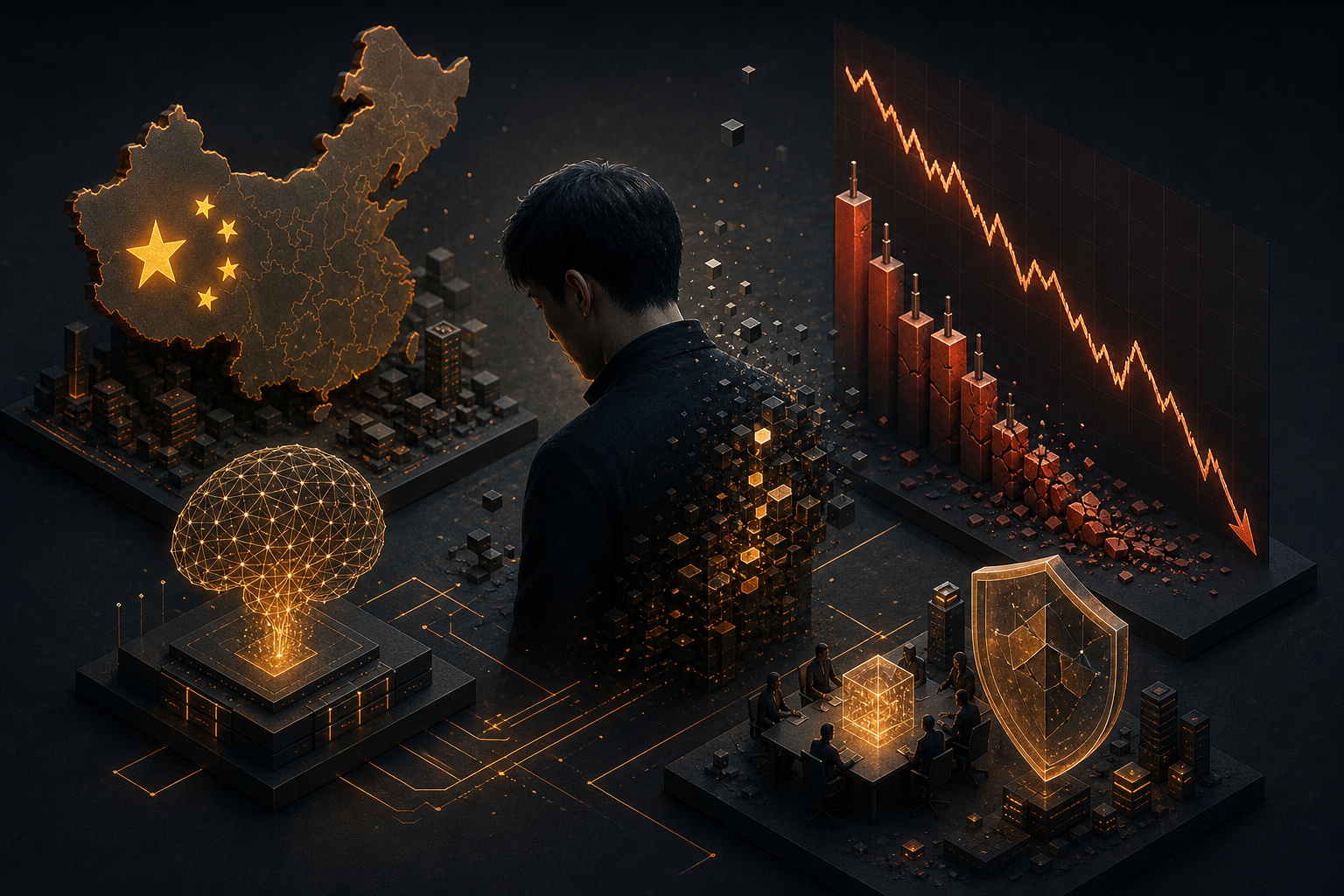
The founder of DeepSeek, the Chinese AI company, has lost approximately 20% of his wealth in a quant crash hitting China's financial markets, according to Bloomberg. The incident reveals how tightly AI entrepreneurs in China are woven into volatile financial markets – and raises questions about the stability of the country's innovation landscape.
Quick Facts
- DeepSeek founder loses 20% of wealth due to quant crash in China
- Quantitative trading strategies – algorithm-driven market approaches – face severe pressure
- Volatility in Chinese financial markets directly impacts AI investor fortunes
- DeepSeek remains operationally independent of the founder's personal asset losses
What Is a Quant Crash?
Quantitative trading strategies rely on mathematical models and algorithms to predict market movements and execute trades automatically. A quant crash occurs when these models simultaneously generate incorrect signals or markets behave unexpectedly – often triggering cascade effects. China has experienced such scenarios multiple times; they strike not only specialized hedge funds but also private investors and entrepreneurs with exposure to these strategies.
Founder Wealth and Company Risk
The DeepSeek founder's personal wealth loss does not immediately impair the company's operational performance. However, it reveals a structural pattern: in China, tech and AI founders are frequently active investors in financial markets simultaneously. When these markets come under pressure, liquidity challenges can emerge – for instance, if founders must liquidate positions or delay investments in their own ventures.
DeepSeek itself has garnered international attention in recent months with its cost-efficient AI models and stands as a serious competitor to OpenAI and other Western providers. The company's ability to develop high-performing models with lower resource consumption has placed it on the agenda of European and American competitive analysts.
What This Means for German Companies
This news illustrates a fundamental risk when assessing Chinese AI competitors: their financial stability depends not only on business model and technology but also on volatility in Chinese markets and the personal wealth situation of founders. For German mid-market companies and industry, this means Chinese AI providers – however technologically impressive – carry heightened risks tied to geopolitical and financial uncertainties in China. At the same time, the message is clear: anyone investing in AI, whether in China or elsewhere, must contend with substantial volatility. German enterprises should avoid anchoring their AI strategy to single providers or markets; instead, prioritize diversification and technological sovereignty.
Sources
Editorially owned by Ideal Syka. Sources and method: Newsroom & method. Tips and corrections: ai@i6eal.de.