
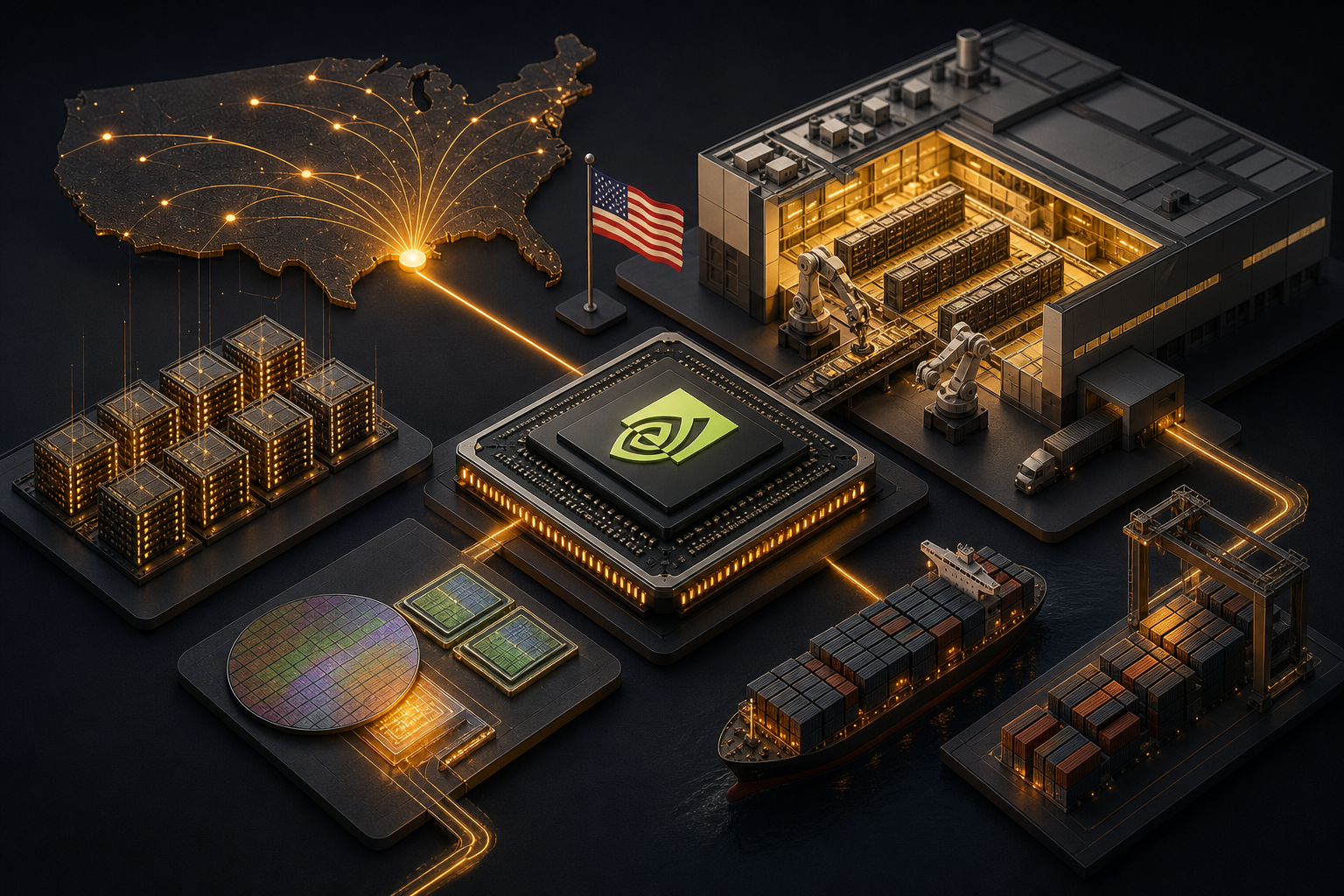
Wistron has opened a new $700 million manufacturing facility in Fort Worth, Texas to produce Nvidia superchips in mass quantities on U.S. soil. The project represents a significant shift in global AI chip supply: until now, such high-end components have been manufactured almost exclusively in Asia – but now the U.S. is building domestic capacity.
Key Facts
- Investment: $700 million for the new production facility in Fort Worth
- Manufacturer: Wistron, a Taiwanese electronics and manufacturing company
- Product: Nvidia superchips for AI applications
- Strategic Goal: Reduce dependence on Asian supply chains and strengthen U.S. chip supply security
Why Now, Why Fort Worth?
The U.S. has invested heavily in reshoring chip manufacturing in recent years – driven by geopolitical tensions and the recognition that critical infrastructure should not depend on a single continent. Wistron is capitalizing on this opportunity: the Fort Worth facility will produce Nvidia superchips that are in high demand in AI data centers worldwide. This signals that the chip industry is actively diversifying its supply chains.
What Does This Mean for Supply Chains?
Historically, mass production of high-end AI chips has been an Asian monopoly. With Wistron's Fort Worth facility, a significant U.S.-based production capacity for these components is emerging for the first time. This could ease supply bottlenecks and reduce dependence on single regions – an advantage for all companies relying on stable chip availability.
| Aspect | Previous Situation | With Fort Worth |
|---|---|---|
| Production Sites | Primarily Taiwan, South Korea, China | Diversification into USA |
| Supply Risk | Concentrated in Asia | Reduced geopolitical risk |
| Availability | Vulnerable to regional disruptions | Multiple sources |
Implications for German Enterprises
For German mid-market companies and large industrial corporations, this development could prove relevant: organizations dependent on AI chips – whether for cloud infrastructure, data processing, or specialized AI applications – may benefit from shorter supply chains and fewer bottlenecks. However, it remains unclear whether the Fort Worth facility will generate sufficient capacity to meet global demand or whether supply constraints will persist. The question of whether German companies will receive preferential access to this production is also unresolved. For decision-makers, this signals that chip supply is becoming less centralized – but also more complex.
Sources
Editorially owned by Ideal Syka. Sources and method: Newsroom & method. Tips and corrections: ai@i6eal.de.