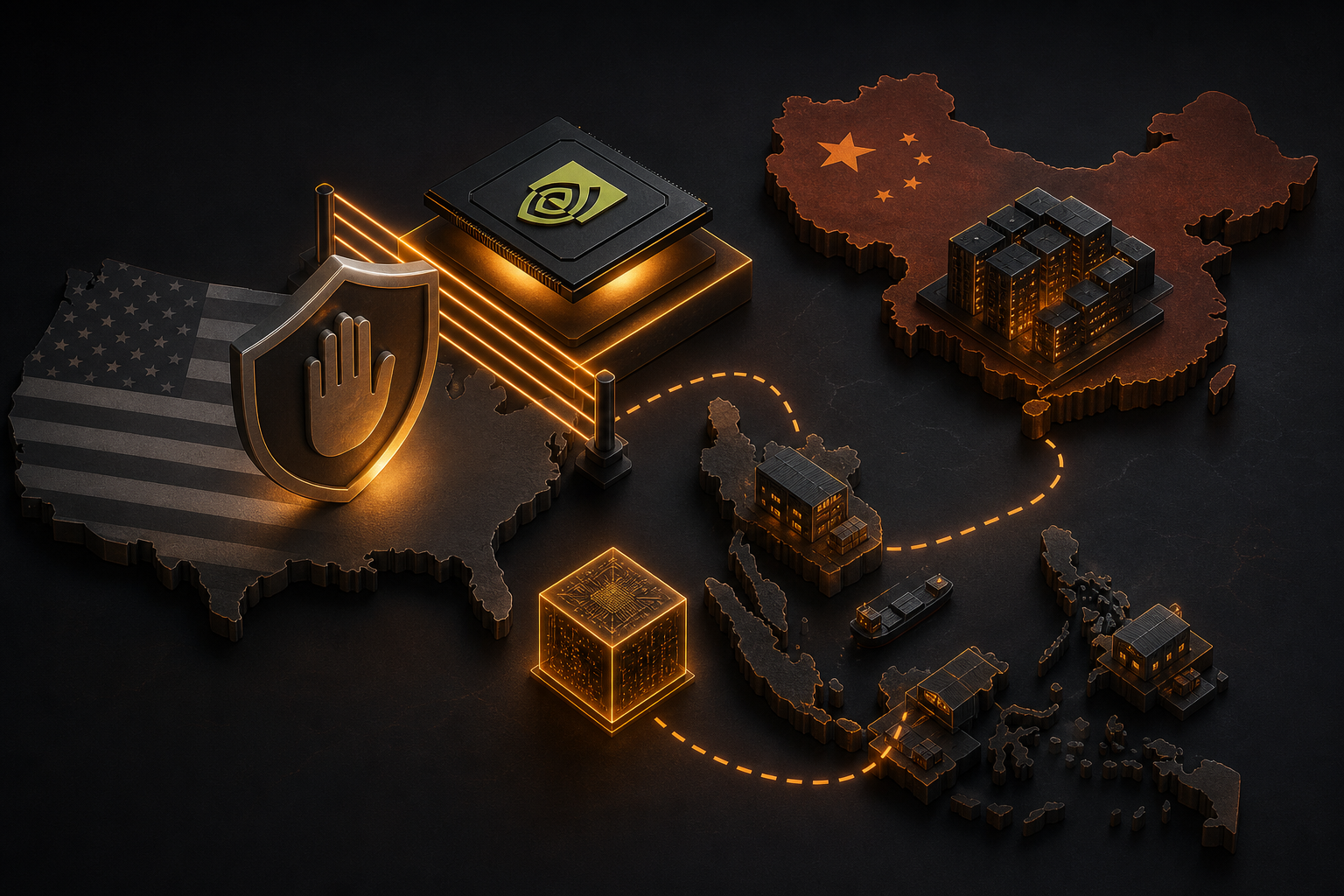
Chinese AI companies have discovered and are systematically exploiting a gap in US export controls: instead of buying Nvidia's most powerful chips directly, they're renting computing power remotely through data centers in Southeast Asia. So far, this is legal – and that's exactly what Washington wants to change.
The Essentials
- Moonshot AI reportedly used Nvidia's advanced chips via a facility in Thailand to train its Kimi K3 model, according to White House allegations
- ByteDance, Alibaba, and Tencent are also said to be accessing Nvidia compute remotely in Thailand, Malaysia, and Japan
- The US export control regime regulates ownership of physical chips, not remote access to their computing power
- Lawmakers are discussing new rules to regulate cloud access to controlled technologies
The Loophole in Export Rules
Nvidia's monopoly on the world's most powerful AI chips has become a key tool in US geopolitical strategy. Washington has banned exports of these chips to China – but the regulation has a blind spot: it controls who owns the hardware, not who uses it.
"The US export control regime controls physical AI chips. It does not cover remote access to those chips."
That's how Cassia King, senior researcher on the Compute Policy team at the Institute for AI Policy and Strategy, explained it to CNBC. As long as Chinese firms don't buy and own the hardware themselves, they operate in a legal gray zone. They simply rent access to data centers in Southeast Asia where Nvidia chips are located – and train their AI models there.
Real Cases and Consequences
This isn't theoretical: less than a week after Moonshot AI released its new model in July, White House official Michael Kratsios publicly accused the company of using advanced Nvidia chips via a facility in Thailand. Moonshot AI's Kimi K3 is part of a wave of new Chinese AI systems that have made significant performance leaps recently.
DeepSeek and Alibaba have also recently released new AI systems that score well on performance benchmarks. Industry observers see access to advanced computing power through foreign cloud providers as a key factor in Chinese AI models gaining capability.
Washington Plans Countermeasures
The US government is working on solutions. Lawmakers are discussing giving the US government authority to regulate remote cloud access to controlled technology. However, hurdles remain before such measures can take effect.
The Trump administration told CNBC: "The Trump administration has implemented the most rigorous export control regime in modern history, and remains committed to safeguarding America's national and economic security."
The Departments of Commerce and the Bureau of Industry and Security (BIS) did not comment on the allegations. ByteDance, Tencent, and Alibaba declined to comment or did not respond.
What This Means for European Companies
This development has indirect consequences for European AI infrastructure: if the US tightens export controls and also regulates remote access, it could fragment the global market for cloud computing power. German and European companies should expect that Nvidia chips will be more heavily regulated in the future – and that data centers in Europe themselves will become a strategic asset in the AI race. At the same time, pressure is mounting to invest in European alternatives and open-source models.
Sources
Editorially owned by Ideal Syka. Sources and method: Newsroom & method. Tips and corrections: ai@i6eal.de.