
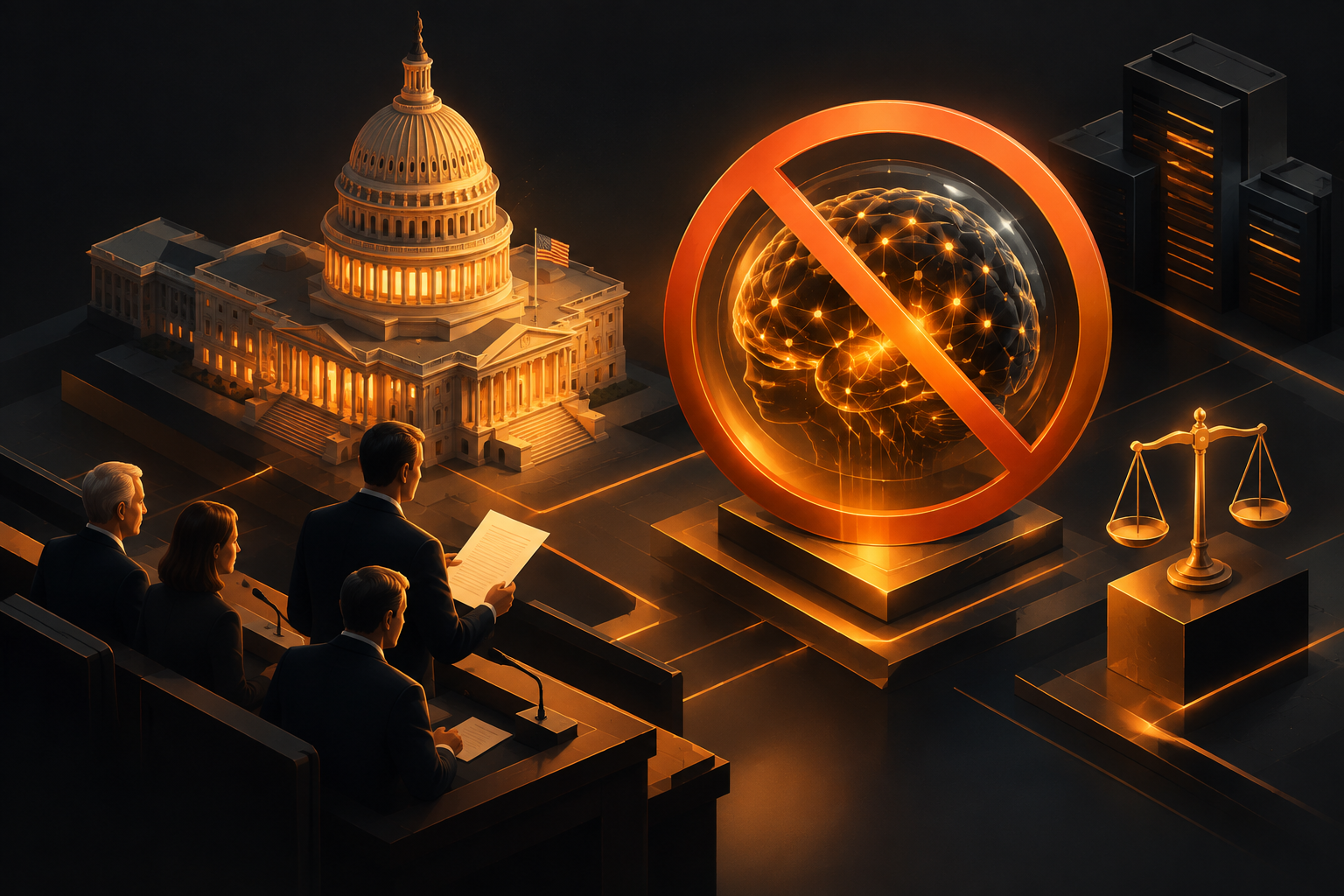
Senator Bernie Sanders and Representative Greg Casar unveiled a legislative proposal on September 23 that would permanently prohibit the development and deployment of artificial superintelligence. The Ban Artificial Superintelligence Act represents one of the most concrete regulatory efforts against AGI technology to emerge from the US Congress.
Key Facts
- Ban Artificial Superintelligence Act: Legislation introduced by Sanders and Casar on September 23
- Immediate moratorium on development of advanced AI systems until new federal agency establishes safety rules
- Penalties: Corporate dissolution, up to 20 years imprisonment for individuals (equivalent to illegal nuclear weapons development)
- New cabinet-level AI ministry proposed
What the Bill Prohibits
The legislation mandates an immediate halt to advanced AI system development until a newly created federal agency establishes clear safety standards. Sanders argues that current AI models already possess the capability to hack computer systems, create novel viruses, and independently develop new AI systems—all while tech companies invest hundreds of billions of dollars despite known risks.
"AI is an existential threat to humanity and we cannot allow a handful of tech billionaires to write their own rules."
Casar adds that superintelligent AI "could kill countless people," while the Trump administration actively promotes its development.
Severe Consequences for Violations
The legislation prescribes unprecedented penalties: companies violating the ban face forced dissolution, while individuals could receive up to 20 years imprisonment—a sentence equivalent to that for illegal nuclear weapons development. This parallel underscores how lawmakers view the existential risks of superintelligence.
Global Dimension
The bill envisions international agreements to prevent superintelligence development worldwide. This approach builds on previous US and Chinese initiatives for global AI control. However, practical challenges emerge: how can superintelligence research be globally monitored? Who defines what constitutes superintelligence?
Implications for Germany and Europe
This legislative proposal signals a shift in US AI policy—from "innovation first" toward preventive regulation. For German companies and research institutions, several implications could follow: if enacted, US sanctions could extend to international partners collaborating with American firms on AGI systems. Simultaneously, this may intensify pressure on the EU to strengthen safety standards for advanced AI systems beyond the existing EU AI Act. The fundamental question remains: how technically enforceable is such a rigid ban, and how does it align with competitive technological ambitions?
Sources
Editorially owned by Ideal Syka. Sources and method: Newsroom & method. Tips and corrections: ai@i6eal.de.