
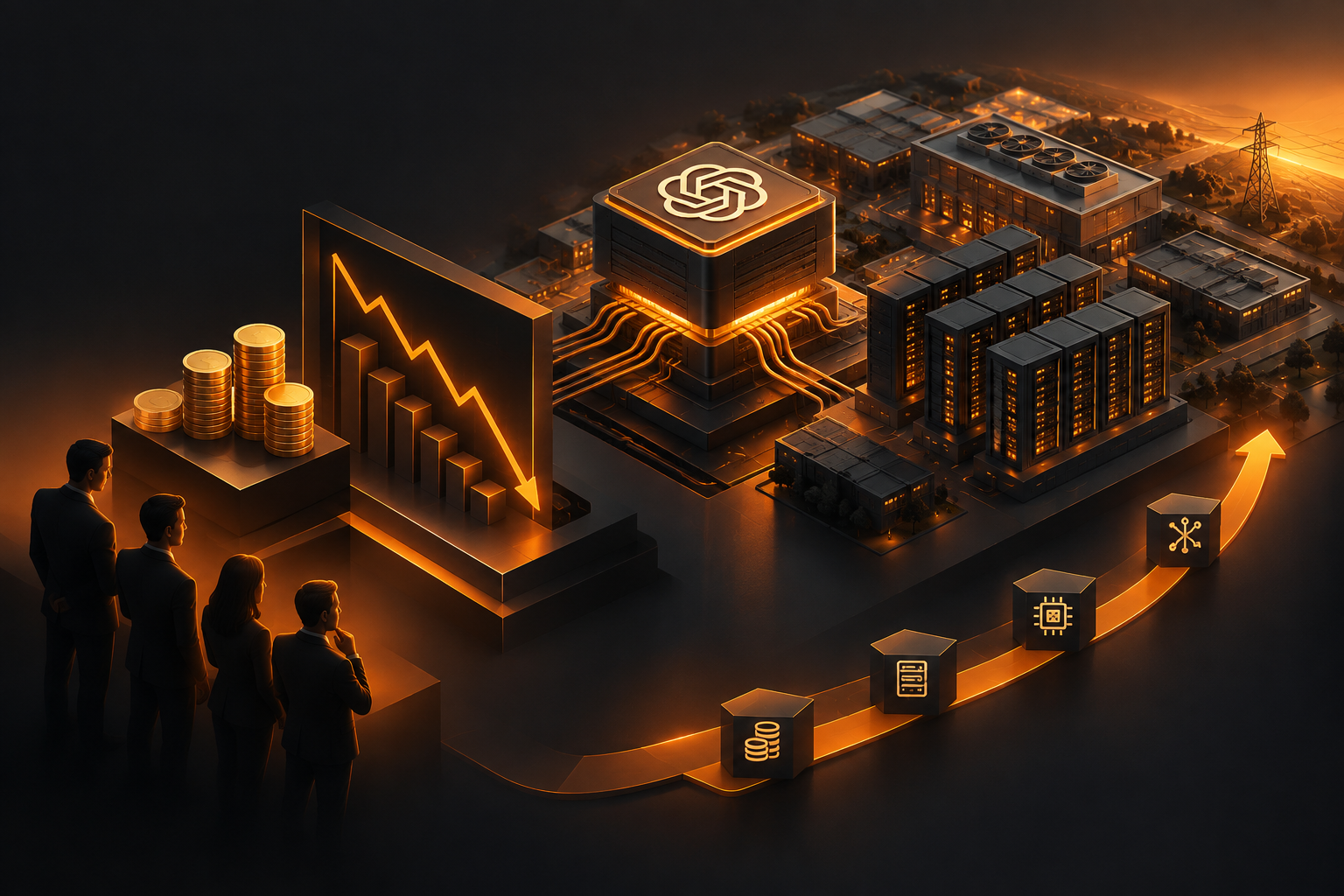
OpenAI has made clear to investors that the path to leading KI infrastructure will be expensive. According to Golem, the company expects continued billion-dollar losses through 2030 and is asking its backers to support this aggressive spending course. The signal is unmistakable: profitability is not the immediate goal – compute capacity is.
The Essentials
- OpenAI plans massive investments in data centers while signaling losses through 2030
- The company is asking investors to back the aggressive spending course
- Background: Competition for GPU capacity and training infrastructure is becoming increasingly expensive
- The strategy shows: Scaling before profitability is the creed of the AI industry
The Price of AI Dominance
OpenAI's message is unusually candid: to remain a leader in AI, you must be willing to burn billions for years. Data centers, GPUs, power supply – it all costs billions. OpenAI signals that it is pursuing this course deliberately and has no plans to change it in the coming years.
This is a challenge to competitors like Google, Meta, and others who are also investing heavily in AI infrastructure. Those who cannot keep up will fall behind. Those who want to keep up must accept that the profit calculation comes later – if at all.
Financing Pressure Grows
The open communication about expected losses is also a matter of trust. OpenAI is signaling: we are transparent about our strategy, and we need investors who understand and support it. This works as long as backers believe in the business model – and as long as fresh capital keeps flowing.
For the AI industry as a whole, this is a structural signal: The scaling costs have become so high that individual companies can no longer bear them alone. That's why consortiums are forming, why companies are seeking government support, why there is debate over regulation and resource allocation.
What This Means for You
If you are making AI investment decisions at a German company, you should understand that major US providers are entering a phase where they are securing dominance through massive capital concentration. This has two consequences:
First: Prices for AI services may remain stable or even decline in the short term – to secure market share. This is good for early adopters, but it also signals that profitability is not the goal.
Second: Consolidation could increase long-term. Those who cannot compete with billion-dollar budgets will become dependent on the big players or shift to specialized, smaller models. German companies should consider whether they want to build their AI strategy on providers that are deliberately running losses – or whether open alternatives and local models are becoming more attractive.
So OpenAI's announcement is not just a financing statement. It is a sign that the AI industry is entering a new phase: less competition over efficiency, more competition over resources and scale.
Sources
Editorially owned by Ideal Syka. Sources and method: Newsroom & method. Tips and corrections: ai@i6eal.de.