
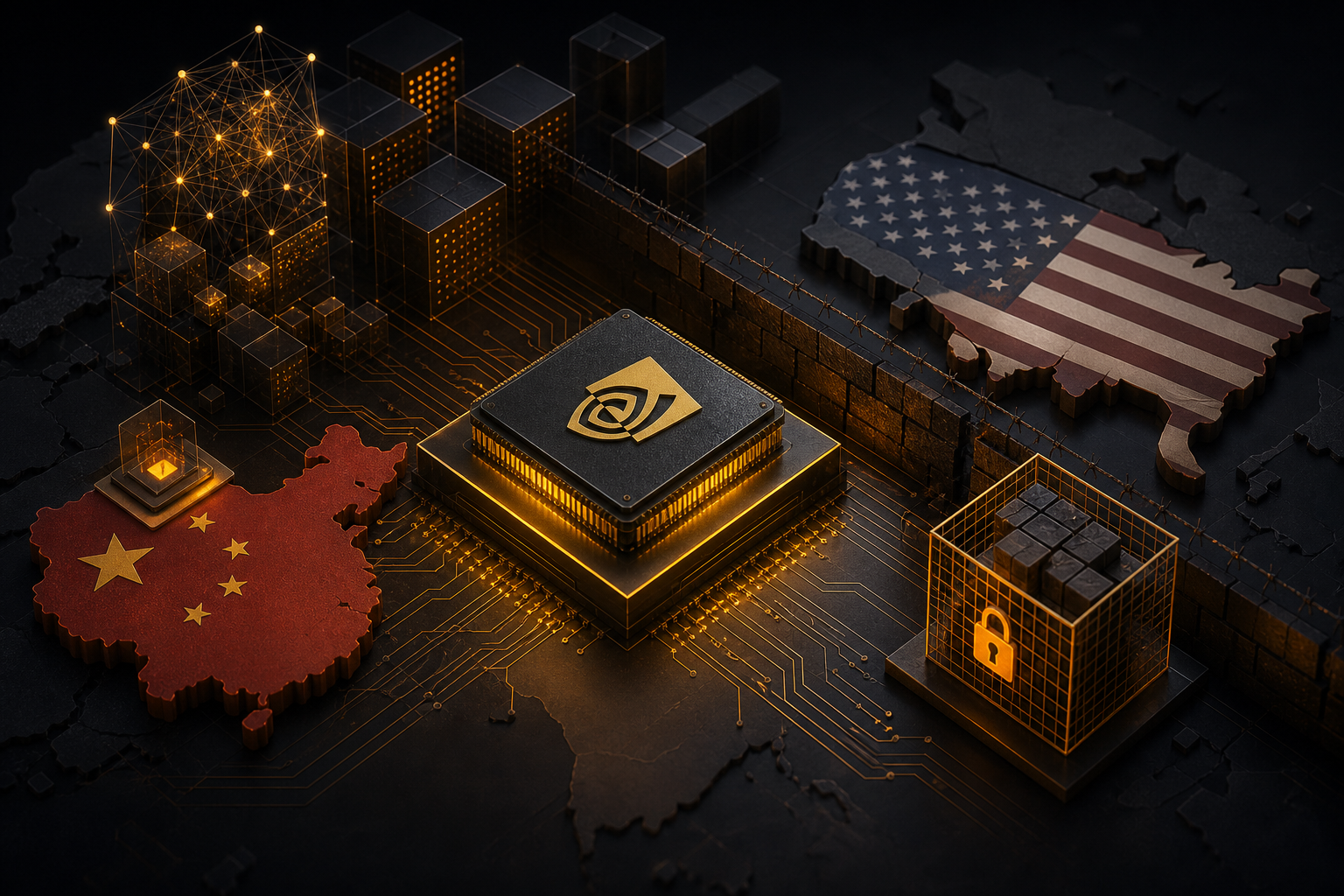
Nvidia is pressing the accelerator while Washington signals it may hit the brakes. The chipmaker announced a "Local AI Initiative" in its Q2 earnings presentation on the 27th that optimizes its products specifically for Chinese open-source models—including DeepSeek's V4 Flash and Alibaba's Qwen 3.8. Yet in the same SEC filing, Nvidia itself warns that US government restrictions could ban precisely this kind of support.
The essentials
- Nvidia is immediately enabling hardware support for Chinese models: Qwen 3.8-27B got RTX GPU backing, DeepSeek V4 Flash and Z.ai GLM 5.2 received software updates for linked DGX Spark systems
- In its SEC filing, Nvidia cautions that US government measures could restrict support for "third-party applications and models built on open-source foundation models originating from China"—with material business impact
- The Trump administration is simultaneously weighing semiconductor tariffs on finished goods including laptops, gaming consoles, and data center servers
- Nvidia is positioning itself as a bridge: pushing for a US open-source AI stack while continuing to work with Chinese firms
The risk is real—and Nvidia acknowledges it
Nvidia is operating in a gray zone. Optimizing for Chinese models is technically legal but politically explosive. The company's own regulatory filing states: the US government is considering measures that would restrict Nvidia's ability to support "third-party applications and models built on Chinese open-source foundation models such as DeepSeek, Qwen and Kimi."
So what does Nvidia do? It acts anyway. When Alibaba released Qwen 3.8 this month, Nvidia immediately enabled RTX GPU support. Software updates now allow multiple DGX Spark systems to be networked and run Chinese models. This is not hidden—it is publicly announced.
Open source, open conflict
The core tension: unlike closed models from OpenAI or Anthropic, open-source models can be modified and self-hosted. This makes them the central battleground in the US-China tech rivalry. China's advantage lies in making these models globally available—and Nvidia can optimize them perfectly.
Yet Nvidia is also pushing back. The company joined Microsoft, Meta, and Palantir in opposing "premature regulation" of open-weight models. An Nvidia official told the press: China is "one of the countries with the world's largest population of developers building open-source foundation models." To draw developers to the US, every model must run optimally on an American tech stack.
Tariffs as the next escalation
The stakes are rising. The Trump administration is considering a massive expansion of semiconductor tariffs—not just on chips themselves, but on all finished products containing them: laptops, gaming consoles, data center servers. Country-specific tariff rates and quotas are under discussion. Details remain unfinal, but the direction is clear: containment.
What this means for German companies
This is a test case for European supply chains. German manufacturers using Nvidia hardware or investing in AI infrastructure are caught in the middle: they cannot simply ignore Chinese models—they are too cheap and too capable. Yet sanctions could retroactively affect their business. Nvidia's explicit SEC warning signals the risks are real. Anyone investing in Chinese AI stacks now is betting either that the US will not enforce restrictions, or that Nvidia will find a way around them.
Sources
Editorially owned by Ideal Syka. Sources and method: Newsroom & method. Tips and corrections: ai@i6eal.de.