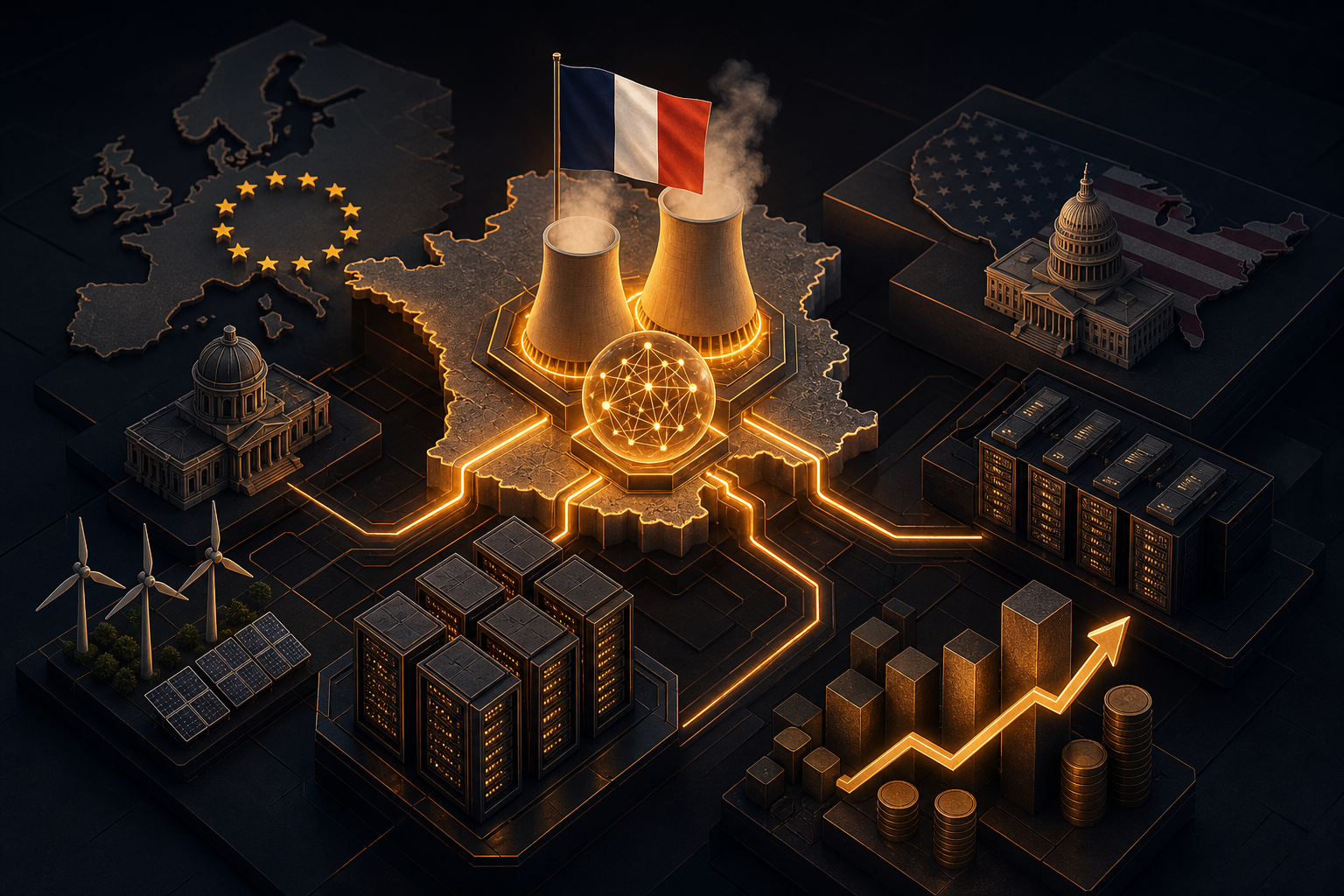
Electricity is the new oil in the AI race. That's the central thesis Arthur Mensch, CEO of Mistral AI, laid out at the G7 meeting in June in Évian-les-Bains before Donald Trump, Emmanuel Macron, and Ursula von der Leyen. France's advantage doesn't lie in algorithms or venture capital—it lies in megawatts.
The essentials
- Arthur Mensch (Mistral AI) warns: Europe must use its cheap electricity for its own AI models, or US corporations will buy it up
- SoftBank supercomputer alone will consume 3–5 gigawatts; all French data centers combined currently use less than 1 gigawatt
- €109 billion in investments were promised after France's 2025 AI Summit—mostly from foreign companies
- "In two years it will be too late" – Mensch warned the French parliament in May of monopolization by US tech
The dilemma: Sell or use it yourself?
Mensch's argument is deceptively simple: France can either sell its nuclear power to American tech companies—who will then resell it as AI services at ten times the price—or invest in European language models itself and keep the value creation.
"Either you sell that to Americans, who will resell it 10 times more expensively in the form of artificial intelligence; or you transform it yourself in order to keep most of the value and carry out R&D."
That's how Mensch described the dilemma to POLITICO. He hasn't just made this warning in Évian-les-Bains, but has also taken it directly to the French government and parliament.
France as a data center magnet
The timing is critical. After Macron's "Plug, baby, plug!" slogan in the context of the 2025 AI Summit, investments are pouring into the country—but mostly from outside. Japanese SoftBank is planning a supercomputer in northern France that alone will require between 3 and 5 gigawatts of electricity. For comparison: all of France's data center infrastructure currently consumes less than 1 gigawatt.
The Élysée Palace has recognized the problem. In June, a closed-door meeting took place ostensibly about "attractiveness strategies for digital infrastructure"—but actually about which data center projects should take priority. An AI expert with insight into the discussion reported that the Élysée was "extremely worried" about the backlash data centers could trigger.
The window is closing
Mensch has issued a clear warning: "In two years it will be too late." His point is geopolitical: once the US has anchored its tech infrastructure in Europe, it will be hard to dislodge it. France would then have to compete not just against American corporations, but against their already-installed data centers.
This is not just a French problem. The debate shows how energy—long treated as a commodity—is becoming a strategic weapon in the global AI race.
What this means for German companies
Germany faces a similar situation: relatively cheap electricity from renewables and nuclear power, but also intense pressure from US tech giants wanting to build data centers. Mensch's warning applies to Germany too—the question is whether German AI startups and established tech companies will control the infrastructure themselves or hand it over to American corporations. This is less a technical issue than an economic policy decision that will be made in the next 12–24 months.
Sources
Editorially owned by Ideal Syka. Sources and method: Newsroom & method. Tips and corrections: ai@i6eal.de.