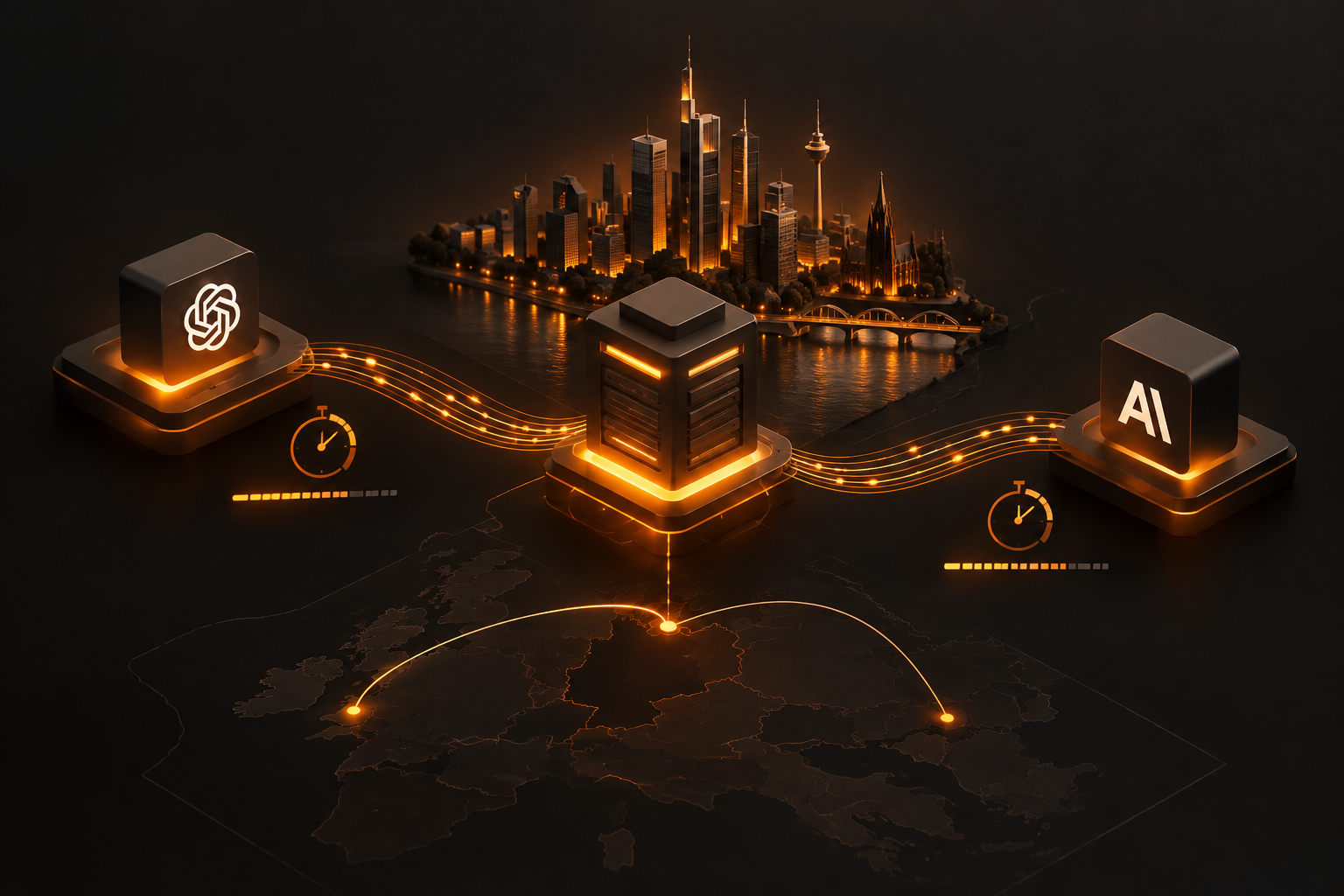

A German research consortium has released the open-source language model Soofi S 30B-A3B – trained entirely on Deutsche Telekom's Industrial AI Cloud in Munich. The project marks a strategic step toward AI sovereignty in the German-speaking region and aims to offer enterprises a genuine alternative to US-based models.
At a glance
- 31.6 billion parameters total, but only 3.2 billion active per token (mixture-of-experts architecture)
- Trained on 27 trillion tokens with deliberate focus on German language data
- Outperforms fully open competitors like Olmo 3 32B and Apertus 70B in benchmarks
- Maintains processing speed even at 256,000 token context length
Sparse hybrid architecture for long documents
Soofi S uses a Mamba-2-Transformer hybrid design – adopted from Nvidia's Nemotron 3 Nano. The key advantage: only 6 of 52 layers maintain a KV-cache, which grows linearly with context length in classical transformers. This makes Soofi S significantly more efficient with longer inputs.
Practical tests demonstrate the difference clearly: at a context of 40,000 tokens with 32 parallel requests, Soofi S generates roughly eight times more tokens per second per GPU than dense models with 14–24 billion parameters. While throughput in classical models drops significantly as context grows, Soofi S maintains nearly constant throughput from 4,000 to 256,000 tokens.
| Aspect | Soofi S | Classical Models |
|---|---|---|
| Total parameters | 31.6B | 30B–70B |
| Active parameters per token | 3.2B | 100% |
| KV-cache layers | 6 of 52 | all |
| Throughput at 40K tokens | stable | significantly declining |
German language data as deliberate priority
The consortium, coordinated by the AI Bundesverband, processed 27 trillion tokens across three training phases: first 20 trillion tokens from a broad mix (web, code, mathematics, technical literature), then 6 trillion from particularly high-quality sources to sharpen learned patterns, and finally a shorter phase to extend the context window. The deliberate emphasis on German language data pays off in benchmarks – Soofi S achieves the highest scores among fully open models for German, English, and programming tasks.
What this means for you
For German enterprises and mid-market companies, Soofi S could become relevant: a fully German-trained, open model reduces dependency on US providers and offers transparency regarding training data and architecture. The high efficiency with long contexts makes it attractive for applications like document analysis or research systems. The consortium is actively seeking industrial partners for practical deployment – whether the model proves itself in production will become clear in coming months. It remains to be seen how the community adopts and further develops it.
Sources
Editorially owned by Ideal Syka. Sources and method: Newsroom & method. Tips and corrections: ai@i6eal.de.