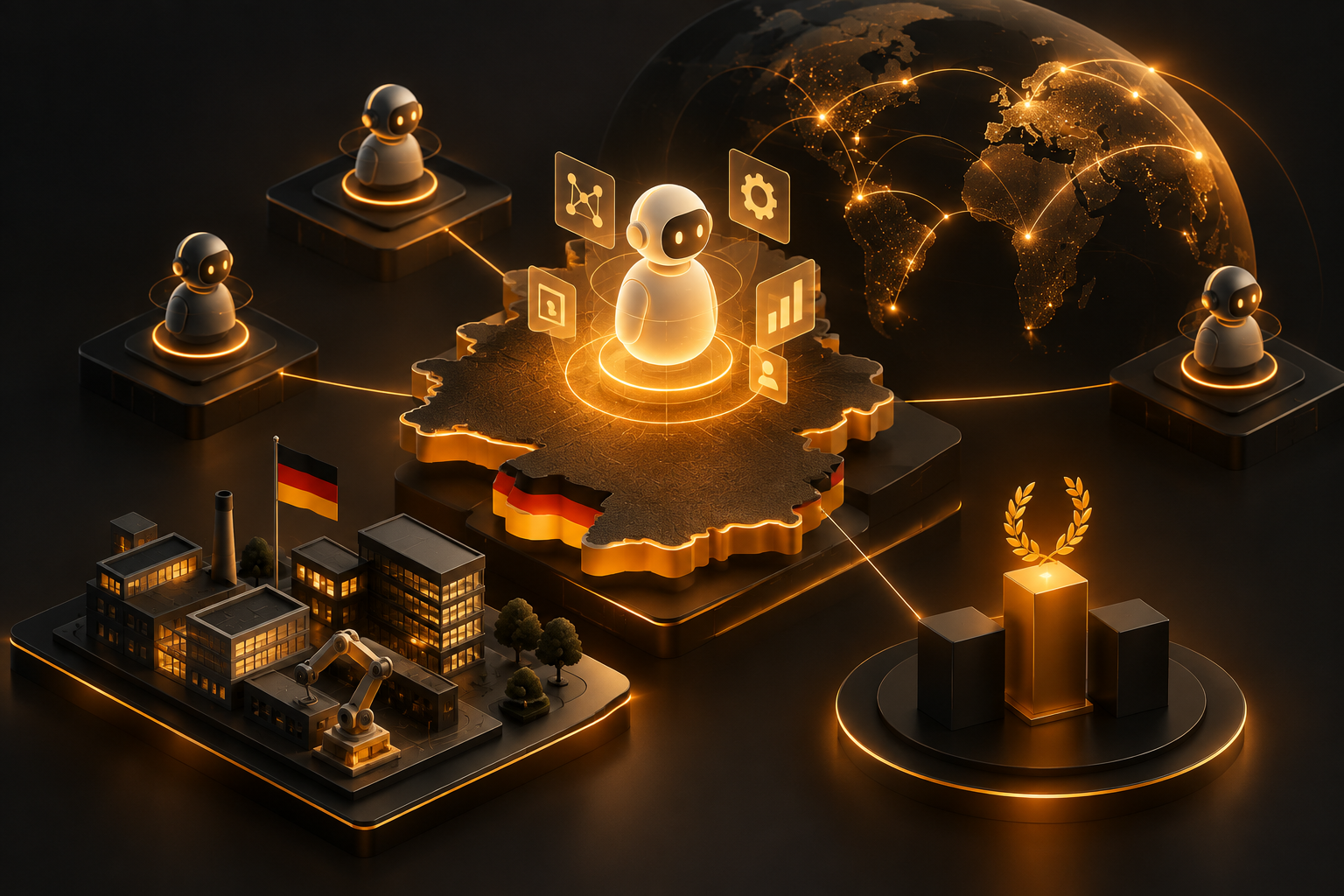
Germany is positioning itself more strongly in the international competition for AI agents than commonly perceived. According to an analysis by heise online, the country ranks in the global top tier in this category—alongside established tech nations like the US and China.
Quick Facts
- Germany belongs to the global top tier in AI agent development
- heise online's analysis documents the country's position in global competition
- AI agents are considered the next evolution beyond large language models
- German companies and research institutions are actively involved in this segment
What Are AI Agents and Why Does It Matter?
AI agents differ from classical language models in that they can execute tasks autonomously—they plan, decide, and act without constant human guidance. They can perform multiple steps in sequence, access tools, and adjust their strategy. This makes them significantly more valuable to enterprises than pure text generators.
The fact that Germany ranks in the top tier in this space means that local developers and researchers are actively shaping this key technology—rather than merely adopting it.
Who Is Driving Development?
The analysis shows that not only large tech corporations but also mid-market companies and research institutions are working on AI agents. This differs from earlier phases of AI development, where resources were heavily concentrated. Germany benefits here from its tradition in engineering, automation, and the Mittelstand model.
The range spans from specialized agents for industrial processes to customer service solutions and university research projects. This suggests the technology is not perceived as an exotic niche project but as a practical tool for real-world problems.
What Does This Mean for German Businesses?
For decision-makers in German firms, this sends a dual message: First, it demonstrates that the competence for AI agents exists domestically—you don't necessarily have to wait for US or Chinese solutions. Second, it raises the pressure to actually integrate and use these technologies. Companies that don't start experimenting with AI agents now risk falling behind.
The position in the top tier is not a reason for complacency. Rather, it's a starting point—and a signal that investment in this direction pays off. At the same time, it's clear: global competition for AI talent, data, and computing capacity is intensifying. Germany must actively defend and expand this strength.
Sources
Editorially owned by Ideal Syka. Sources and method: Newsroom & method. Tips and corrections: ai@i6eal.de.