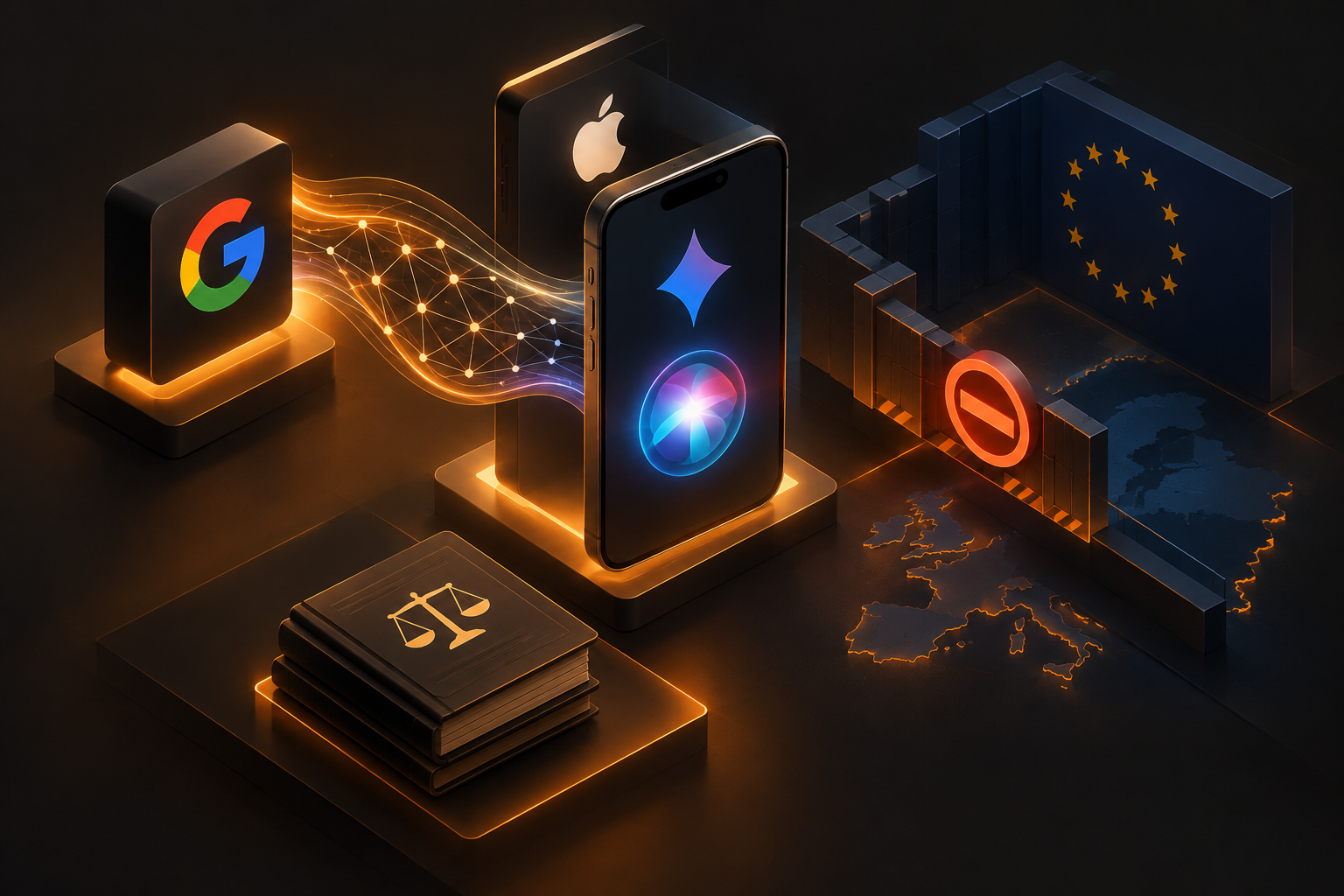
Apple has finally released the next generation of Siri after multiple postponements. This marks a strategic shift: for the first time, Apple is not relying on its own AI model but on Google's Gemini. The new "Siri AI" runs partly on-device, partly through Apple's Private Cloud Compute – and is available as a beta according to Apple. There's a catch: the service is not launching in the EU or China.
Quick Facts
- Siri AI is built on Google's Gemini models with hybrid processing (on-device + Private Cloud Compute)
- Available initially in English; additional languages (French, Japanese, Korean, Portuguese, Spanish) coming next month
- The assistant understands personal context from messages, emails, and photos, plus screen content
- EU blockade: The service is not available in the European Union at launch
- Rolling out via iOS 27, iPadOS 27, macOS 27, watchOS 27, and visionOS 27
What the New Siri Does
The redesigned system is fundamentally different from its predecessor. The assistant now grasps personal context from messages, emails, and photos, interprets screen content, and retrieves web information. Through system-wide app actions, it can draft emails, edit and share photos, or – Apple's example – find a family recipe mentioned in messages and transfer its ingredients to the Notes app.
Beyond Apple's own apps, Siri integrates with third-party services: WhatsApp and Audible are already on board, with Outlook, Notability, and Tripsy coming soon. You can invoke the assistant via "Hey Siri," the side button, Dynamic Island, or – on iPad and Mac – Spotlight. A new Siri app syncs chat histories across iCloud.
Early Tests: Progress with Caveats
TechCrunch editor Ivan Mehta, who has been testing iOS 27 since beta, describes the new Siri as a step forward. He now regularly uses the assistant for multi-step queries and screen context – something he, like many users, rarely did before. However, early testers also report persistent issues: hallucinations and gaps in personal context remain problematic.
Why the EU Is Left Out
The EU absence is not a technical limitation – it's regulatory. The EU AI Act and its compliance requirements make it harder for Apple to launch the service quickly in Europe. Apple has already signaled that multiple AI features will be delayed or unavailable in the EU. Siri AI joins that list.
Apple's Broader AI Strategy
Siri is just the beginning. Apple is distributing AI features across the system: the Photos app gains tools like Spatial Reframing and Extend, Image Playground now generates photorealistic images via Private Cloud Compute and will support the SynthID standard for AI image labeling. Safari organizes tabs by topic, Shortcuts can be described in natural language. Audio Intelligence features for Apple Watch and a Health app redesign arrive later this year.
What This Means for German Enterprises
Apple's reliance on Google's Gemini underscores how concentrated the AI landscape has become among a few players. For German businesses, three takeaways matter: First, the European market is fragmenting due to regulatory differences – features available in the US arrive in the EU late or not at all. Second, even tech giants like Apple depend on external partners for language models. Third, this opens opportunities for specialized European AI providers while sharpening the question of how dependent European infrastructure remains on US-based models.
Sources
Editorially owned by Ideal Syka. Sources and method: Newsroom & method. Tips and corrections: ai@i6eal.de.