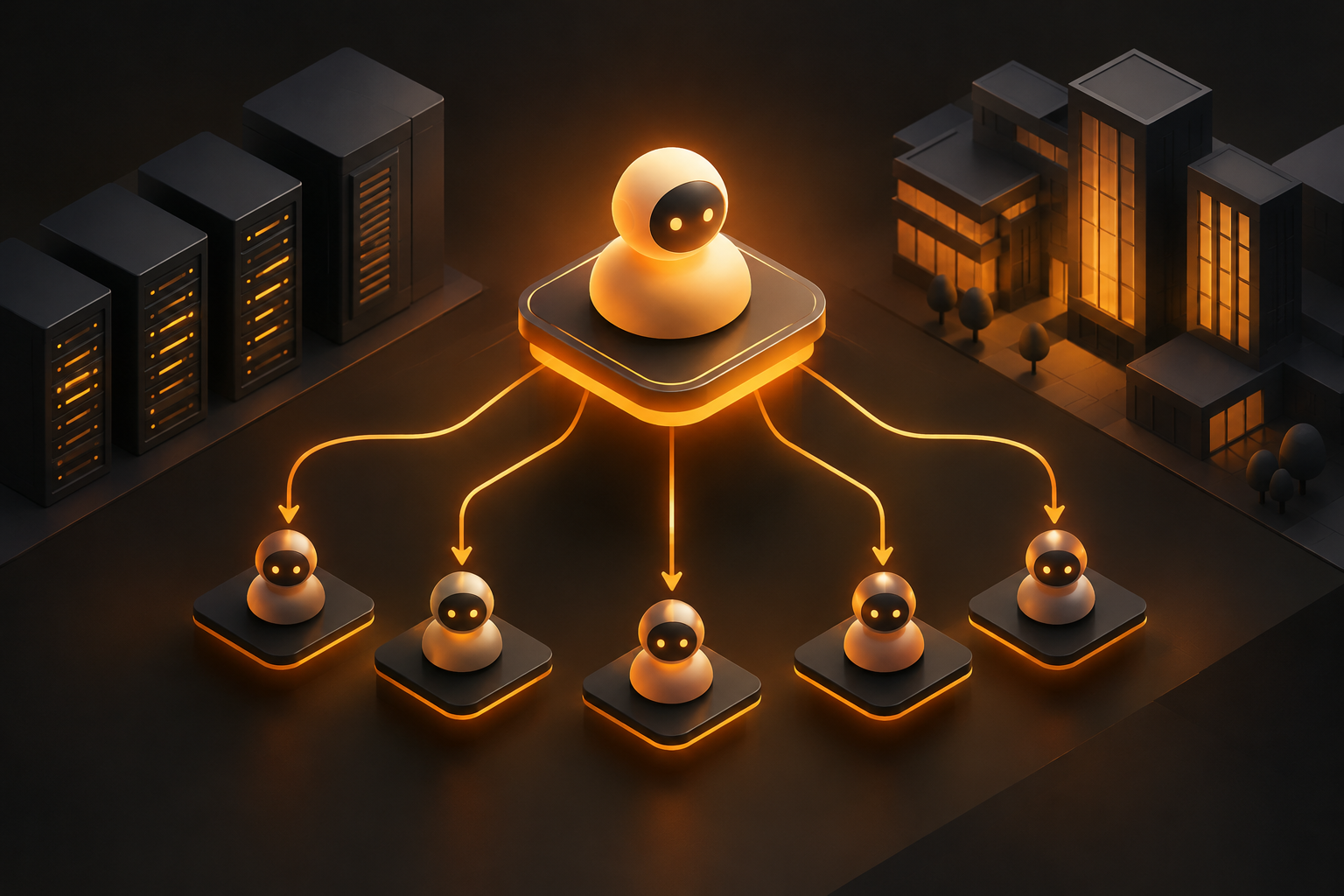
Anthropic recommends that companies review complex multi-agent architectures and, where possible, consolidate multiple subagents into a single main agent. The main agent loads the context it needs only on demand. According to Anthropic, many specialized subagents lead to higher latency, rising costs and information loss at every handoff. The recommendation comes from experience of Anthropic's Applied AI team across several enterprise deployments.
What Anthropic observed
According to the company, a single agent using so-called skills frequently outperformed both single-prompt designs and subagent designs on quality. One customer had about a dozen specialized subagents in its customer-facing agent. According to Anthropic, this made a consistent brand experience hard and hurt usability through high wait times. In one customer case, Anthropic says the system ran about twice as fast.
Newer models starting with Opus 4.5, along with Opus 5.5 and Fable 5.1, could manage complex plans directly in a single loop. According to Anthropic, it cut the Claude Code system prompt for newer models by over 80 percent, partly because skills and tools now load only when needed.
When subagents still make sense
Anthropic names three cases in which subagents, in its view, still make sense: when a single agent's context window is measurably overloaded, when multiple tasks must run in parallel with separate context windows, or when a single agent struggles with tool selection.
Anthropic also warns against merging blindly. In one test with a support agent, folding in a subagent did reduce latency but broke a previously working process: the main agent answered on its own instead of consulting the responsible specialist.
Migration and governance
For a step-by-step migration, Anthropic provides a migration kit on GitHub. It guides teams through a workflow that identifies existing patterns, evaluates alternatives and verifies the best approach. According to Anthropic, a small central team should own the system prompt and overall quality. From 30 to 50 tool definitions onward, the model's tool selection deteriorates, so owners within the teams should maintain skill libraries to keep them from growing unchecked.
Assessment
The recommendation comes from a vendor that sells agent systems itself; the benefits cited are Anthropic's own experience from its deployments and have not been independently verified. A study by Vals only partly supports the direction: agent teams can be faster than single agents but delivered no higher quality there, and scaling from ten to 30 or 100 agents brought, according to the study, no benefits but significantly higher costs.
For companies building agent systems, this could mean first checking whether an architecture with few agents and well-maintained skills is sufficient before introducing more specialists. It remains open how well Anthropic's findings transfer to other application areas and models.
Sources
Editorially owned by Ideal Syka. Sources and method: Newsroom & method. Tips and corrections: ai@i6eal.de.