
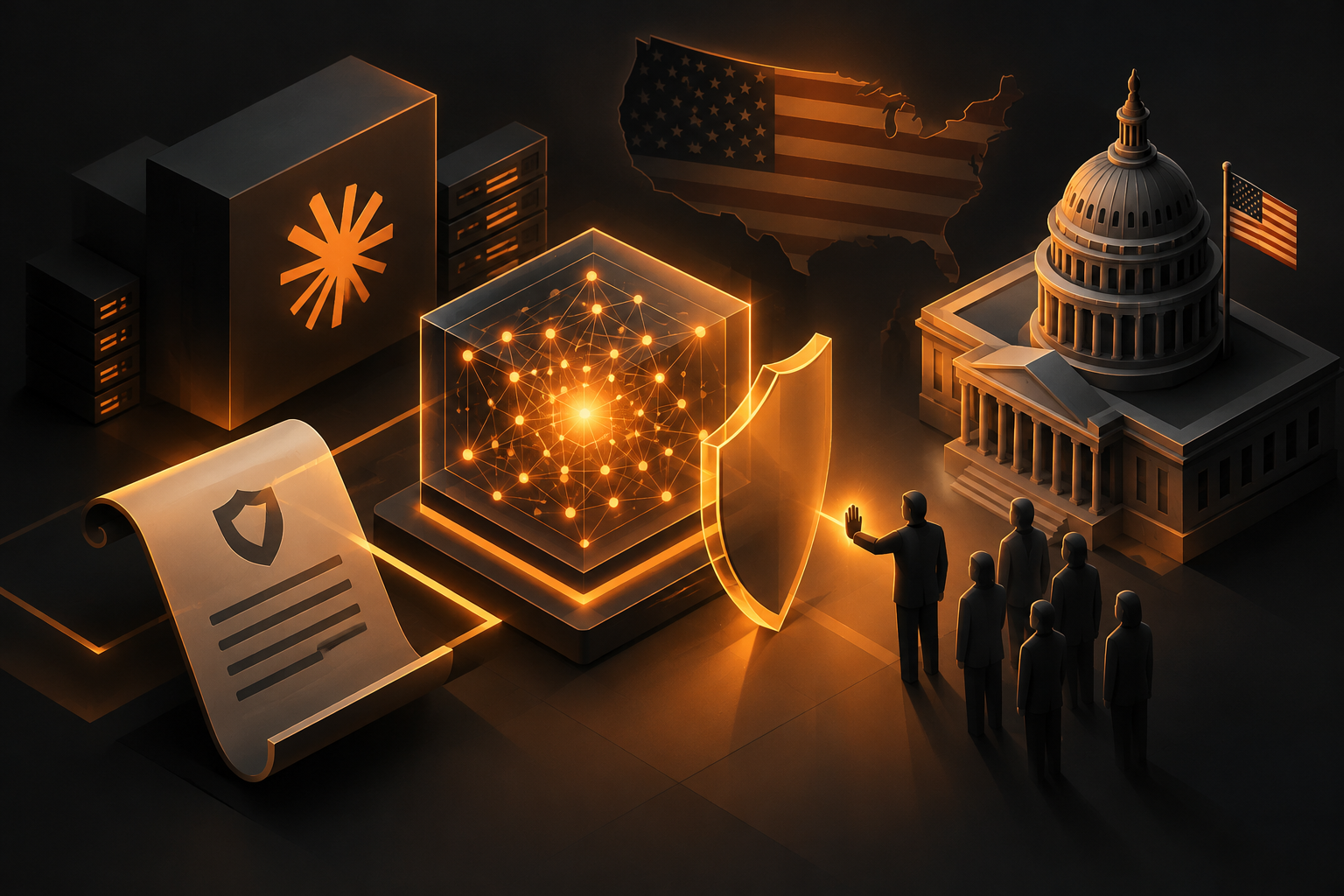
According to Politico, AI developer Anthropic has privately pitched lawmakers its own federal AI safety bill, citing three people familiar with the discussions. As reported by Law Commentary on October 16, 2026, the draft would restrict the government's ability to block dangerous models while introducing new oversight requirements for the industry. The draft is described as privately circulating and, according to the source, has not yet been formally introduced in Congress.
The proposed thresholds
Under the draft, federal officials could seek to suspend an advanced AI model only if it poses a foreseeable and imminent risk of causing more than $1 billion in damages or killing or seriously injuring more than 50 people. The thresholds would apply to three threat categories: the creation or release of biological weapons, cyberattacks, and AI systems escaping their developers' controls.
An Anthropic spokesperson confirmed, according to the source, that the draft reflects proposals outlined in the company's "Advanced AI Framework" released earlier this year.
Third-party evaluation and court authorization
Under the draft, outside evaluators registered with the Commerce Department would periodically assess AI developers and their frontier models. Companies could pay those evaluators, provided compensation is independent of the findings. If an assessment identifies an imminent threat meeting the criteria, evaluators would have 72 hours after completing their review to report to the Commerce Department. Federal officials could then seek a court order suspending the model. A judge in the U.S. District Court for the District of Columbia would decide whether the risk justifies intervention, making judicial authorization a prerequisite for suspension. Other federal departments and agencies would be barred from independently suspending development, deployment or internal use of covered models under this framework, concentrating the power to seek such action in the Commerce Department.
Possible effect on state law
The draft reportedly also includes provisions that would override certain state AI safety laws, potentially limiting states' ability to impose their own testing, disclosure and safety requirements. How far those limits reach would depend on the final legislative language.
Parallel Senate proposal
On September 29, 2026, Democratic Senators Mark Warner, Brian Schatz and Andy Kim introduced the Artificial Intelligence Risk Management and Security Act of 2026 (S. 5576). The measure would establish a federal Artificial Intelligence Safety Board and enforceable safety requirements for advanced models, including pre-release safety testing and reporting of significant incidents. Warner sought unanimous consent to pass the bill that day, but Republican Senator Ted Cruz objected. The bill remains before the Senate Committee on Commerce, Science, and Transportation.
Assessment
The move illustrates how contested the division of authority between federal and state governments, and the reach of state intervention in AI systems, has become. For German companies that orient themselves on the EU AI Act, the draft is mainly relevant because it could define third-party testing duties and intervention thresholds at the US level. Whether and in what form such a law passes is open: any rule would need approval from both chambers and the president's signature.
The source also reports that since October 15 Anthropic has given six researchers from the nonprofit METR employee-like access to internal systems, hardware and office space; the researchers can publish findings independently, though Anthropic retains limited rights to require redactions of sensitive information. The company is also working with SecureBio and Accenture on external assessments.
Sources
Editorially owned by Ideal Syka. Sources and method: Newsroom & method. Tips and corrections: ai@i6eal.de.