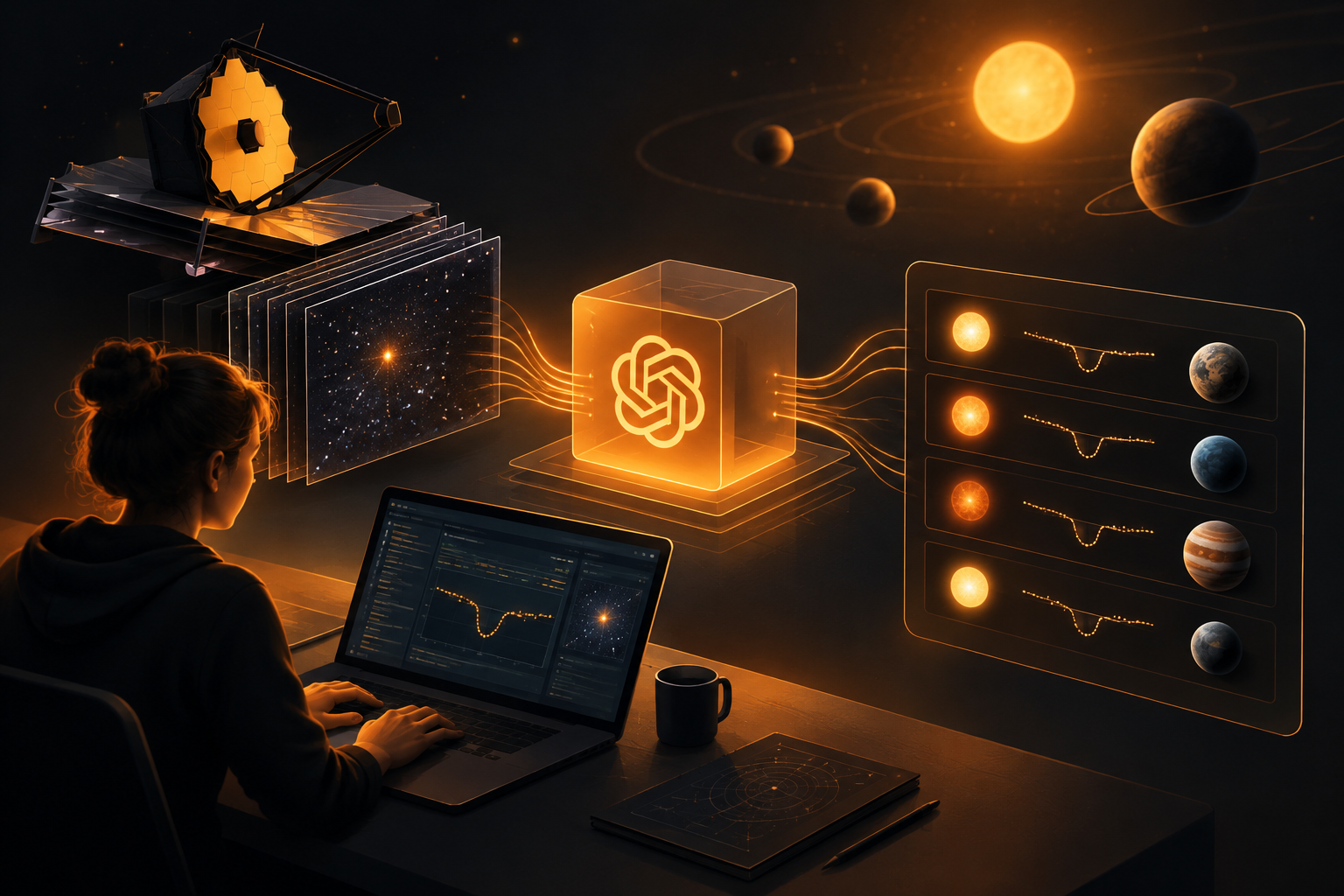
Two amateur astronomers used OpenAI AI tools to search freely available measurement data from NASA space telescopes for unknown planets. According to The Decoder, Kevin Bond, an OpenAI engineer and amateur astrophotographer, and Ethan Byrd, founder of the email start-up Primitive, used the tools independently of each other. Both searched for so-called transits, the small dip in a star's brightness curve when a planet passes in front of it.
The Kepler data approach
Bond had Codex compare published search methods, combine them into one program, and test whether code changes improved the search. An AI agent scanned the brightness curves of around 100,000 stars from the Kepler mission, which ran from 2009 to 2018. A second agent checked the flagged candidates more closely. The program reported more than 200 signals, including ten from already confirmed planets.
Two stars stood out: KIC 5689121 in the constellation Lyra is cooler than the Sun and about half its size. Its brightness drops every 13.8 days, and a possible planet would have about 2.4 times Earth's diameter. For KIC 6691030 in the northern sky, the dip repeats every 4.8 days, which would fit a planet smaller than Neptune. Vishal Gajjar of the SETI Institute found both signals again in his own search. He says Bond's pipeline found candidates that conventional searches might have missed.
The TESS data approach
Byrd had the model Astra design two searches: a broad search for planet candidates and one restricted to the habitable zone, the distance from a star at which liquid water could exist. The data on around 19 million stars came from the NASA satellite TESS, launched in 2018, and other public archives. The first run produced 49 candidates. Byrd has sent one of the strongest to researchers on the TESS mission, who want to examine it more closely.
Background
A dip in starlight does not yet prove a planet. Two stars eclipsing each other produce similar signals, and temperature fluctuations on board a telescope can also make a star appear dimmer. Astronomers therefore confirm findings statistically or keep observing the star with other methods, such as the radial velocity method. According to OpenAI, this can take months or years.
Assessment
The first checks were encouraging, according to the report, but whether these are real planets is open. For research, it is notable that AI tools make old archival data searchable outside large institutes. Whether this leads to new discoveries will depend on follow-up observations.
Sources
Editorially owned by Ideal Syka. Sources and method: Newsroom & method. Tips and corrections: ai@i6eal.de.