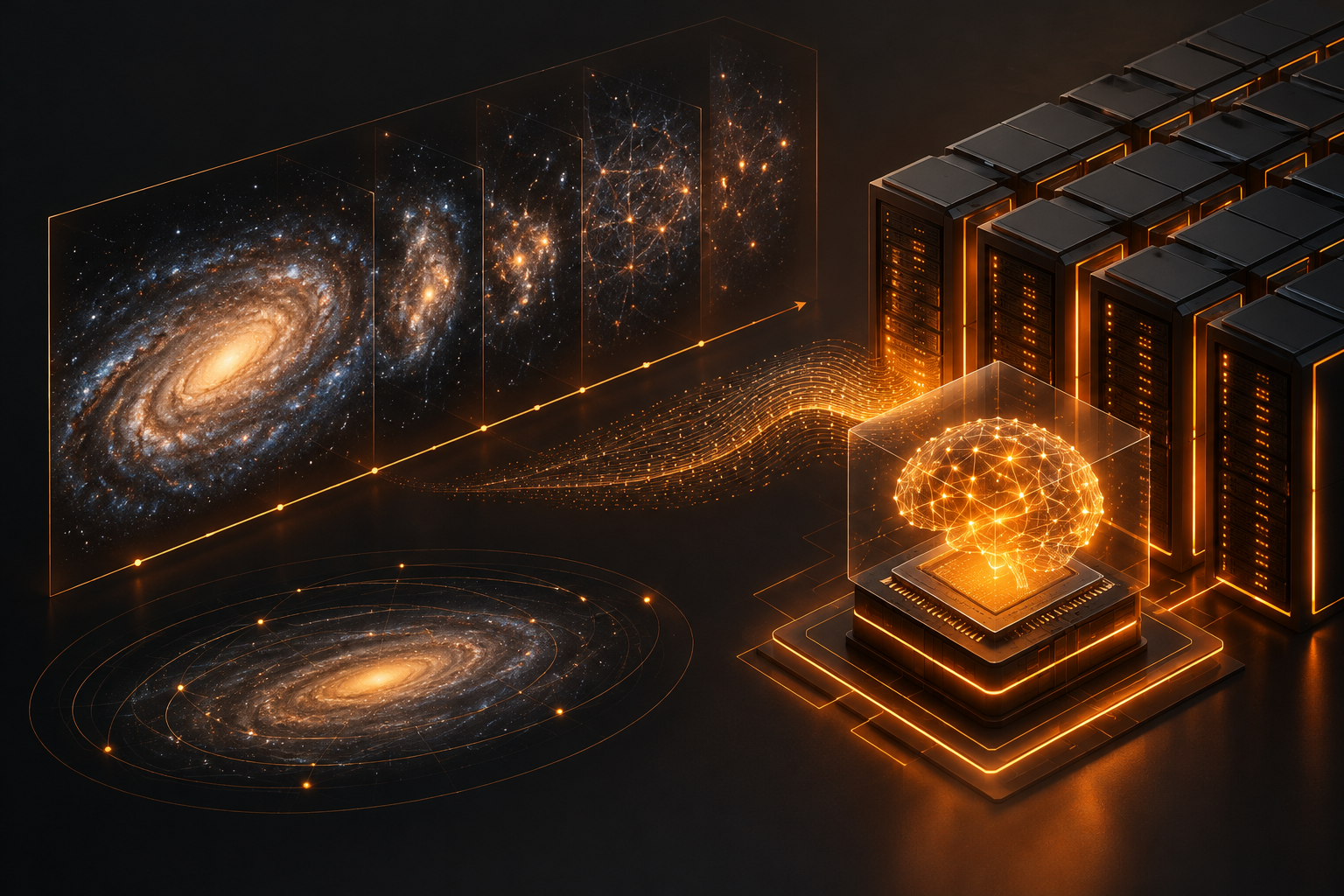
According to t3n, researchers around the Riken institute in Wako, Japan, and the University of Tokyo have simulated the Milky Way down to individual stars. The team presented the study at the SC26 supercomputer conference in Chicago. Using the Pheasant program, they computed up to 5.4 trillion particles; according to the report, the resolution is a thousand to ten thousand times higher than in previous models of the entire galaxy.
Background
According to t3n, high-resolution galaxy models struggle with large differences in scale: the Milky Way's disk spans up to 200,000 light-years, while it completes one rotation in 200 million years. Stellar explosions, by contrast, change the surrounding gas within decades and force short time steps.
The AI as a Shortcut
To resolve this computing bottleneck, Riken astrophysicist Keiya Hirashima developed his own AI prediction model, according to a University of Tokyo announcement. At each stellar explosion, the main program sends the surrounding gas data to the AI and receives the calculated state after the pressure wave has subsided. According to t3n, this moves the simulation of the whole galaxy forward in time steps of 2,500 years instead of about 30. AI training took one day on a single graphics chip; the prediction runs on ordinary main processors.
Hardware
The software was adapted to run on hardware from Intel, AMD and Nvidia. It was tested on the US systems Frontier and Aurora and on the Jupiter supercomputer in Jülich. According to Forschungszentrum Jülich, Jupiter is Europe's fastest supercomputer; with just under 21,000 Nvidia chips it computed 135 billion particles per second. Aurora reached 144 billion with just over 60,000 Intel chips, and Frontier with AMD chips reached 5.4 trillion particles.
Assessment
According to t3n, the work for now provides a technical proof of performance. The record run comprised only ten short test steps, the model starts from an already formed galactic disk, and it omits magnetic fields, radiation, dust formation and black holes. As the report notes, it cannot yet model how a spiral galaxy like the Milky Way emerges from the early universe. Whether the method can be transferred to climate models is possible according to the report, but not established.
Sources
Editorially owned by Ideal Syka. Sources and method: Newsroom & method. Tips and corrections: ai@i6eal.de.