
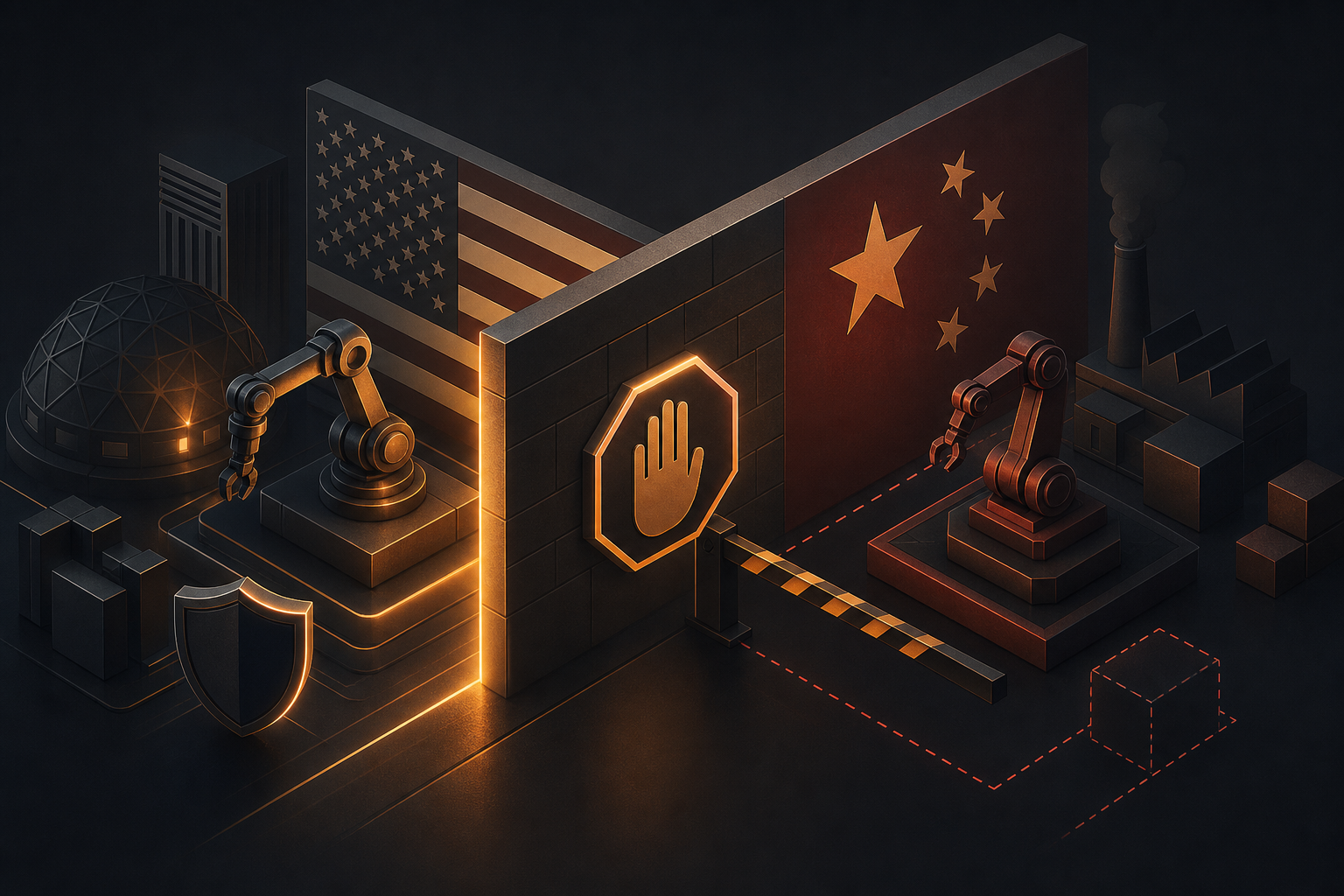
The United States is tightening controls on robot imports significantly. According to the Federal Communications Commission (FCC), mobile robots manufactured abroad will in future only be permitted with special approval, for example from the Department of Defense. This primarily affects Chinese manufacturers and shields American developers from their competition.
Key Facts
- FCC regulation: Mobile robots (over 2 kg, with sensors and network connectivity) now require special approval
- Rationale: Network capabilities could be misused for espionage, surveillance, or remote control
- Grandfather clause: Already-approved models may continue to be imported
- Exemptions: Stationary industrial robots are explicitly excluded from the ban
The Definition Is Broader Than Expected
The US government defines mobile robots as technical devices over two kilograms that move autonomously, avoid obstacles, have sensors, and can navigate via network. This definition is deliberately broad – it could even catch advanced vacuum cleaners, a market segment where Chinese vendors have already beaten US pioneer iRobot.
The ban therefore targets not just humanoid or specialty robots. It potentially captures entire product categories dominated by China.
Security or Protectionism?
The FCC justifies the measure on security grounds: network capabilities could be misused for espionage, surveillance of Americans, or remote operation. That is a legitimate concern – but the measure also has a clear protectionist component. The market for humanoid robots could one day be enormous, and the US wants to ensure American companies dominate it, not Chinese ones.
Stationary robots – such as those for industrial production – are explicitly exempt from the ban. This shows: it is not about blanket security, but targeted market protection in the mobile, networked robotics segment.
What This Means for German Companies
The US import ban signals escalation in the tech competition between the USA and China. German robotics manufacturers could face a dilemma: either develop separate product lines for the US market (with additional approval procedures), or focus on other markets. At the same time, the ban could indirectly benefit European suppliers – if they are perceived as a "neutral" alternative to Chinese products. However, there is also a risk that the EU will come under pressure to adopt similar measures. The question is: does Europe follow the US course, or stick with a more open approach?
Sources
Editorially owned by Ideal Syka. Sources and method: Newsroom & method. Tips and corrections: ai@i6eal.de.