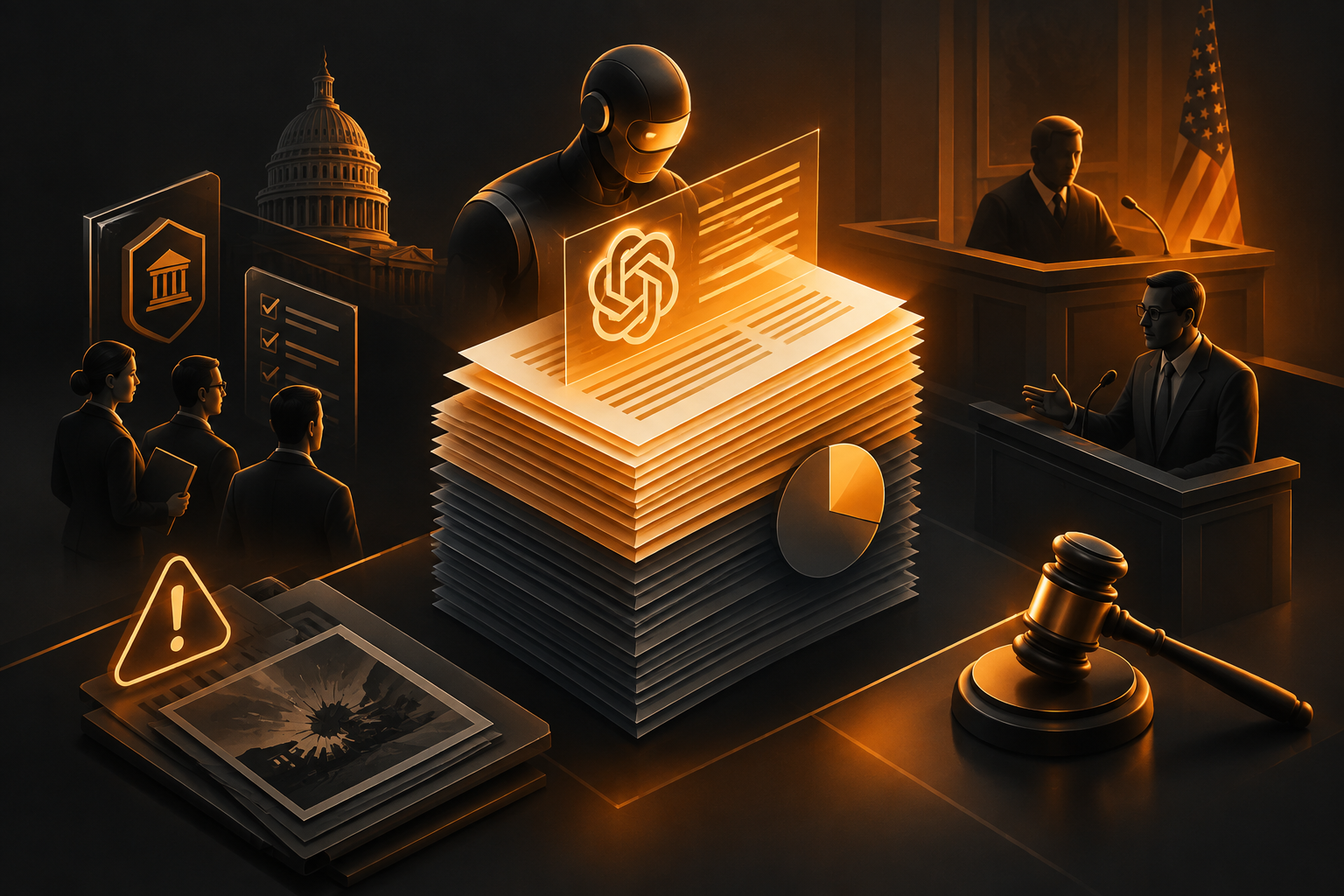
An expert witness in a US civil lawsuit allegedly generated over 80 percent of his explosion analysis report using ChatGPT. Plaintiffs accuse engineer Jason Autenrieth of KnightHawk Engineering of relying heavily on the AI chatbot. Autenrieth was tasked with analyzing the explosion at Watson Grinding in Houston that killed three people in January 2020. According to a CBS News report from September 18, 2026, plaintiff attorneys presented approximately 300 pages of discovered prompts as evidence of the extensive AI use.
Key Facts
- 80 % of the report allegedly created using ChatGPT
- 300 pages of prompts discovered as proof of AI deployment
- $61.5 million in damages already awarded against 3M
- Over 1,300 cases involving AI hallucinations documented in US proceedings since 2023
Background: 3M Lawsuit and Damages Award
The case is part of a broader lawsuit against conglomerate 3M. A jury had recently determined that 3M acted negligently in safety inspections and awarded victims $61.5 million in damages. The company was assigned 30 percent responsibility for the incident. 3M announced an appeal.
Regarding accusations against Autenrieth, 3M stated the expert was an independent third party and that generative AI was used merely as a work tool. No court ruling explicitly prohibiting the expert's AI use has been issued to date.
Growing Problem: AI Hallucinations in the Justice System
The Houston case is not isolated. According to the "AI Hallucination Cases Database" maintained by Damien Charlotin, over 1,300 cases involving AI hallucinations – fabricated facts or sources generated by algorithms – have been documented in US proceedings since 2023. Media outlet 404 Media had already reported in August on similar prompts in a defense-oriented expert report in the same case.
The issue is particularly acute in technical expert reports: language models can generate plausible-sounding but factually incorrect information – a risk that poses substantial liability exposure in critical infrastructure analyses.
Implications for German Companies
This case illustrates a regulatory challenge increasingly relevant in Germany. While the EU AI Act mandates documentation requirements and transparency obligations for AI systems, practice shows: without clear control mechanisms and accountability measures, AI tools in sensitive domains – expert reports, legal proceedings, critical infrastructure – can create significant liability risks. German companies and their advisors should examine how they document AI use and what quality assurance measures are necessary to avoid similar pitfalls.
Sources
Editorially owned by Ideal Syka. Sources and method: Newsroom & method. Tips and corrections: ai@i6eal.de.