
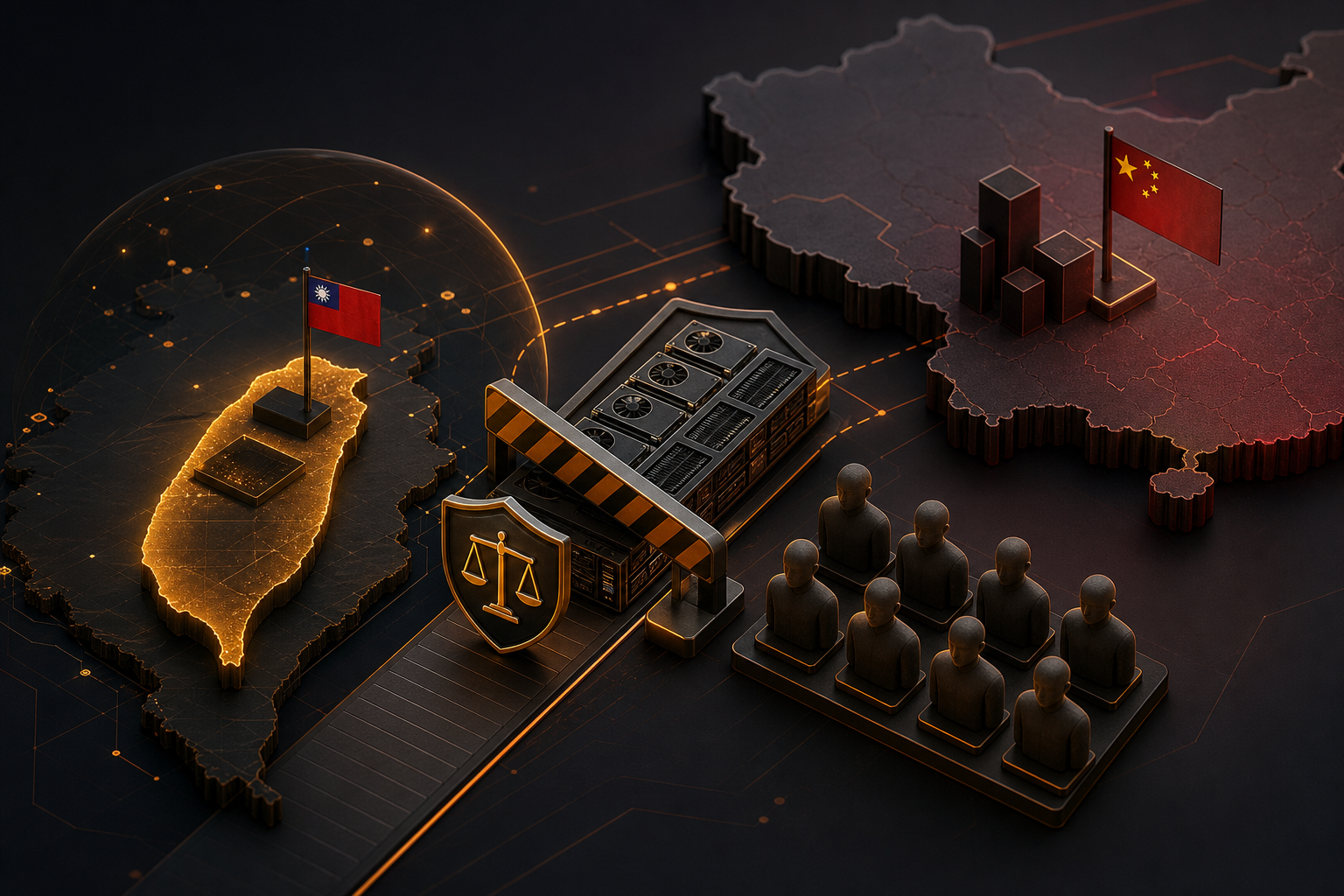
Taiwan has indicted nine individuals, including employees of Nvidia and Super Micro, for allegedly illegally exporting advanced AI servers to China. Reuters reports the case marks a rare instance of direct criminal prosecution of individuals for circumventing export controls—underscoring how seriously Taiwan and the US treat the blockade of cutting-edge technology from reaching China.
Key Facts
- Nine defendants from Nvidia and Super Micro allegedly conspired to illegally export advanced servers to China
- Prosecutors accuse them of acting despite being "fully aware" of the companies' "rigorous" export control procedures
- The Keelung (northern Taiwan) prosecutors office cites "enormous profit" as motive and claims the exports "severely damaged" Taiwan's international standing
- Context: The US has banned sales of cutting-edge AI hardware to China since 2022; Taiwan enforces even stricter rules
Why Taiwan Holds the Key
Although Nvidia is American, most of its chips flow through TSMC (Taiwan Semiconductor Manufacturing Company), the world's largest chipmaker. TSMC packages and assembles chips in Taiwan—making the island a chokepoint for export enforcement. Taiwan fears violations will anger the US, particularly the Trump administration, which already pushes hard against China.
"They colluded with one another at various levels for enormous profit, illegally exporting high-end servers, increasing corporate compliance costs, and severely damaging our nation's international image," prosecutors from Keelung said, according to Reuters.
The indictment stresses that defendants knew about strict export controls at both companies—this was deliberate circumvention, not ignorance.
A Familiar Pattern: Routing Through Third Countries
Illegal exports follow an established playbook: instead of shipping directly to China, servers are rerouted through Southeast Asia (Thailand, Malaysia). Reuters and US authorities have documented multiple cases:
| Case | Value | Details |
|---|---|---|
| Reported instance | ~$1 billion | According to Reuters, may have involved server racks shipped via Southeast Asia to China |
| US indictment | $3.5 billion | Three individuals charged with exporting AI servers |
These detours are hard for investigators to trace because goods leave Taiwan legally—only the final destination is prohibited. That makes Taiwan's move to prosecute individuals directly, rather than just at the corporate level, all the more significant.
What This Means for German Companies
The indictment is a warning shot for anyone operating in global AI supply chains. Companies trading hardware or chips must assume that authorities in Taiwan, the US, and increasingly the EU will conduct end-use verification checks. For German firms: AI business with China is not just politically risky but increasingly subject to criminal prosecution—including at the personal level. Compliance processes are no longer paperwork; they are liability protection.
Sources
Editorially owned by Ideal Syka. Sources and method: Newsroom & method. Tips and corrections: ai@i6eal.de.