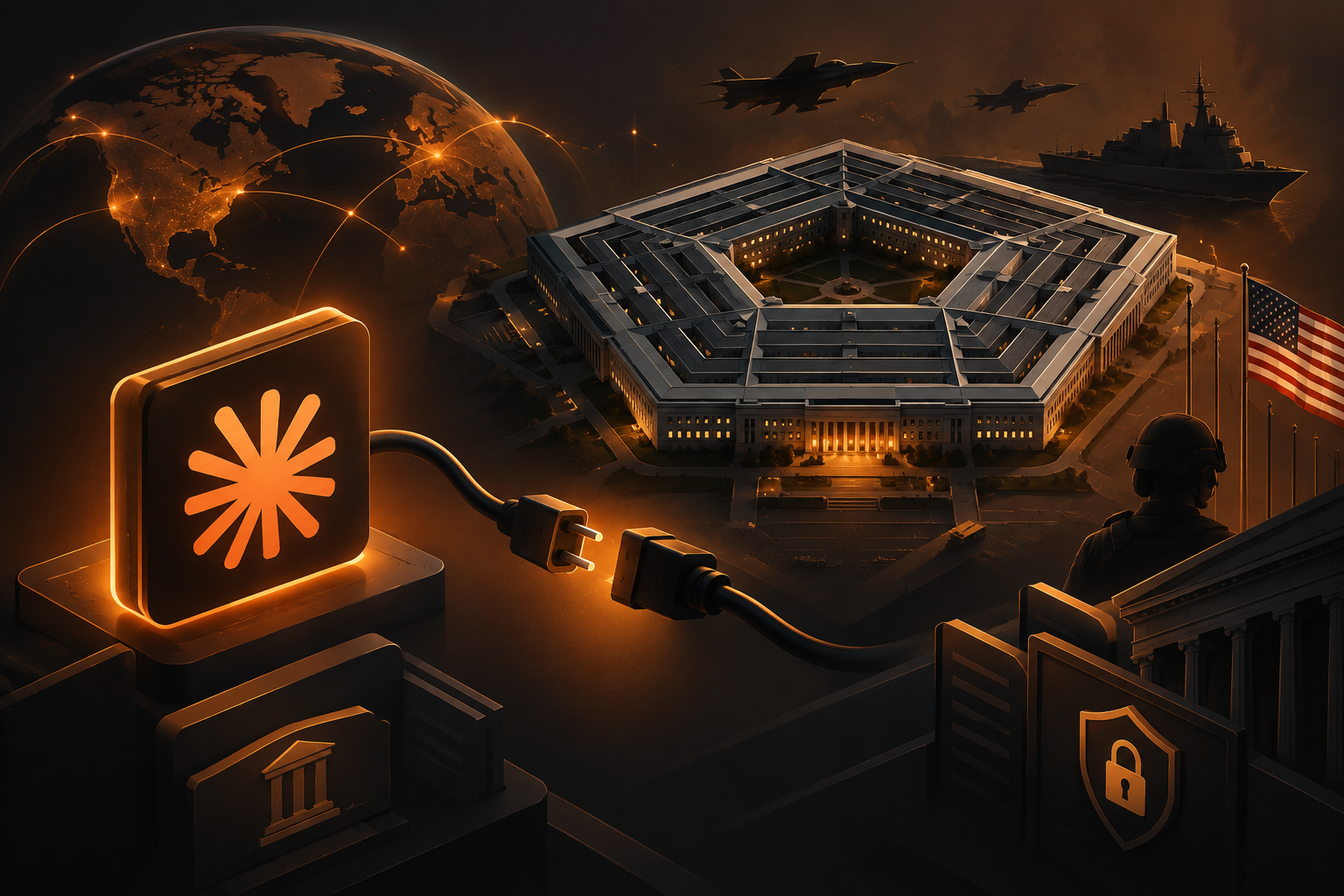
The Pentagon has discontinued its use of Anthropic's Claude model. A US Department of Defense official confirmed to the BBC on Monday that the agency "has ceased the use of Anthropic products"—months after Defense Secretary Pete Hegseth designated the company a "supply chain risk" on national security grounds in February.
Key Facts
- Pentagon ends Claude deployment: The Defense Department had used Anthropic's AI tools for research, analysis, intelligence gathering, and military operations against Iran—still active as recently as last week
- Hegseth's ultimatum: The Defense Secretary demanded Anthropic remove safety guardrails and grant unfettered military access; Anthropic refused
- Designated as risk: Hegseth classified Anthropic as a "national security supply-chain risk"—a category typically reserved for companies from countries posing a threat to the US
- Legal counteroffensive: Anthropic is suing the Trump administration, calling the move "unprecedented and unlawful"
The Battle Over AI Control
Claude had been deployed by the Pentagon since 2024 and was the first advanced AI model to be used in US government agencies handling classified work. Anthropic had positioned itself as a strategic military partner—until requirements escalated.
Hegseth demanded that Anthropic remove safety guardrails to give the military unfettered access. Anthropic refused, citing concerns about mass surveillance and autonomous weapons systems. This led to the blacklisting decision in February.
Delayed Exit, Deep Integration
Hegseth announced the Pentagon would cease all Anthropic use by late August. Yet as recently as last week, Pentagon staff were still actively using Claude—a sign of the technical complexity of the exit. According to multiple sources, including former US defense officials and contractors, Claude was deeply embedded in Maven Smart System, Palantir's primary platform for Pentagon intelligence and data organization.
Lauren Kahn, Senior Research Analyst at Georgetown's Center for Security and Emerging Technology, told the BBC:
"The fact that it took the Pentagon until now to remove all use shows how difficult it was to quickly extract Claude from the system."
The delay suggests Anthropic had strategically embedded its technology deep within critical military infrastructure—now a disadvantage.
New Pentagon Alliances
As Anthropic was phased out, the Pentagon signed contracts with other major tech firms: Google, xAI, and OpenAI. OpenAI tools are increasingly adopted in some military departments, according to two defense AI insiders. The Pentagon is diversifying its AI dependencies—and signaling clear priorities: companies willing to meet military requirements without ethical hesitation get the contract.
Anthropic has sued over the designation, calling it "unprecedented and unlawful."
What This Means for International Firms
The situation demonstrates how quickly geopolitical tensions can sever AI business relationships. For companies working with US agencies or NATO partners, a critical lesson emerges: security concerns and control requirements will increasingly outweigh technological excellence. Organizations should assess whether their AI solutions are so deeply integrated into critical infrastructure that rapid exit becomes impossible—that can become a liability.
Sources
Editorially owned by Ideal Syka. Sources and method: Newsroom & method. Tips and corrections: ai@i6eal.de.