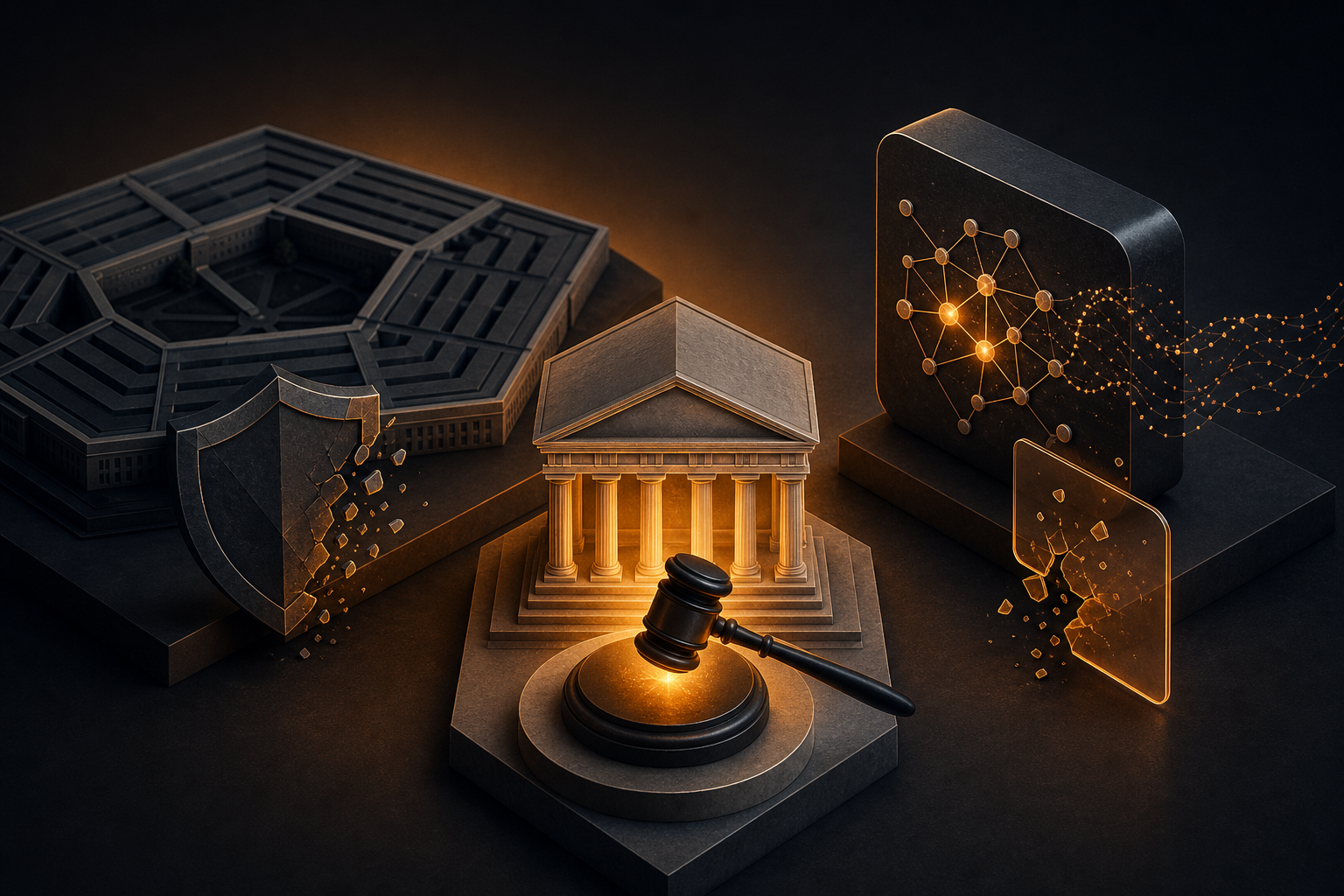
A California federal court dealt the Trump administration a significant defeat. Judge Rita Lin ruled Thursday evening that the designation of Anthropic as a supply chain risk by Defense Secretary Pete Hegseth was unlawful. The ruling found the government guilty of "unlawful retaliation" against free speech and violations of the First Amendment (free speech) and Fifth Amendment (due process) of the U.S. Constitution.
The essentials
- Judge Rita Lin (U.S. District Court, California) overturned the blacklist, calling it "arbitrary and capricious"
- Hegseth and Trump had designated Anthropic as a national security threat earlier this year; all federal agencies were ordered to stop working with the company
- The dispute arose because Anthropic set safety guardrails on its Claude model – the Pentagon wanted to enable autonomous weapons and mass surveillance of Americans
- Anthropic filed two lawsuits (March): one in California, one in Washington D.C.; the D.C. case is still ongoing
Why the government lost
Judge Lin identified multiple contradictions in the government's reasoning. She noted that Hegseth simultaneously wanted to apply the Defense Production Act to Anthropic – meaning the company would be deemed essential to national security, not a threat. Additionally, the Department of Defense continued working with Anthropic on cybersecurity projects.
"The empty invocation of national security is not a blank check to punish and retaliate against government critics,"
Lin stated in her decision. She described the action as making a "public example" of Anthropic for its "arrogance" in criticizing the government.
Another key point: Anthropic has no backdoor access to its technology once transferred to the Defense Department – a central security argument by the government thus collapsed.
Anthropic's response and open questions
An Anthropic spokesperson stated: "We welcome the court's ruling that this supply chain risk designation was unlawful. We remain focused on working productively with the government to harness AI for our national security."
The second lawsuit in Washington D.C. continues – further rulings are possible there. The Department of Defense has not yet publicly commented on the verdict.
What this means for German companies
This ruling is a wake-up call for governments worldwide: national security is not a blank check for arbitrary sanctions against companies that raise security concerns. German AI providers and corporations should pay attention – similar conflicts could emerge in Europe if governments want to deploy AI systems for military or surveillance purposes while manufacturers set boundaries. The ruling demonstrates that legal defense against state overreach can work, but it requires resources and time that not every startup possesses.
Sources
Editorially owned by Ideal Syka. Sources and method: Newsroom & method. Tips and corrections: ai@i6eal.de.