What's new
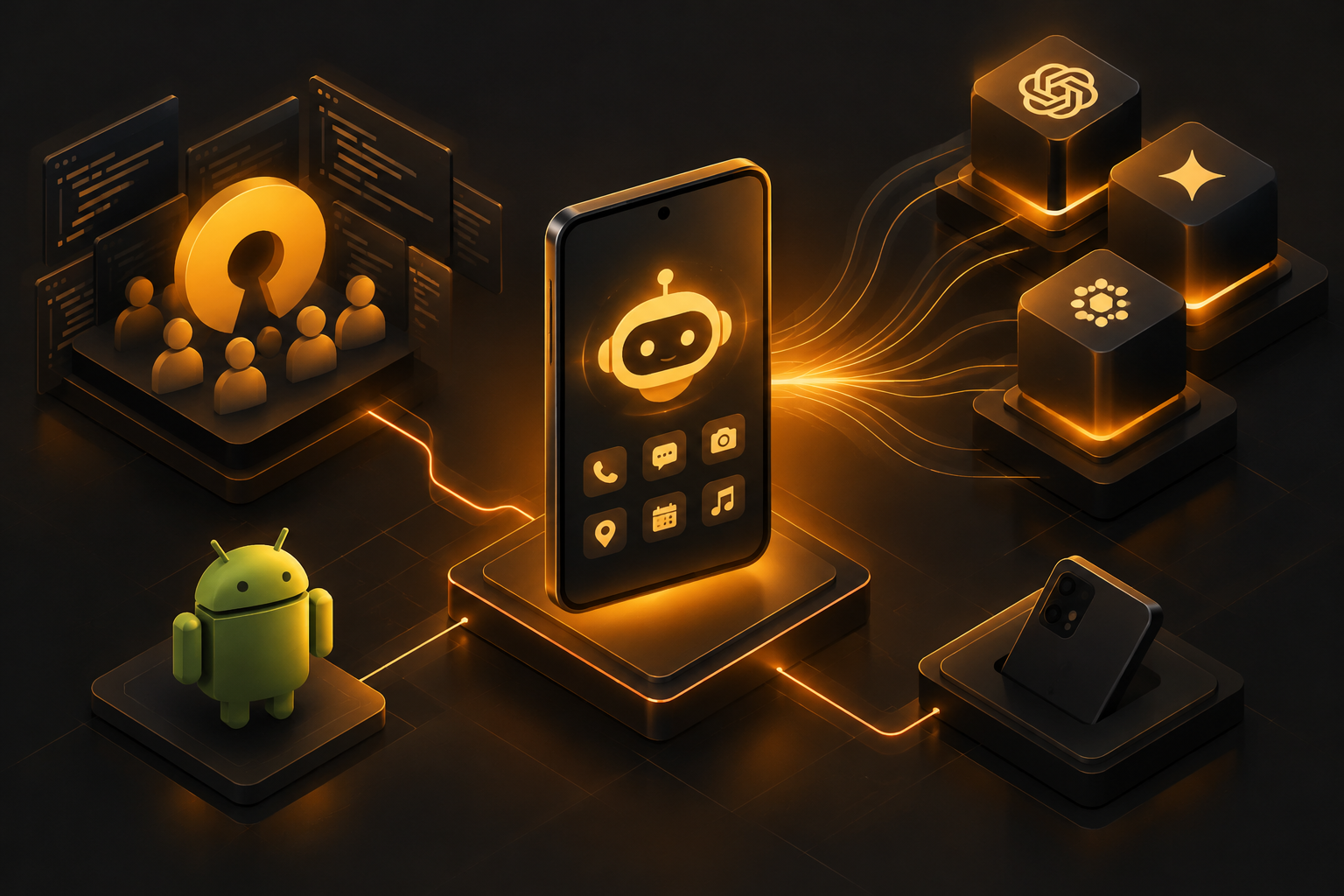
The open-source project OpenMobile-2 trains AI agents that operate smartphones on their own. Researchers from Nanjing University, AI company SenseTime and other universities are releasing two models built on Qwen3.5 with 9 billion and Qwen3.6 with 27 billion parameters, along with the full training environment, data and instructions for reproducing everything. According to the authors, their model ranks near the top of current smartphone agents. These claims come from the researchers' paper and have not yet been independently verified.
Practice ground instead of real apps
According to the researchers, training on real apps is laborious, because logins, real purchases and the lack of reset options make it expensive and hard to repeat. They therefore rebuilt 35 apps popular mainly in China, including Taobao, JD, DiDi and Meituan, as well as services such as Slack and Google Drive. Together with existing simulations and apps in the Android emulator, the practice ground covers over 110 applications. Every simulation resets automatically. The agent sees only screenshots and has no access to the apps' internal data.
According to the paper, this environment produced about 11,600 example workflows and over 2,000 practice tasks with automated success checks. Google's Gemini 3.1 Pro served as the teacher model, so OpenMobile-2 indirectly learns from a closed system.
Results in tests
On the AndroidWorld benchmark, the authors report that the larger model rises from 67.1 to 79.9 points and the smaller one from 54.3 to 74. The predecessor OpenMobile-1 scored 64.7 there. On the more demanding MobileWorld, the larger model improves from 35.9 to 50.4 points.
The biggest jump appears on real Android devices: on SPA-Bench, the larger model improves from 31.9 to 59.6 points. The researchers describe this as the best score among open models. On AndroidWorld, according to the paper, it trails only Gemini 3.1 Pro.
Diversity beats data volume
With the amount of data held constant, the researchers found that the number of different apps an agent trained on mattered most. The success rate on unseen apps rose from 60.7 to 67.5 percent. Additional reinforcement learning brought only limited gains, and on AndroidWorld it even scored slightly lower: 79.9 instead of 80.8 points.
Assessment
For German companies that use or evaluate smartphone agents, an open model they can run themselves could reduce dependence on individual proprietary providers. It remains open how the results hold up outside of benchmarks. The authors themselves describe the interface approach as experimental, and the training partly depends on a closed teacher model.
Sources
Editorially owned by Ideal Syka. Sources and method: Newsroom & method. Tips and corrections: ai@i6eal.de.