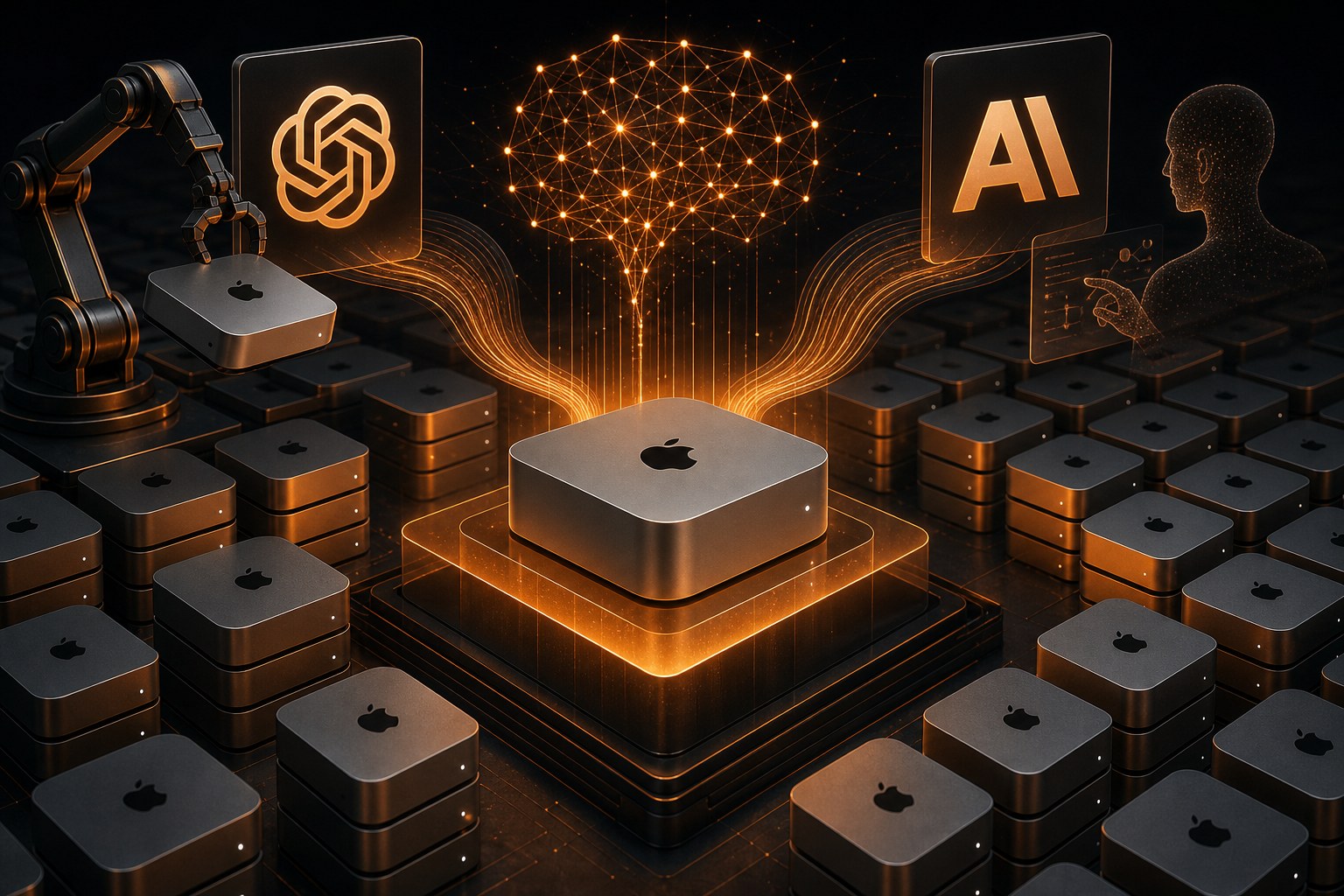
OpenAI and Anthropic are buying tens of thousands of Mac minis and Mac Studios, according to The Information, to train computer-use agents – AI software that independently completes multi-step tasks on computers. OpenAI is urgently trying to source more Macs; however, the most powerful models have been sold out for months due to memory chip shortages. This signals a clear trend: the AI infrastructure strategy is diversifying away from pure GPU clusters toward Apple's memory-optimized hardware design.
Quick Facts
- OpenAI and Anthropic are buying/renting tens of thousands of Mac minis and Mac Studios for agent training
- Apple's most powerful models have been sold out for months; memory chip bottlenecks are slowing procurement
- Apple's Mac revenue grew nearly 29 percent in the June quarter to $10.4 billion
- Anthropic also rents Mac Minis through Amazon's AWS cloud service
Why Apple Hardware Attracts AI Training Workloads
The machines impress with powerful chips, shared memory, and excellent cooling – ideal for long AI tasks. Apple's Unified Memory approach differs fundamentally from Nvidia's GPU strategy: instead of dedicated CUDA and Tensor cores, Apple integrates memory architecture. This makes Macs more efficient for certain training scenarios – particularly when training agents that must process complex sequences.
By comparison: Nvidia offers the DGX Spark as a compact alternative, but remains in the classical GPU compute paradigm. Apple's approach is complementary, not competitive – and apparently the better choice for agent training right now.
The Local AI Trend Accelerates
The Mac mini is becoming the standard training machine not just at OpenAI and Anthropic. The open-source software Exo lets users connect multiple Macs into a cluster and run large AI models locally. Peter Voell, formerly responsible for OpenAI's compute infrastructure, is even building Mount Thor, a cloud service based on Apple hardware. This trend shows: localized, decentralized AI infrastructure is becoming a competitive advantage.
Demand is so massive that Apple hardware is becoming scarce – a rare signal in tech. Memory chips are the bottleneck; without them, the Unified Memory architecture cannot be fully utilized.
What This Means for German Companies
OpenAI and Anthropic's strategy signals: hardware diversification is now mainstream in AI infrastructure. If you're training or deploying AI agents yourself, don't rely solely on GPU cloud providers – also evaluate local Apple hardware or comparable Unified Memory systems. This can reduce latency, optimize costs, and decrease dependency on single cloud providers – especially important for German companies with data protection requirements.
At the same time, the message is clear: when top labs buy hardware in bulk, supply chains tighten. If you want to invest in local AI infrastructure now, act early – the market is getting tighter.
Sources
Editorially owned by Ideal Syka. Sources and method: Newsroom & method. Tips and corrections: ai@i6eal.de.