
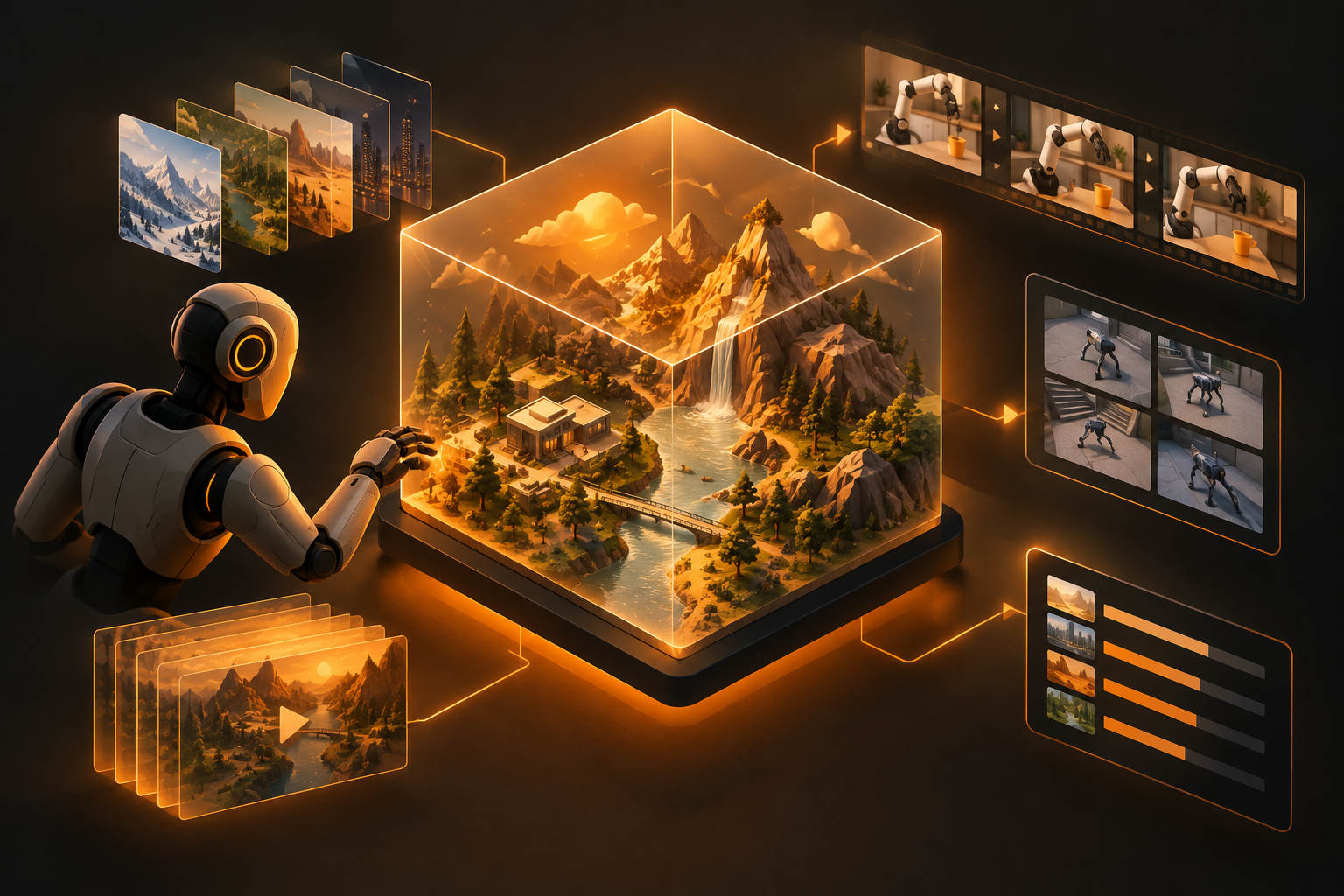
California-based AI company Odyssey has launched a public research preview of its world model Odyssey-3. You can generate interactive environments from text descriptions and explore them in real time. According to Odyssey, the model simulates physical processes and predicts how an environment changes through specific actions. Developers can apply for API access. Founders Oliver Cameron and Jeff Hawke had already unveiled the model on September 15, with a focus on robotics, autonomous driving and video games. What is new now is public access, additional technical details and benchmark results.
Key points
- Public research preview of Odyssey-3 launched; the free online demo runs on Odyssey-3 Flash.
- Base model with 14 billion parameters and a video resolution of 832 × 480 pixels; Odyssey-3 Pro supports 1280 × 720 pixels.
- According to the company, 66.1 points on the Physics-IQ benchmark, but with caveats (see below).
- API access for developers available on application.
Interactive worlds to try
In the online demo you choose between a first-person and a third-person perspective. You move through the generated world, trigger events and watch how the model responds in real time. Technically, Odyssey-3 is built on an autoregressive diffusion transformer that continuously generates new video frames based on previous frames and user actions. According to Odyssey, the model learns physical relationships and cause-and-effect from visual observations. Training data included internet videos with event descriptions, video game footage paired with keyboard and mouse inputs, and simulated physical interactions. An additional technique reduces the number of required compute steps, making real-time generation possible.
Physics benchmarks with caveats
According to the company, Odyssey-3 Pro scores 66.1 points on the video-to-video benchmark from Physics-IQ Verified. However, this top score comes from a single test run in which a selection method picked one of eight generated videos for each task. The benchmark rules require four test runs with standard deviation reported for any record claim; the reported value does not meet that requirement. Without the selection method, Odyssey-3 Pro averaged 63.37 points across four runs. Both results appear on the official leaderboard but were submitted by Odyssey itself.
On the WorldMark benchmark, Odyssey places first in three of four categories by its own evaluation: First-Person Stylized (77.2), Third-Person Real (79.0) and Third-Person Stylized (76.3). In First-Person Real, the model ranks third with 80.6 points.
| Category | Odyssey result | Placement per Odyssey |
|---|---|---|
| First-Person Stylized | 77.2 | 1st |
| Third-Person Real | 79.0 | 1st |
| Third-Person Stylized | 76.3 | 1st |
| First-Person Real | 80.6 | 3rd |
Controlling robots, drones and games
Odyssey wants to use the same world model for different tasks. Depending on the application, it is paired with a specialized controller that translates its predictions into concrete commands. According to the company, an AI built on Odyssey-3 controlled several robotic arms, with a few dozen hours of demonstration data as training basis. For humanoid robots, Odyssey works with Swiss robotics company Flexion. For drones, Odyssey reports that in a virtual indoor environment the system avoided obstacles and flew to specified targets. The company also demonstrated an AI playing GTA V autonomously; a controller trained on about two hours of GTA footage transferred its abilities to Red Dead Redemption 2 without additional training. How reliably this works in practical use remains open. The public preview initially offers only interactive environment generation; robotics and autonomous systems require additional adaptation.
The benchmark results were submitted by Odyssey itself and are subject to the caveats mentioned above.
Assessment for German companies
For companies in industry, logistics or software development, this development could become relevant once world models are used for simulation and training of robots or agents. Open questions include how robust the physics results are under independent review and how far the demonstrated control tasks extend beyond laboratory conditions. Anyone wanting to evaluate such models should look for independent benchmarks and practical tests in their own use cases.
Sources
Editorially owned by Ideal Syka. Sources and method: Newsroom & method. Tips and corrections: ai@i6eal.de.