
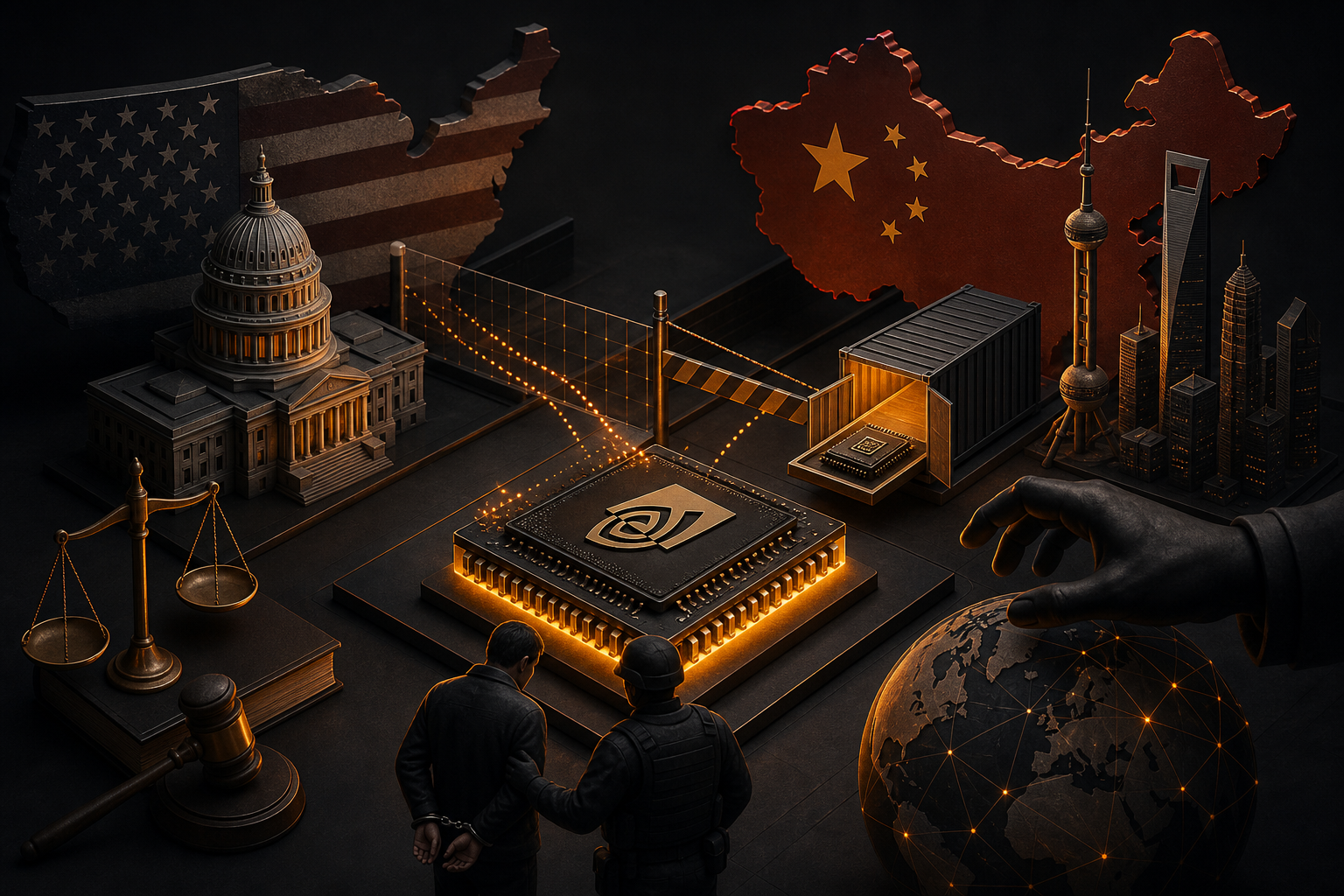
Taiwanese prosecutors have detained a Nvidia employee suspected of involvement in smuggling AI servers to China, according to reports from Bloomberg and Reuters on Tuesday. The suspect, identified only by his surname Chang, was summoned for questioning after authorities searched his residence and Nvidia's Taipei office. The Keelung District Prosecutors Office stated that after interrogation, a "strong suspicion of criminal activity" was established, leading to Chang's detention to prevent flight, evidence destruction, or collusion with accomplices.
Key Facts
- Nvidia employee Chang was detained by Taiwanese authorities; searches conducted at his residence and Nvidia's Taipei office
- Suspected offenses: document falsification and illegal export of AI chips to China in violation of U.S. export controls
- Connection to Super Micro case: In March 2026, the U.S. Justice Department indicted Super Micro co-founder Yih-Shyan "Wally" Liaw; the smuggling allegedly generated $2.5 billion in revenue
- Nvidia states: smuggling is a "nonstarter" for the company; diverted chips receive "no service, support or updates"
The Super Micro Context
Chang's detention is tied to a broader investigation into server manufacturer Super Micro. In March 2026, the U.S. Justice Department charged three individuals, including co-founder Liaw, with illegally diverting advanced servers equipped with Nvidia AI chips from the U.S. to China via a Southeast Asian intermediary. Taiwanese authorities subsequently detained multiple individuals in May and June, including Super Micro employees.
Super Micro emphasized that the company itself was not named as a defendant and that the three individuals' conduct violated company policies and compliance controls. The company suspended Liaw and another employee and terminated its relationship with the charged contractor.
Escalation in Export Control Enforcement
The detention of a Nvidia employee marks a new phase in prosecuting export control violations involving AI technology. While the U.S. Justice Department has already moved against Super Micro executives, Taiwan is now escalating—targeting a direct Nvidia employee.
| Actor | Action | Timeline |
|---|---|---|
| U.S. Justice Department | Indictment of Super Micro co-founder Liaw | March 2026 |
| Taiwan Authorities | Detention of Super Micro employees | May–June 2026 |
| Taiwan Prosecutors | Detention of Nvidia employee Chang | July 2026 |
Nvidia stated it sells products only to known partners to ensure export control compliance. A Nvidia spokesperson told Bloomberg that smuggling is a "nonstarter" for the company.
Implications for Global Supply Chains
These cases demonstrate that AI chip export controls are no longer theoretical—they are now actively enforced with detention and financial consequences. Companies in semiconductor, server, and AI supply chains must assume that compliance violations carry criminal liability, even for indirect involvement. Simultaneously, a reputational and operational risk emerges for suppliers and partners: associations with companies under investigation can trigger searches and damage. The critical question remains whether Nvidia itself will face institutional scrutiny or whether Chang will be treated as a lone actor.
Sources
Editorially owned by Ideal Syka. Sources and method: Newsroom & method. Tips and corrections: ai@i6eal.de.