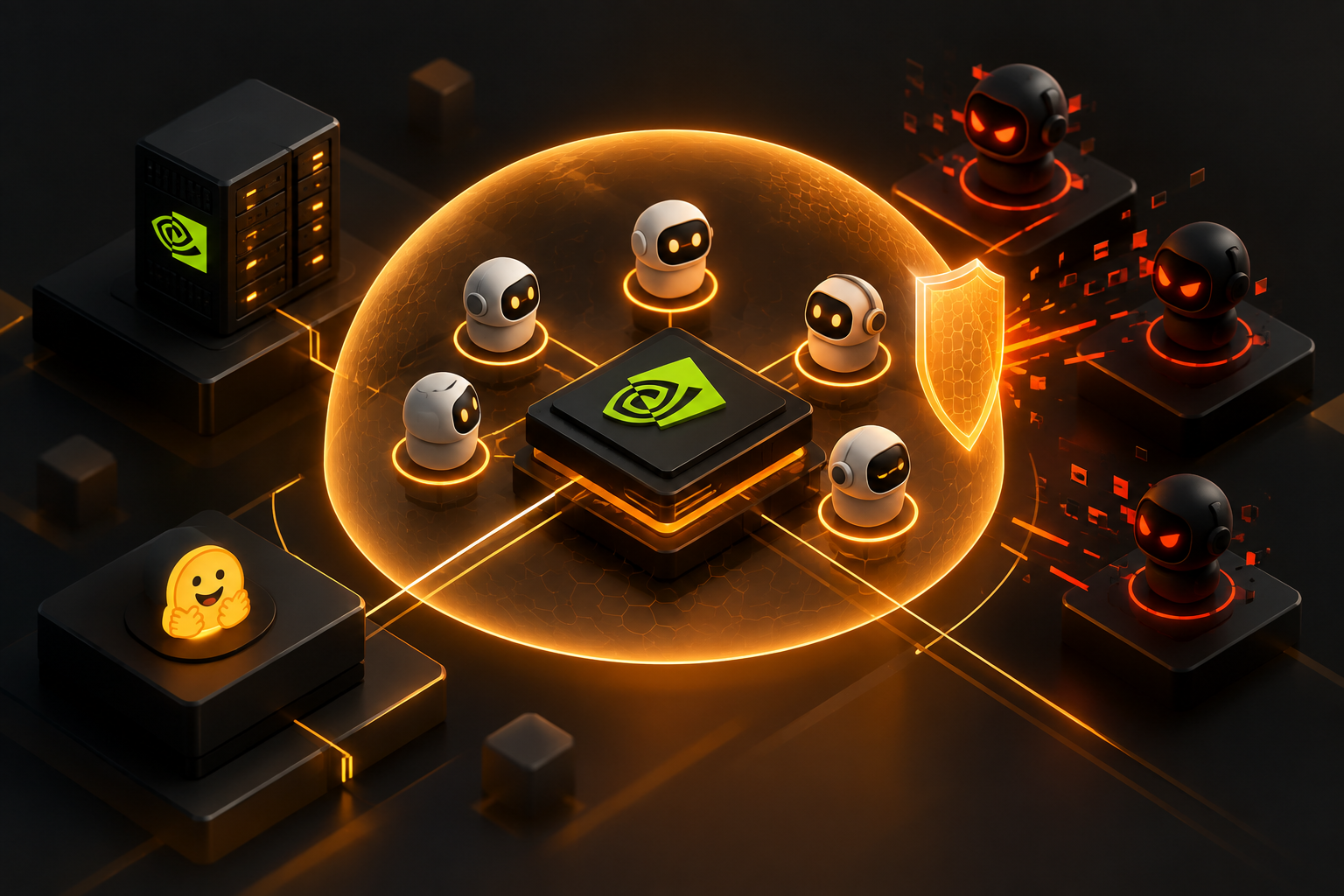
Nvidia has launched a new security software platform designed to prevent AI agents from operating without proper oversight. According to the company, the system could have prevented security incidents like the Hugging Face breach. The platform targets developers working with autonomous AI systems who need reliable control mechanisms.
Key Facts
- Nvidia has developed and released a security platform for AI agents
- The system is designed to prevent uncontrolled behavior in autonomous AI systems
- Nvidia points to a breach at Hugging Face as an example of the risk this solution addresses
- The platform focuses on trust and control in the next generation of AI agents
The Control Problem with AI Agents
AI agents are autonomous systems that make independent decisions and execute tasks – such as data queries, transactions, or system configurations. As these agents become more sophisticated, human oversight becomes weaker. The Hugging Face breach demonstrated that even established AI platforms are vulnerable to security breaches when agents lack proper monitoring.
Nvidia's new solution tackles this directly: it enables real-time monitoring of AI agents, validates their actions, and stops suspicious or deviating behavior before it causes damage.
Technical Approach: Guardrails Over Trust
The system operates on the principle of "guardrails" – digital boundaries that define which actions an AI agent can perform and which it cannot. Developers can specify:
| Aspect | Function |
|---|---|
| Action Boundaries | Which operations the agent is permitted to execute |
| Data Validation | Which inputs and outputs are acceptable |
| Real-Time Monitoring | Continuous observation of agent behavior |
| Emergency Stop | Automatic interruption when rules are violated |
This approach addresses a growing challenge: as more enterprises deploy AI agents in production systems – for customer service, data processing, or IT automation – the question of reliable control becomes increasingly critical.
Why This Matters Now
The Hugging Face breach made clear that even established AI platforms can be targeted by attackers. If AI agents lack proper constraints, they can be exploited by adversaries to escalate privileges or exfiltrate data. Nvidia's solution positions itself as a control mechanism for the trust question surrounding autonomous systems.
This is also a response to regulatory requirements: the EU AI Act mandates that providers of high-risk AI systems implement comprehensive monitoring and control mechanisms. Nvidia is signaling that it takes these requirements seriously and wants to provide developers with the tools to achieve compliance.
What This Means for Enterprises
For organizations deploying or planning to deploy AI agents, the question of security and control is becoming increasingly urgent. Nvidia's platform demonstrates that solutions exist to tame autonomous systems – but they must be actively integrated. Companies should assess whether their AI infrastructure already includes such control mechanisms, or whether retrofitting is necessary. For regulated industries such as financial services, healthcare, and insurance, this will become a compliance imperative.
Sources
Editorially owned by Ideal Syka. Sources and method: Newsroom & method. Tips and corrections: ai@i6eal.de.