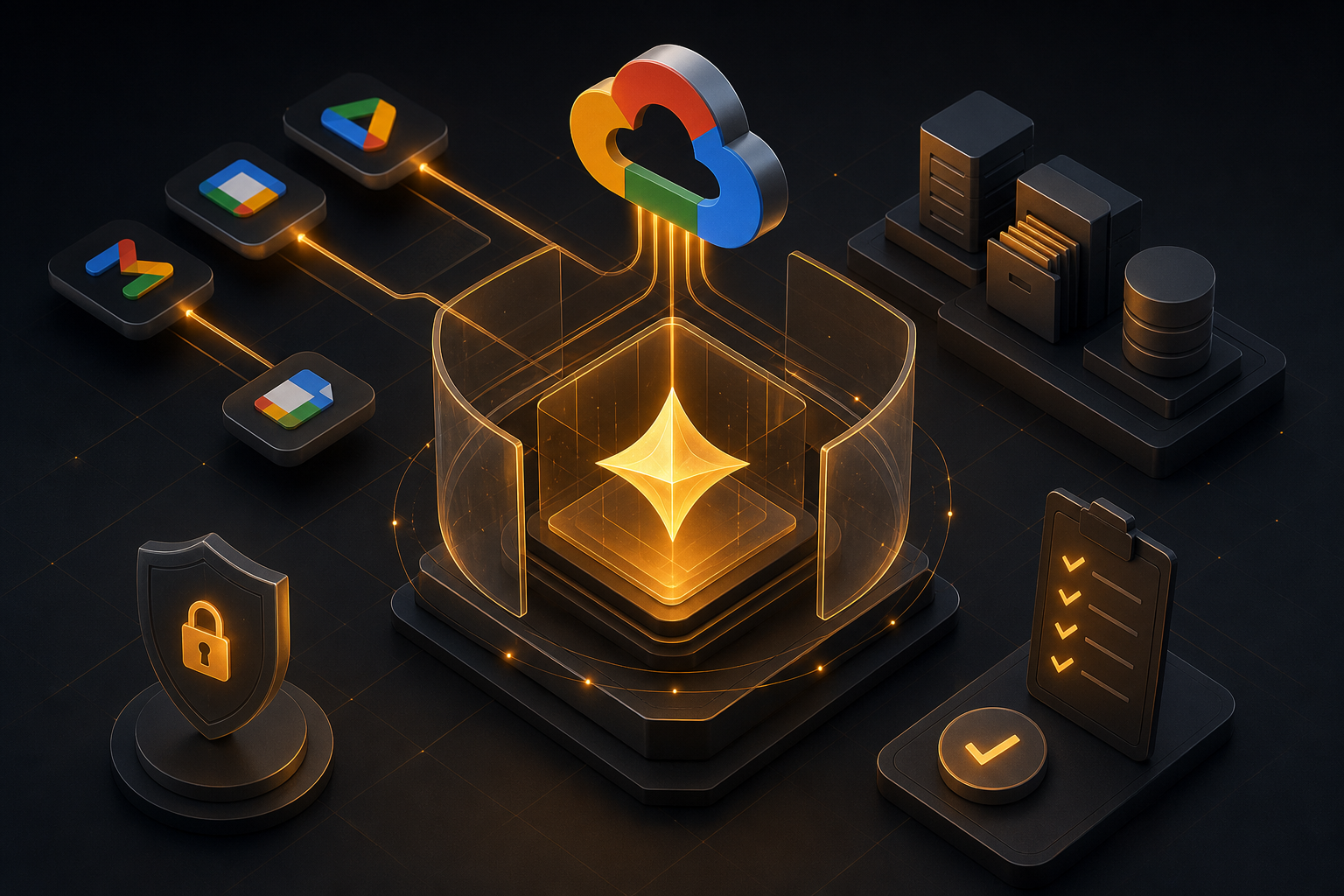
Google gives its Gemini AI default access to sensitive company data in Workspace, according to reporting by ZDNET. The affected services include Gmail, Google Docs, Calendar, and Chat—Gemini can tap into them to generate more relevant responses. Additionally, Drive and Meet are available as Workspace Intelligence Sources. For many enterprises, this is a surprise that immediately raises questions about data protection and compliance.
The essentials
- Enabled by default: Google Workspace activates Gemini access to company data automatically, without requiring explicit administrator consent
- Affected services: Gmail, Docs, Calendar, Chat, Drive, and Meet are designated as Workspace Intelligence Sources and are open to Gemini by default
- No external use: Google says it does not use this data for training, does not share prompts with other users, and does not create AI-specific databases from your documents and emails
- Disable available: Administrators can turn off access per service individually
What Google does—and doesn't—with your data
First, the reassurance: Google promises that Workspace data is not used for AI training and is not processed outside your company's domain. Prompts and generated responses are not shared with other users or organizations. There are also no separate AI databases built from your documents and emails.
That sounds comforting—and it shifts the risk from a potential compliance disaster to more of an internal corporate policy question. However, for enterprises with strict data protection requirements (healthcare, finance, public administration), even this "safe" access can be problematic.
How Gemini accesses your data
Gemini functions in Workspace like an intelligent search engine. To generate relevant answers, Google indexes your Workspace sources—similar to how classic Google Search works. This is the technical reason Gemini can access your emails, documents, and calendar at all. Each service counts as a separate Workspace Intelligence Source.
The result: When you ask Gemini in Gmail, the AI can access your email history. Ask in Docs, and Gemini has access to your documents. This makes the AI potentially more helpful—but also turns it into a window into sensitive company data.
How to disable it
Workspace administrators can turn off Gemini access per service individually. The good news: it's not all-or-nothing. You can allow Gemini in Meet but block it in Gmail—or vice versa. Google has built these controls into the admin settings, though Google enabled them by default rather than requiring explicit administrator approval.
What this means for German enterprises
For German companies, this is an important wake-up call. Many firms use Google Workspace without knowing that an AI automatically accesses their data. This is not automatically illegal or unethical—but it requires transparency with employees and a deliberate decision by IT leadership.
Anyone operating under GDPR requirements or handling sensitive data should review Gemini access settings and consider disabling them if necessary. Those who want to use Gemini should do so deliberately—not by accident because Google switched it on by default. The control is yours, but only if you know it exists.
Sources
Editorially owned by Ideal Syka. Sources and method: Newsroom & method. Tips and corrections: ai@i6eal.de.