
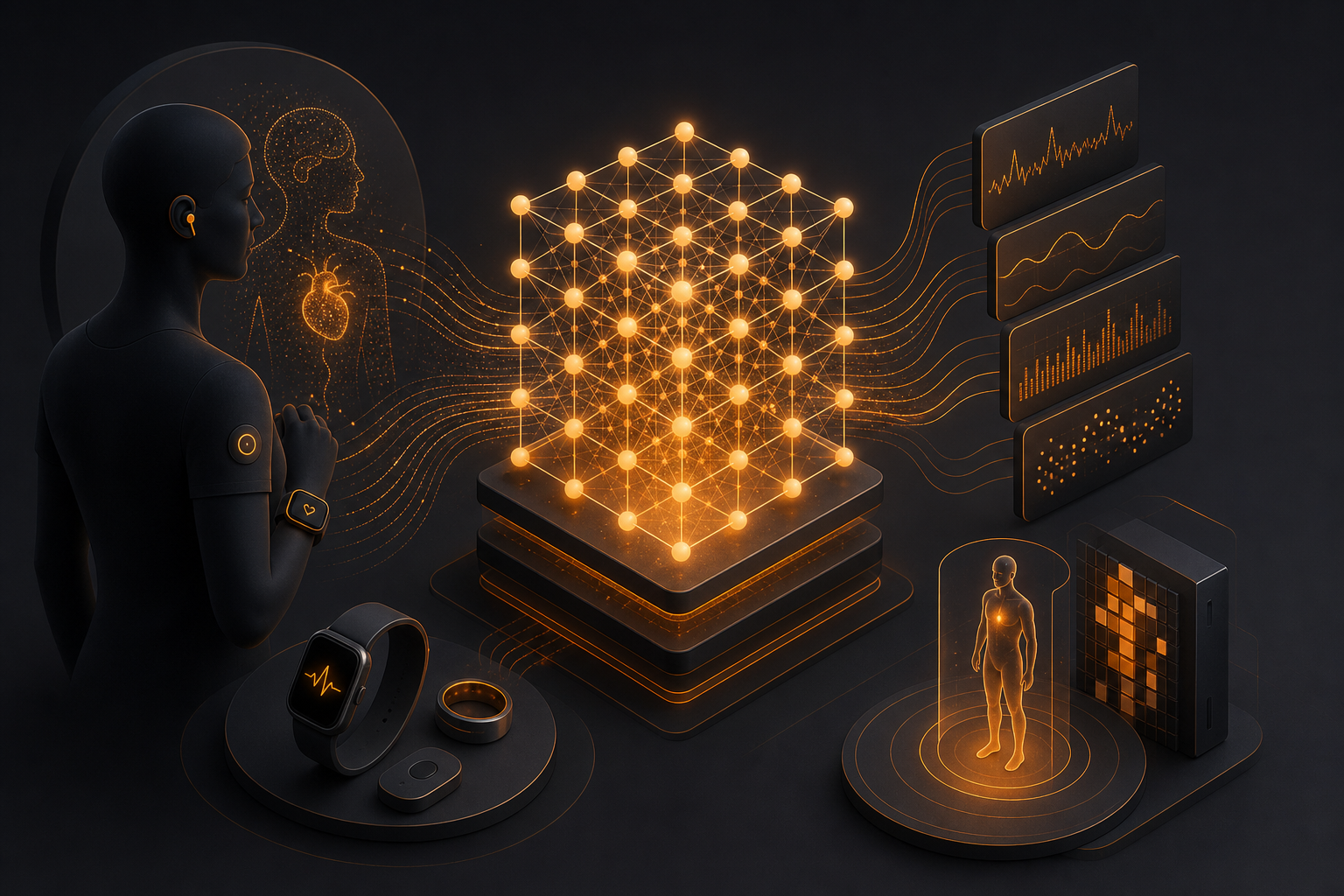
Google Research has unveiled a new foundation model specifically designed for analyzing wearable health data: SensorFM. The model was pre-trained on over one billion minutes of sensor data from five million people and is intended to serve as a universal interface for smartwatches and fitness trackers. This addresses a central challenge in mobile health monitoring – converting raw sensor signals into clinically actionable insights.
Quick Facts
- SensorFM trained on data from five million individuals across over 100 countries – collected between September 2024 and September 2025
- Processes 34 different sensor features from five modalities: heart rate, blood oxygen, sleep stages, movement, and skin temperature
- Transfers to 35 different health prediction tasks – without requiring task-specific labels for each application
- Uses self-supervised learning instead of traditional supervised approaches to handle fragmented wearable data
The Problem: Fragments Instead of Continuity
Billions of wearable devices collect daily data on heart rate, movement, skin temperature, and blood oxygen. Yet extracting medical insights from these raw signals remains difficult. The reason: human physiology varies enormously from person to person. A heart rate pattern signaling risk in one individual may be completely normal in another. Additionally, training labels – clinically confirmed diagnoses or validated measurements – are expensive, time-consuming, and often impossible to obtain retrospectively.
Previous wearable models were therefore typically developed in isolation for a single health outcome. SensorFM takes a different approach.
Self-Supervised Learning Without Labels
Rather than relying on manually annotated data, SensorFM uses self-supervised learning – the model reconstructs missing or fragmented sensor signals from available data. This is critical because wearables in practice constantly have data gaps: devices are removed, sensors lose contact, or users don't wear them continuously.
Google employed the LSM-2 approach with the Adaptive and Inherited Masking (AIM) framework for SensorFM. The model processes 34 aggregated one-minute features from five sensor types:
| Sensor Type | Captured Signals |
|---|---|
| Photoplethysmography (PPG) | Heart rate, heart rate variability |
| Accelerometry | Movement, steps |
| Electrodermal Activity (EDA) | Skin conductance |
| Thermometer | Skin temperature |
| Altimetry | Altitude changes |
The result: a single, reusable model that functions across 35 different health prediction tasks – from cardiovascular to metabolic, sleep, and mental health.
Scale as the Key
The data foundation is impressive: Google trained SensorFM on over two billion hours – more than one billion minutes – of sensor data. The data comes from consented participants across over 100 countries, all 50 U.S. states, and over 20 different Fitbit and Pixel Watch models. According to Google, this is the largest and most diverse wearable dataset ever used to train a model.
Researchers Xin Liu and Daniel McDuff from Google Research emphasize a principle now central to AI development: co-scaling model size and data volume leads to better generalization.
What This Means for European Companies
For medical device manufacturers, insurers, and health apps across Europe, SensorFM could be a game-changer. A universal model for wearable data significantly lowers the barrier to personalized health prognosis – previously, each new application required a separate development project. However, questions remain about how Google will make the model available and what data protection requirements will apply. For European companies, GDPR compliance and the forthcoming EU AI Act will likely be central considerations.
Sources
Editorially owned by Ideal Syka. Sources and method: Newsroom & method. Tips and corrections: ai@i6eal.de.