
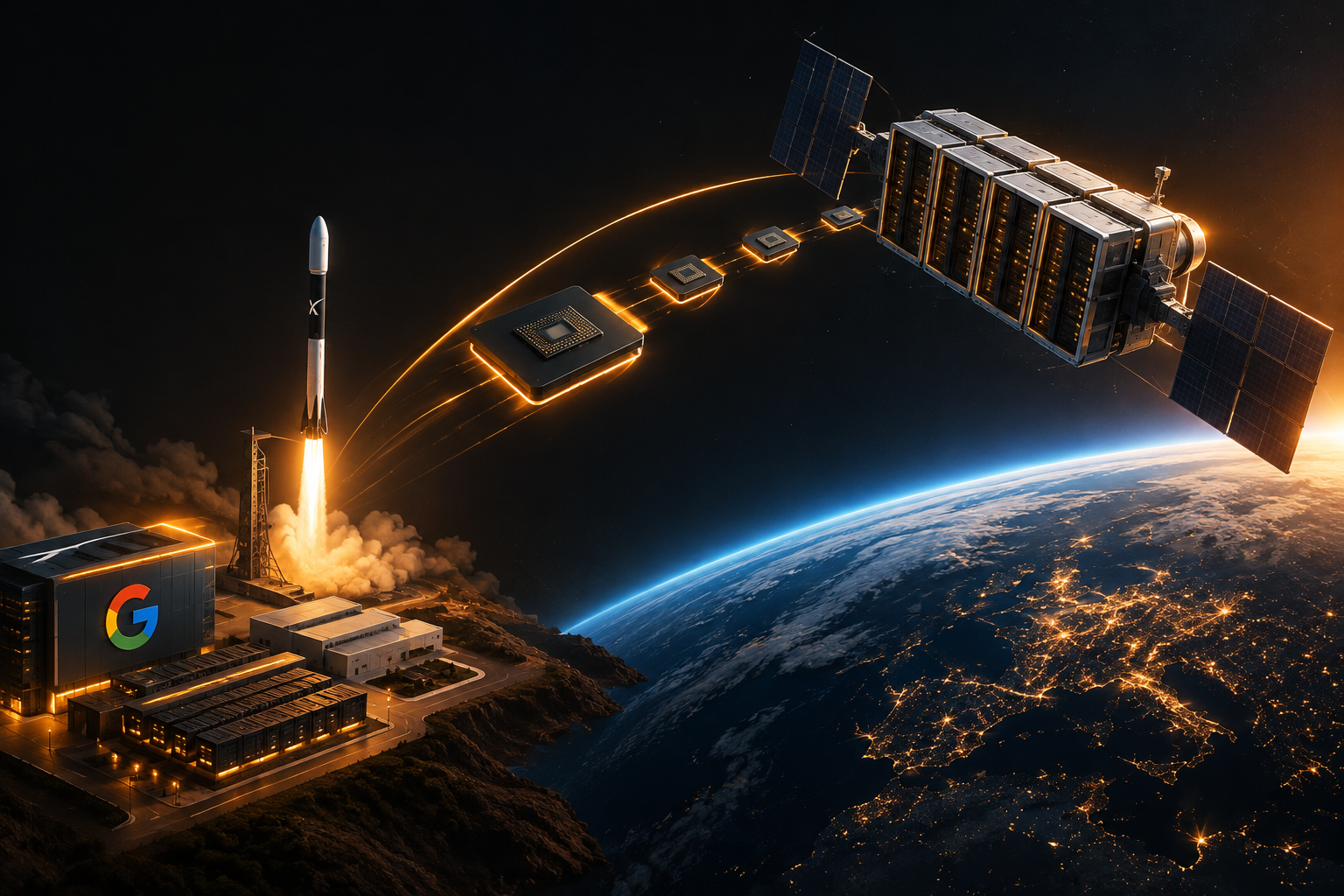
Google is now making it real: the company is sending four of its AI chips into orbit to test whether data centers in space are practically feasible. The satellite carrying the Tensor Processing Units (TPUs) is set to launch next week aboard a rocket from Elon Musk's space company SpaceX. This is not science fiction – it's a concrete test with a clear objective: the chips must prove their reliability over five years in orbit.
Key Facts
- Google is testing four AI chips (TPU models) in orbit – planned mission duration: five years
- Launch date: next week on a SpaceX rocket
- Main challenges: vibrations during launch, cosmic radiation, extreme temperatures
- Goal: validate space-based data centers as an alternative to Earth-bound AI infrastructure
The Technical Hurdles
Google has already prepared the chips on Earth. In the lab, they underwent vibration tests simulating the shocks and multiple G-forces during launch. Additionally, Google bombarded the TPUs with a proton beam to simulate the effects of cosmic radiation, which can damage electronics.
"But some things can only be tested in space," Google stated in its blog post.
That's the core problem: lab tests have limits. Only in actual space will the hardware prove itself – under real radiation, true vacuum, and genuine thermal cycles.
Musk's Vision Meets Reality
Elon Musk has been promoting orbital data centers for years. His argument: in space, solar power can be generated at massive scale – without the environmental burden and energy costs of Earth-based facilities. Meanwhile, political pressure is mounting in the US: the massive expansion of AI data centers faces growing resistance. Outsourcing to space could ease these conflicts.
Google is not the first to explore this direction – but Google is the first tech giant to test it concretely. That's the difference between speculation and engineering.
What This Means for German Companies
For German data center operators and AI infrastructure providers, this is a wake-up call. If space-based data centers become technically viable, the global value chain for AI hardware could shift fundamentally – away from high-energy-cost locations and space-constrained sites, toward orbital solutions. This opens opportunities for specialized hardware development and satellite technology, but also raises questions: who controls this infrastructure? What regulatory rules apply? German companies should watch this closely and consider where they can position themselves in this emerging value chain.
Sources
Editorially owned by Ideal Syka. Sources and method: Newsroom & method. Tips and corrections: ai@i6eal.de.