
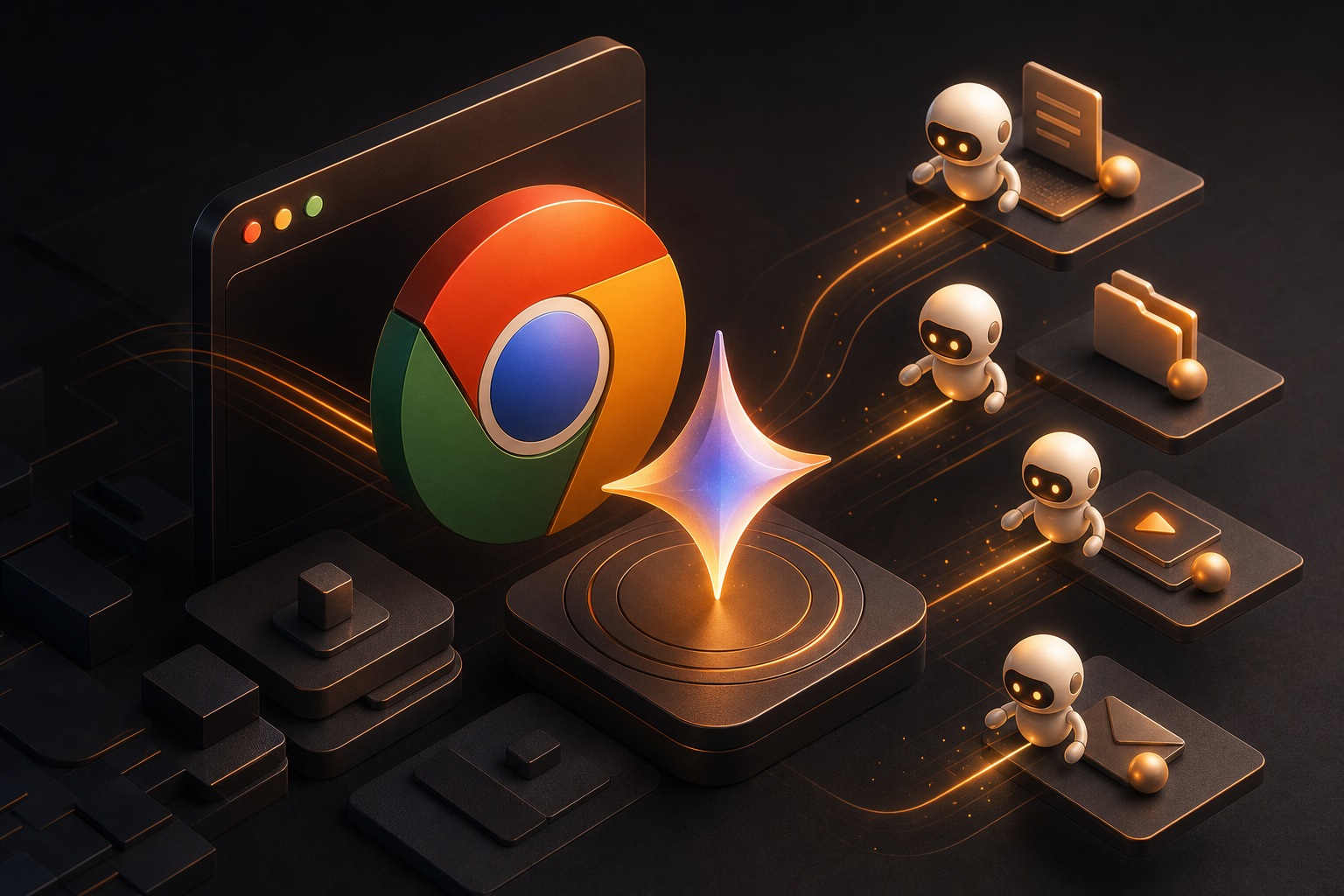
Google has reached a new level of browser automation: Gemini Spark, an agentic AI system, is now integrated into Chrome. In practical terms: you can assign the AI a task – such as planning a trip or updating an itinerary – and it works in the background while you concentrate on other things.
Quick Facts
- Gemini Spark runs on Gemini 3.6 Flash and automates complex web tasks directly in the browser
- Users must explicitly enable the feature and retain full control over permissions and sensitive actions
- Capabilities range from trip planning to real-time data collection to itinerary updates – all without manual intervention
- Rollout begins in the US, with expansion to additional regions planned
What Sets This Apart from Existing AI Tools?
Until now, AI assistants in the browser were largely reactive: you ask a question, the AI responds. Gemini Spark works differently. The system can independently search websites, gather data, and make changes – all in the background. This is a leap from chatbot to true agent.
The technology is built on Gemini 3.6 Flash, Google's fast language model. This allows the system to handle complex tasks smoothly without slowing down your browser.
Security Through User Control
Google has deliberately prioritized security here. The system protects against prompt injection attacks – attempts to manipulate the AI through hidden commands. More importantly: for sensitive actions like payments, the system requires explicit user confirmation. You retain control, even as the AI works in the background.
| Aspect | Details |
|---|---|
| Base Model | Gemini 3.6 Flash |
| Launch Region | USA |
| User Control | Explicit activation required |
| Sensitive Actions | User confirmation needed |
What This Means for Enterprises
This integration signals a fundamental shift: AI agents are moving from specialized tools into mainstream applications. For enterprises, this could have several implications. First, web applications must increasingly account for automated agents – raising new demands on API design and security. Second, user expectations may rise that services also offer such automations. Third: organizations that don't adapt risk their platforms being poorly or not at all compatible with agents.
The question remains how quickly and in what form Google will bring this feature to Europe – and how the EU AI Act will regulate such autonomous systems.
Sources
Editorially owned by Ideal Syka. Sources and method: Newsroom & method. Tips and corrections: ai@i6eal.de.