
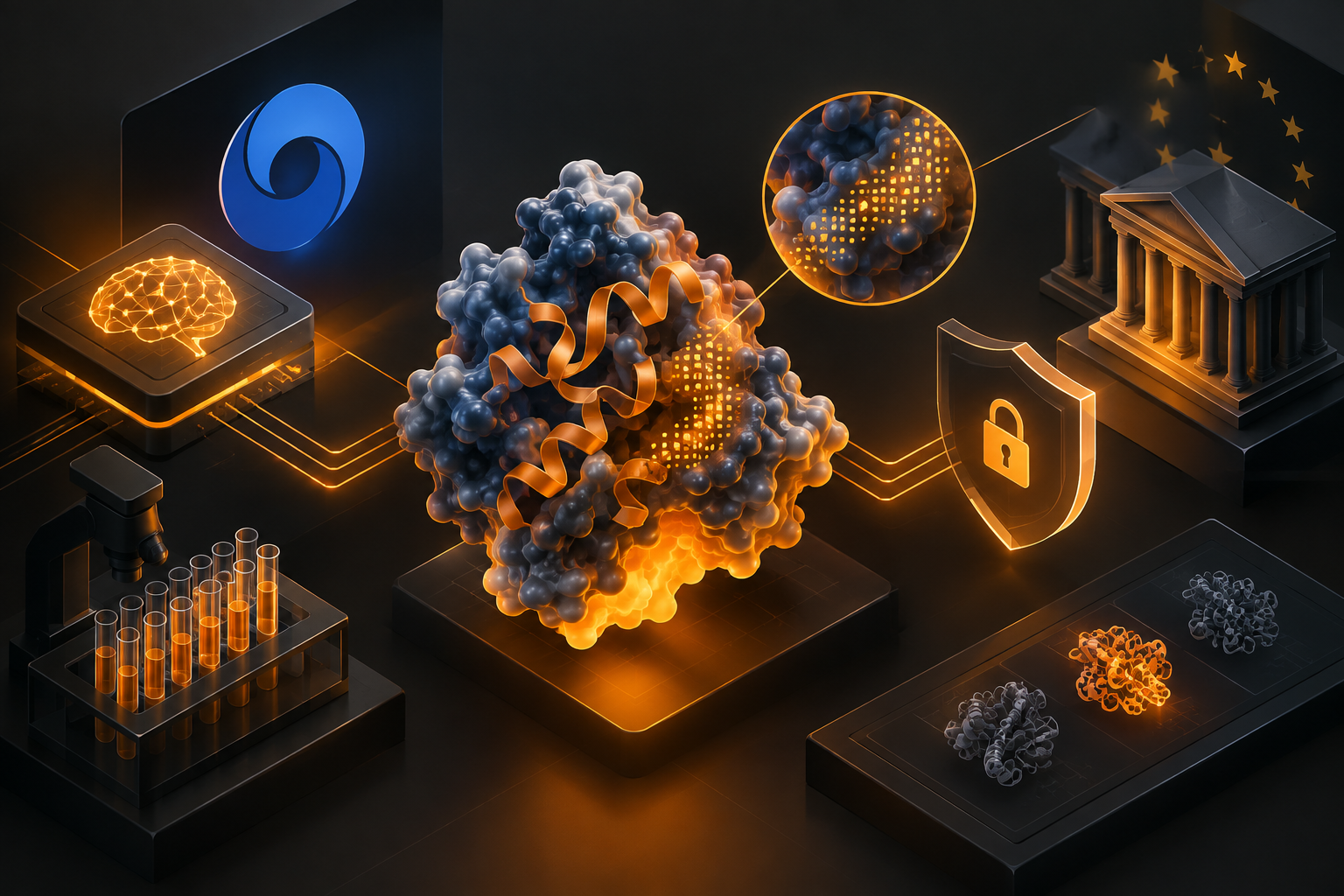
Google DeepMind has unveiled a working proof of concept for SynthID Bio – a method that embeds invisible digital signatures in AI-generated proteins while preserving their biological activity. This is a breakthrough for a problem that has remained unsolved until now: how to prove that a protein comes from an AI system without destroying it in the process?
The essentials
- SynthID Bio is a watermarking system for AI-generated proteins from Google DeepMind
- The proof of concept demonstrates that digital signatures can be embedded in biological molecules without compromising function
- The system is based on AlphaProteo, which was announced by Google DeepMind in September 2024
- Potential use cases: biosecurity, authentication, and regulatory control of biotech products
Why this problem was so tricky
Until now, there was no reliable method to mark AI-generated proteins. Classical digital watermarks – as they work for images or videos – cannot be simply transferred to biological molecules. Any marking risks altering the three-dimensional structure of the protein and thus destroying its biological function. This was a real dilemma for regulators and security experts: how do you control what emerges from laboratories if you cannot mark it?
SynthID Bio solves this conflict by embedding watermarks into the protein sequence in such a way that biological activity is preserved. This is not trivial – it requires deep understanding of protein structure and the rules by which biological systems function.
Application: From research to regulation
The system could serve multiple purposes:
| Use case | Benefit |
|---|---|
| Biosecurity | Tracking of AI-generated pathogens or dangerous sequences |
| Authentication | Proof that a protein actually comes from a specific AI system |
| Regulation | Authorities can control which AI systems are used in the biotech industry |
| Research integrity | Transparency about protein origins in scientific publications |
This is particularly relevant because AI systems like AlphaProteo can design entirely new proteins – molecules that have never existed in nature. Without marking, it would be impossible to say whether a protein arose naturally or was created by AI.
Next steps: From concept to practice
The current status is a proof of concept – meaning the method works in the laboratory under controlled conditions. Whether it gains traction in industry depends on several factors: how robust is the watermarking against manipulation? Can it be applied to all types of proteins? And will regulators demand it as a standard?
Google DeepMind announced the research in September 2024 – a signal that the company considers the results robust enough to present to the scientific community.
What this means for German biotech
For German companies in biotechnology, SynthID Bio could become a compliance standard – similar to encryption in IT security. Companies developing AI-generated proteins may need to mark them to obtain regulatory approvals. On one hand, this is an additional requirement; on the other, it is also a competitive advantage: companies that invest early in such systems position themselves as responsible actors – important for trust with investors, authorities, and customers. At the same time, many questions remain open: who sets standards? How will this be coordinated internationally? The answers will be crucial in the coming months.
Sources
Editorially owned by Ideal Syka. Sources and method: Newsroom & method. Tips and corrections: ai@i6eal.de.