
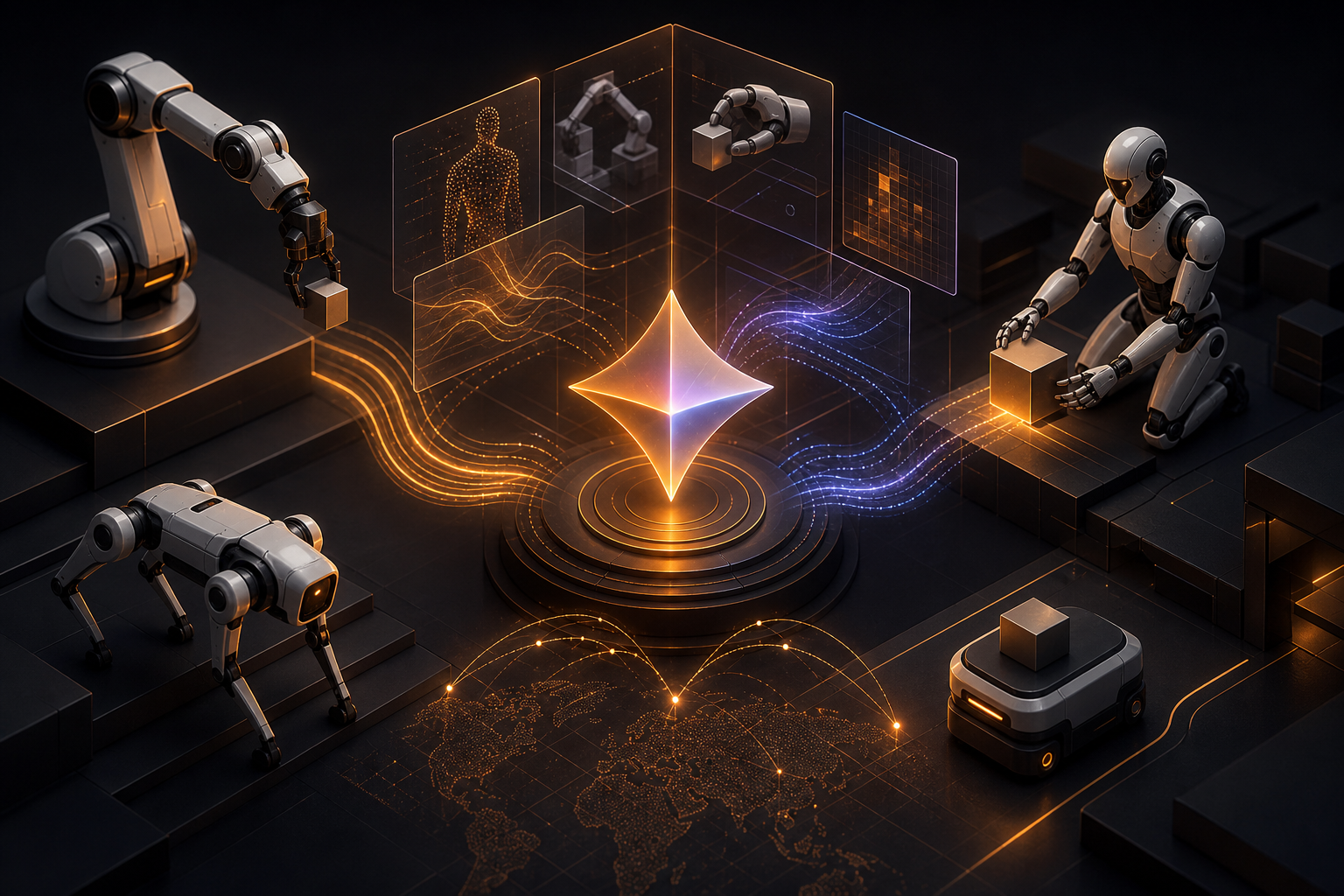
Google DeepMind unveiled Gemini Robotics ER 2 on July 30, 2026 – a new AI model designed to act as a "high-level brain" for robots. The system enables robots to reason spatially, plan multi-step tasks, and work in real time with continuous video feeds. This marks a significant breakthrough in embodied AI – the ability of AI systems to act in the physical world.
Key Facts
- Gemini Robotics ER 2 is a new embodied-reasoning model for robotics applications
- The model enables real-time spatial reasoning, multi-step task planning, and multi-robot collaboration
- Robots can process continuous video feeds to track progress and self-correct errors
- Available via the Gemini API, Google AI Studio, and in private preview on the Gemini Enterprise Agent Platform
How the Model Works
Gemini Robotics ER 2 differs from earlier systems through its ability to "think" while executing. The model orchestrates steps for the robot while it simultaneously performs actions. Developers can declare low-level control interfaces – such as Vision-Language-Action (VLA) models or navigation APIs – as tools and stream multimodal data (video, audio, text) directly into the model.
The system observes continuous video feeds, enabling robots to track their own progress, adapt when something goes wrong, and know precisely when to move to the next step. A key advantage: the model can also call native tools – such as Google Search or custom functions – to retrieve information.
Significant Upgrade Over Previous Version
Gemini Robotics ER 2 represents a significant upgrade over Gemini Robotics ER 1.6. The new version substantially improves tool orchestration and makes robots safer and more reliable in real-world environments. A central new feature is multi-robot collaboration: robots can now work together in shared spaces and complete complex workflows that a single robot could not handle alone.
Implications for Enterprise
For German manufacturing and automation companies, Gemini Robotics ER 2 could become relevant as it moves into production scenarios. The ability to coordinate multiple robots and self-correct in real time addresses key challenges in factory automation: complex, multi-step processes that previously required rigid programming could become more flexible and adaptive. However, questions remain about robustness in harsh industrial environments, latency in critical applications, and integration with existing robotics infrastructure.
Sources
Editorially owned by Ideal Syka. Sources and method: Newsroom & method. Tips and corrections: ai@i6eal.de.