
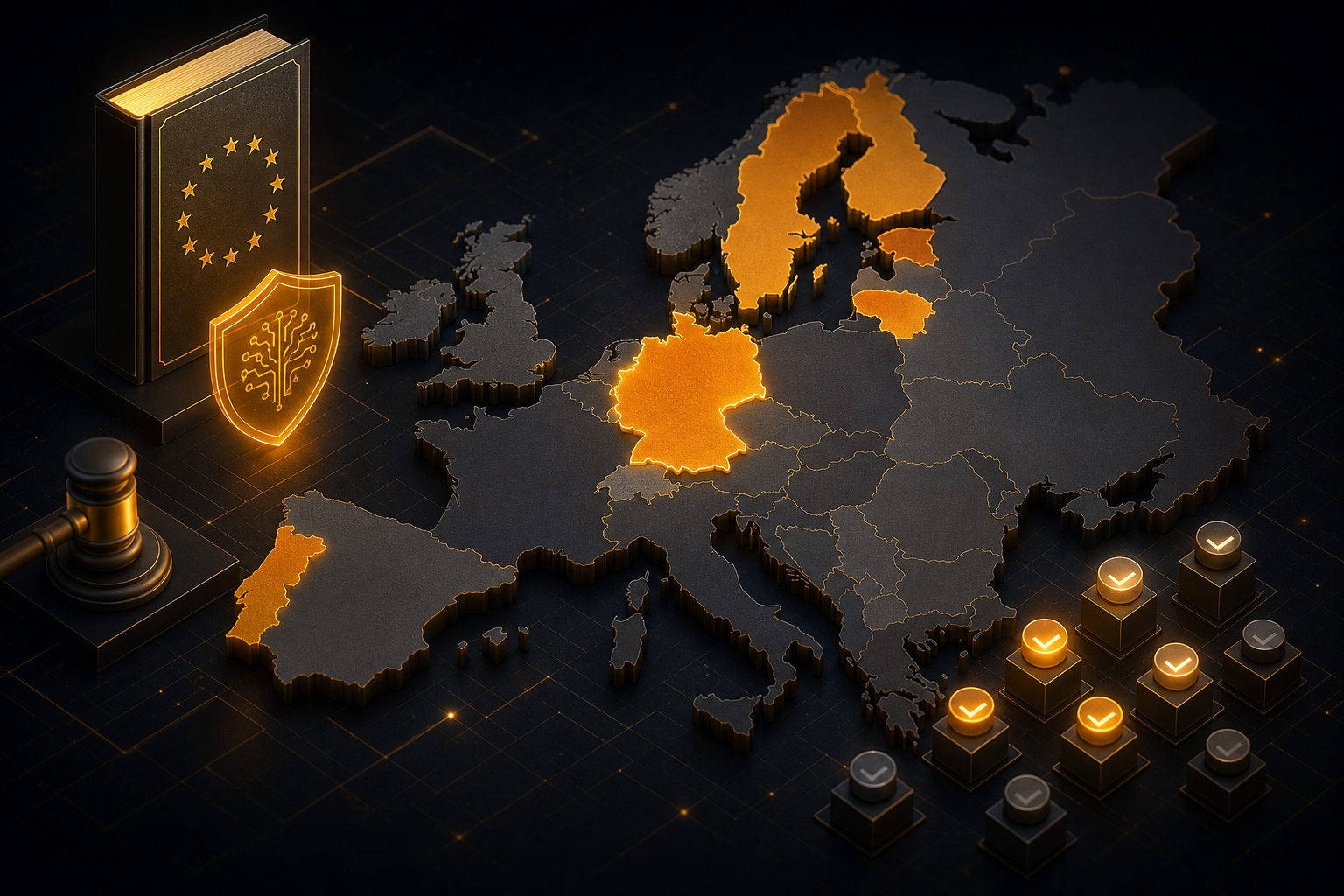
More than a year after the original deadline, a critical enforcement gap has emerged in the EU AI Act rollout: According to the European Commission, only 8 of 27 member states have built adequate capacity to enforce the new rules. While core prohibitions have been in effect since February 2025 and transparency requirements have been fully applicable since August 2026, large parts of the EU lack the personnel and structural resources to monitor compliance—a vacuum affecting both businesses and authorities.
Key Facts
- Only 8 of 27 EU countries have sufficient capacity to enforce the EU AI Act
- Germany: Currently only 20 of 43 planned supervisory positions are filled
- Penalties: Violations of prohibitions carry fines up to €35 million or 7% of global annual revenue
- Lithuania plans just 2 full-time positions for AI oversight; Romania lacks a legal enforcement framework
Staffing Shortfalls in Germany and Across Europe
Implementation is proceeding unevenly across member states. While Romania has submitted a plan, it still lacks the legal foundation for enforcement. Lithuania is planning only two full-time positions for its entire AI supervision—a pittance given the regulatory complexity.
Germany faces a particularly stark gap: of the 43 planned positions for national supervision, only 20 are currently filled. This delay is serious because the regulation is already in force. The prohibitions specified in Article 5 have been binding since February 2, 2025. Since August 2, 2026, the general transparency requirements under Article 50 have been fully applicable.
Penalties Are Real—Companies Are Acting
Violations carry substantial fines:
| Violation Type | Maximum Fine | Alternative |
|---|---|---|
| Prohibitions (Art. 5) | €35 million | 7% global annual revenue |
| Other violations | €15 million | 3% annual revenue |
Despite sluggish government implementation, leading AI developers are beginning to deploy technical solutions. Anthropic has introduced invisible watermarks and C2PA metadata for its Claude model—covering all of the company's interfaces and cloud platforms. The company emphasizes, however, that these markers do not constitute definitive proof of AI creation but serve as transparency tools.
Governance Gap in the Private Sector Too
Problems are not limited to public authorities. According to research by Axipro, there is currently only one AI governance position for every seven AI development roles. Critically, fewer than 30 percent of governance positions explicitly address EU AI Act requirements. Large enterprises with more than 5,000 employees concentrate half of available compliance talent in this area—a sign of resource concentration and fragmented capacity.
What This Means for You
The implementation gap presents a double-edged sword for German companies: on one hand, sluggish enforcement suggests that supervisory bodies cannot conduct comprehensive audits in the short term. On the other hand, the fact that companies like Anthropic are already complying signals that the regulation is real—and penalties will follow once capacity is built. If you don't yet know which prohibitions and transparency obligations apply to you, you risk facing steep fines later. The EU AI Act roadmap clarifies which deadlines are already in effect.
Sources
Editorially owned by Ideal Syka. Sources and method: Newsroom & method. Tips and corrections: ai@i6eal.de.