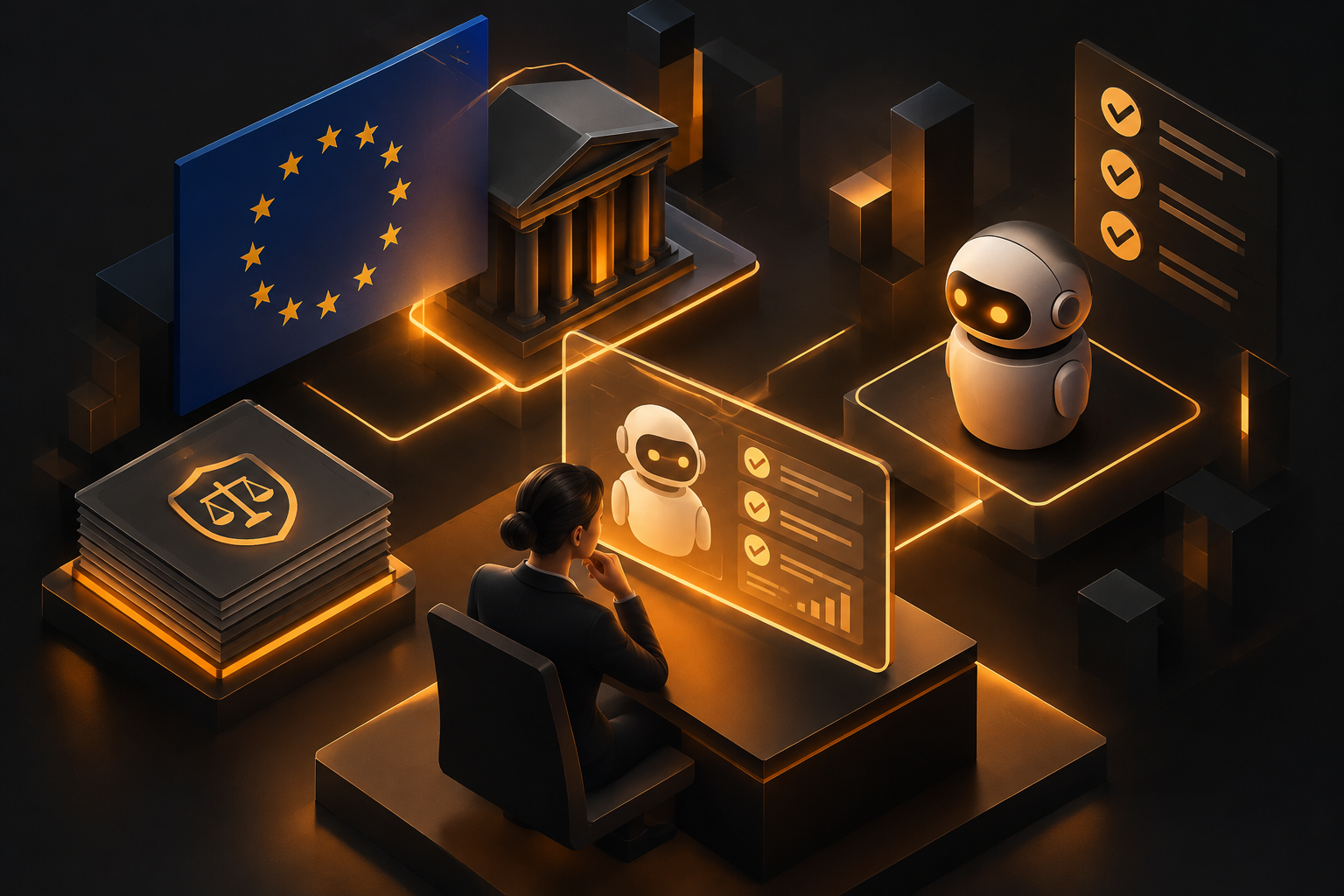
The EU AI Act is getting serious: For high-risk AI systems, it explicitly requires effective human oversight. That sounds abstract – but becomes concrete when you need to understand how AI agents can legally operate in German and Austrian companies going forward.
The essentials
- The EU AI Act demands explicit human oversight for high-risk systems
- Language model-based AI agents combine a chat-like model with tools (file access, web search, data entry)
- This architecture requires new control mechanisms to meet regulatory requirements
- The requirement applies across Germany and Austria – legal clarity is growing
What exactly is an AI agent?
An AI agent is not simply a chatbot. A language model runs in the background, similar to ChatGPT – but the agent also gets additional tools: it can read files, search the internet, enter data into systems, or send emails. This autonomy with tools is what's new – and it's precisely what makes it a high-risk system under EU regulation.
The regulation draws a clear distinction: a pure chat service is less critical than an agent that independently steers business processes.
Human oversight: Not optional
The phrase "effective human oversight" is not a recommendation – it's a requirement. In practice, this means:
- Humans must be able to monitor the agent (monitoring)
- They must be able to intervene before or during agent actions (intervention)
- Audit trails are needed to track what the agent did
- Control cannot just be theoretically possible – it must be practically feasible
For companies, this means: you can't simply press "Start" on an AI agent and hope for the best. You need processes, personnel, and systems that actively monitor the agent.
What this means for German firms
The EU AI Act applies to high-risk systems – and agents fall into this category when operating in sensitive areas (HR, credit decisions, healthcare, security). German and Austrian companies must act now:
- Build audit processes to monitor agents
- Designate responsible parties who can intervene
- Maintain documentation of agent decisions
- Conduct risk assessments – is the agent truly high-risk?
Ignoring this risks fines and reputational damage. Getting it right builds trust with customers and regulators.
The open question remains: how much oversight is "effective"? The EU will clarify further – but one thing is already clear: high-risk agents without human control are no longer permitted.
Sources
Editorially owned by Ideal Syka. Sources and method: Newsroom & method. Tips and corrections: ai@i6eal.de.