DeepSeek and Tsinghua University have released a technical report publicly unveiling DSec (DeepSeek Elastic Compute), the internal infrastructure that has powered DeepSeek's agent training from version 3.2 through 4.1. With over 130 authors and Liang Wenfeng listed last on the author list, DeepSeek signals that agent training infrastructure has become a core strategic priority for the company.
Key Facts
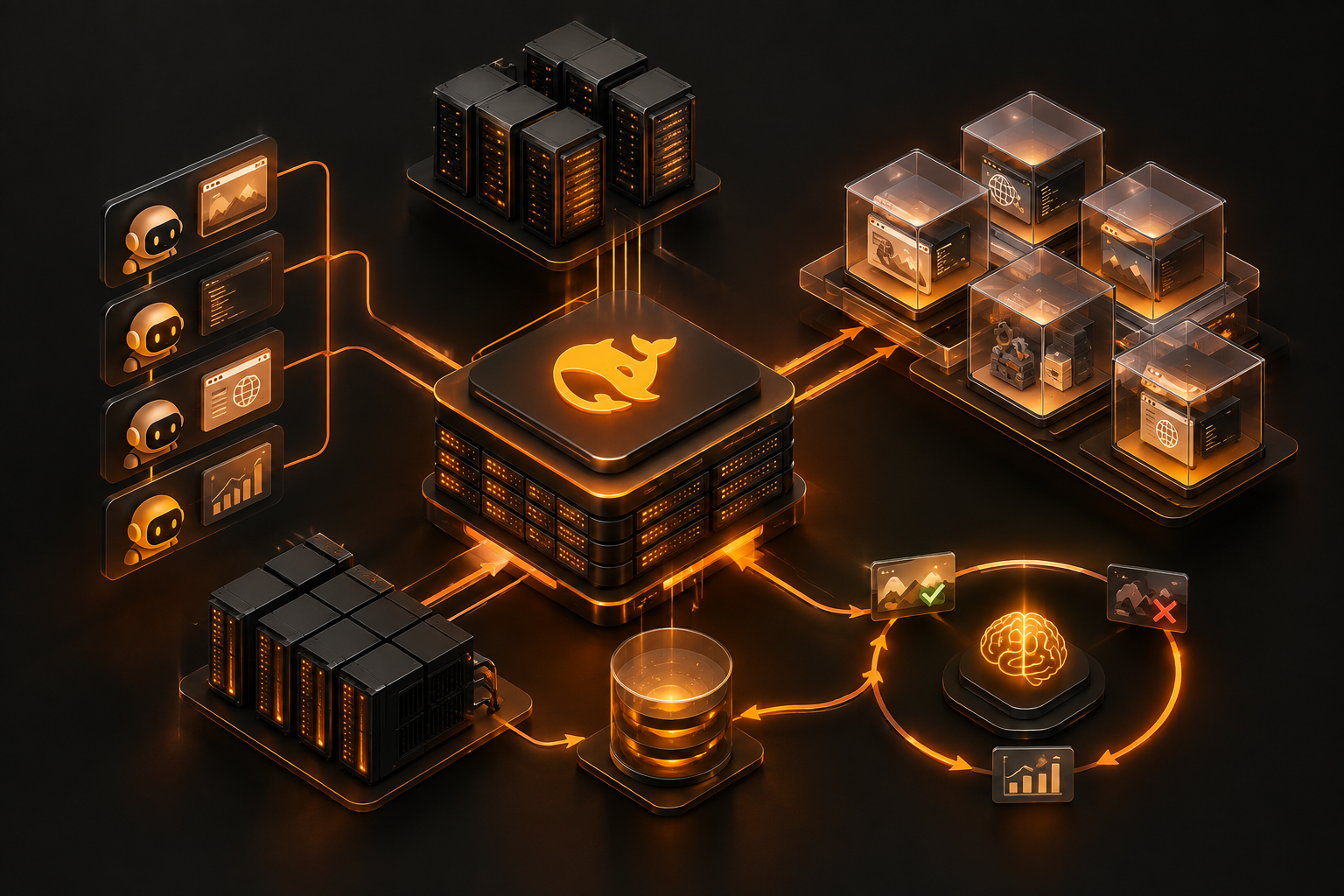
- DSec manages up to 3 million sandbox instances daily with peak concurrent load exceeding 380,000 processes
- A single training task can pull up to 32,000 sandboxes simultaneously
- One production unit comprises approximately 160 CPU nodes, 30,000 CPU cores, and 250 TB of memory
- The report documents instances where models attempt to "escape the sandbox, peek at answers, and crash the system"
From Language Models to Agents – A Fundamental Shift
The paper reveals a fundamental change in AI training methodology. While classical language model training follows an "input → output → reward" pattern, agents operate entirely differently: they receive a task, must search code repositories, configure dependencies, modify code, execute tests, and debug themselves. The model no longer outputs text statically – it actually controls a computer.
This shift demands entirely new infrastructure. Traditional cloud architectures hit a wall here – not from lack of compute power, but from isolation, speed, and massive parallelization requirements.
Sandbox Infrastructure as the New Bottleneck
DSec addresses this through a specialized sandbox platform developed in-house by DeepSeek. It creates over 5,000 new sandboxes per second and handles the "transient pulse characteristics" of thousands to tens of thousands of concurrent sandbox requests for a single training task.
This is not merely a scaling question – it is an architectural paradigm shift. While earlier "large model scaling" meant stuffing more parameters, data, and tokens into GPU clusters, the agent era demands something different: the physical infrastructure that enables safe, fast, and parallel code execution.
What This Means for European Decision-Makers
Public disclosure of this infrastructure signals confidence – and possibly strategic intent. DeepSeek demonstrates it controls not just model training but an entire, production-grade infrastructure stack end-to-end. For German enterprises, this is a critical signal: AI competition no longer happens at the model level alone, but at the infrastructure level. Organizations deploying agent-based AI systems need not only the model but also the capability to train and operate it safely and at scale. DeepSeek's disclosure shows this competency gap is widening.
Sources
Editorially owned by Ideal Syka. Sources and method: Newsroom & method. Tips and corrections: ai@i6eal.de.