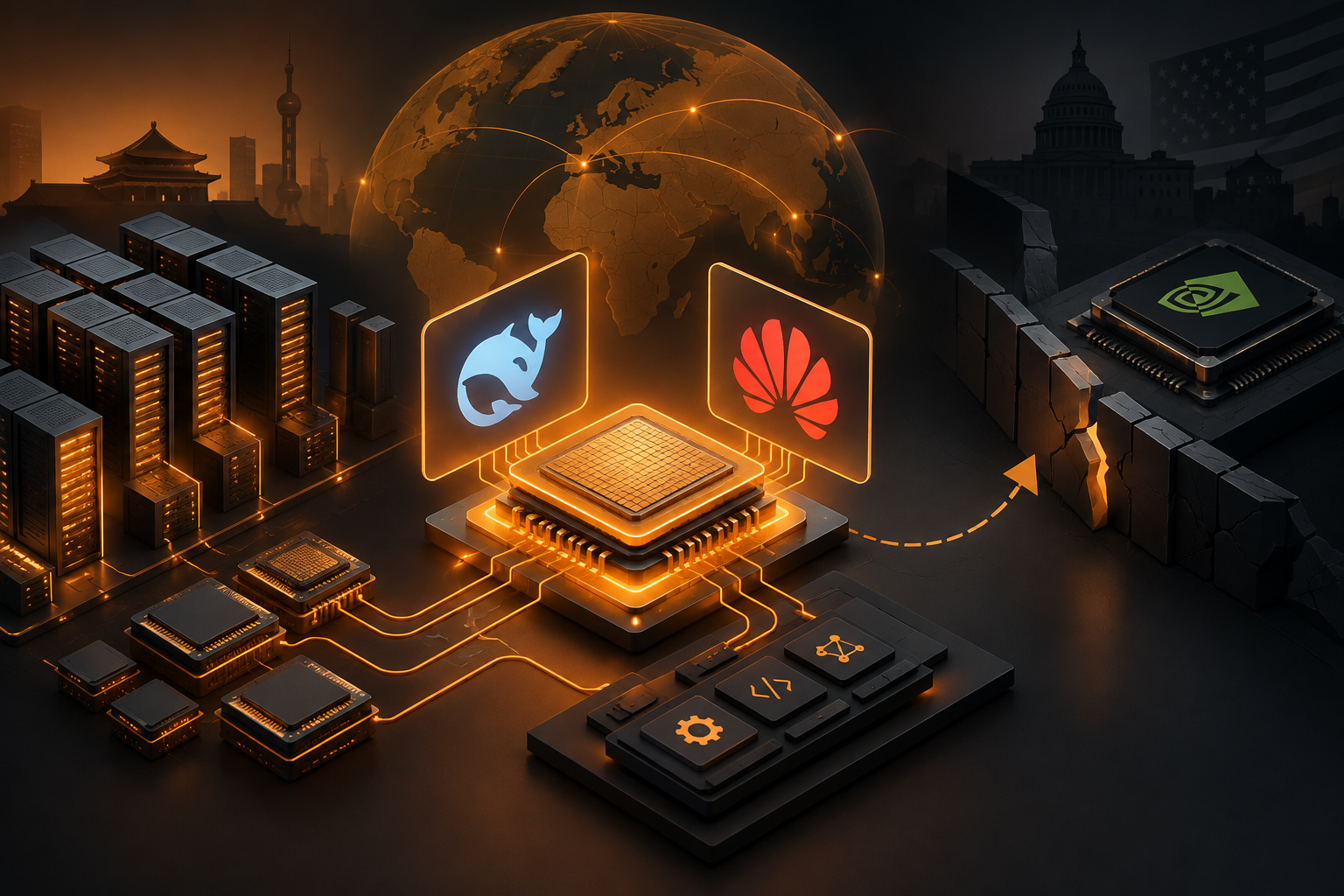
DeepSeek and Huawei have announced a strategic partnership to jointly develop chip programming tools. With this move, the two Chinese companies aim to reduce their dependency on Nvidia – a step that reflects the geopolitical shifts in global AI infrastructure.
Key facts
- DeepSeek and Huawei are collaborating on chip programming tool development
- The goal is to reduce Nvidia dependency in AI infrastructure
- The partnership addresses geopolitical tensions
- Both companies are building independent technology ecosystems
Strategic partnership
The collaboration between DeepSeek and Huawei aims to develop proprietary programming tools. With these, the companies seek to strengthen their autonomy – while also making Huawei's own chip development more usable.
Competition for AI infrastructure
The initiative demonstrates how intense the global competition for AI infrastructure has become. It's not just the chips themselves that are contested, but also the software layers surrounding them – the programming tools that developers use to train and optimize AI models. Whoever controls these tools has influence over the entire value chain.
DeepSeek has positioned itself as an aggressive competitor in recent months. A partnership with Huawei – one of the few Chinese conglomerates with its own chip manufacturing – significantly strengthens this position.
What this means for German companies
For German AI companies and chip developers, this news is a wake-up call: global chip supply is becoming increasingly fragmented. While China works toward independence, European actors should in parallel strengthen their own alternatives – whether through open-source models, European chip initiatives, or diversified supply chains. Dependence on a single source (Nvidia) or region becomes a strategic risk. At the same time, opportunities emerge for European specialists working on AI infrastructure, chip design, or programming tools.
Sources
Editorially owned by Ideal Syka. Sources and method: Newsroom & method. Tips and corrections: ai@i6eal.de.