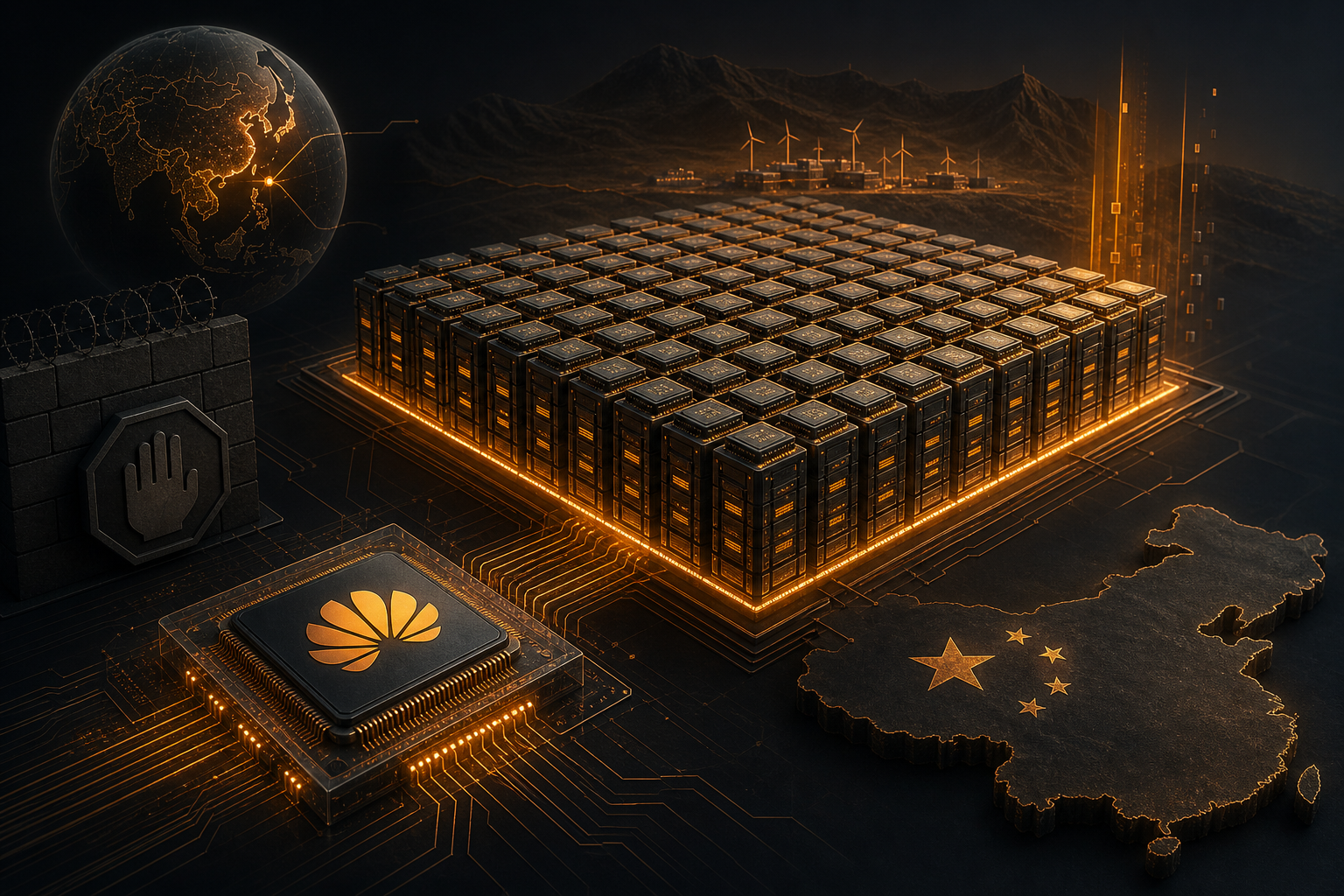
DeepSeek plans to procure at least 160,000 Huawei AI accelerators for a new data center in Inner Mongolia, according to Bloomberg and other media reports. This would be the largest known Huawei chip cluster of its kind – a sign of massive capacity expansion by the Chinese AI startup and its reliance on Chinese semiconductors amid Western export restrictions.
Key Facts
- DeepSeek orders at least 160,000 Huawei AI accelerators for new data center
- Location: Inner Mongolia (China)
- This is the largest known Huawei chip cluster of its kind
- The project underscores China's strategy to become independent from US chip sanctions
Massive Inference Capacity, Not Training
The 160,000 Huawei chips are primarily designed for inference – running already-trained AI models – rather than the resource-intensive training of new models. This distinction matters: while DeepSeek still relies on more powerful chips for training, this cluster enables the company to process massive volumes of user requests in parallel. For an AI services company, this is crucial for achieving scalability.
Strategy Beyond US Sanctions
The Huawei Ascend series is one of the few Chinese alternatives to Nvidia GPUs not subject to US export controls. Since 2023, the US has tightened restrictions on advanced semiconductors to slow China's AI capabilities. DeepSeek's major Huawei order demonstrates how Chinese tech companies respond to these sanctions: through massive investments in domestic hardware.
The Inner Mongolia data center also aligns with China's strategy to build AI infrastructure in a decentralized manner. The region is known for cheap energy and cooling capacity – critical factors for data centers with extreme power consumption.
What This Means for German Companies
For German AI providers and infrastructure firms, this development has several implications: First, it shows that the Chinese market is increasingly decoupling technologically – competing there requires reckoning with Chinese chips. Second, global competition for inference capacity intensifies; European cloud providers must keep pace to avoid falling behind. Third, it underscores that geopolitical chip dependency remains a persistent issue – including for European companies that should reconsider their own supply chains.
Sources
Editorially owned by Ideal Syka. Sources and method: Newsroom & method. Tips and corrections: ai@i6eal.de.