
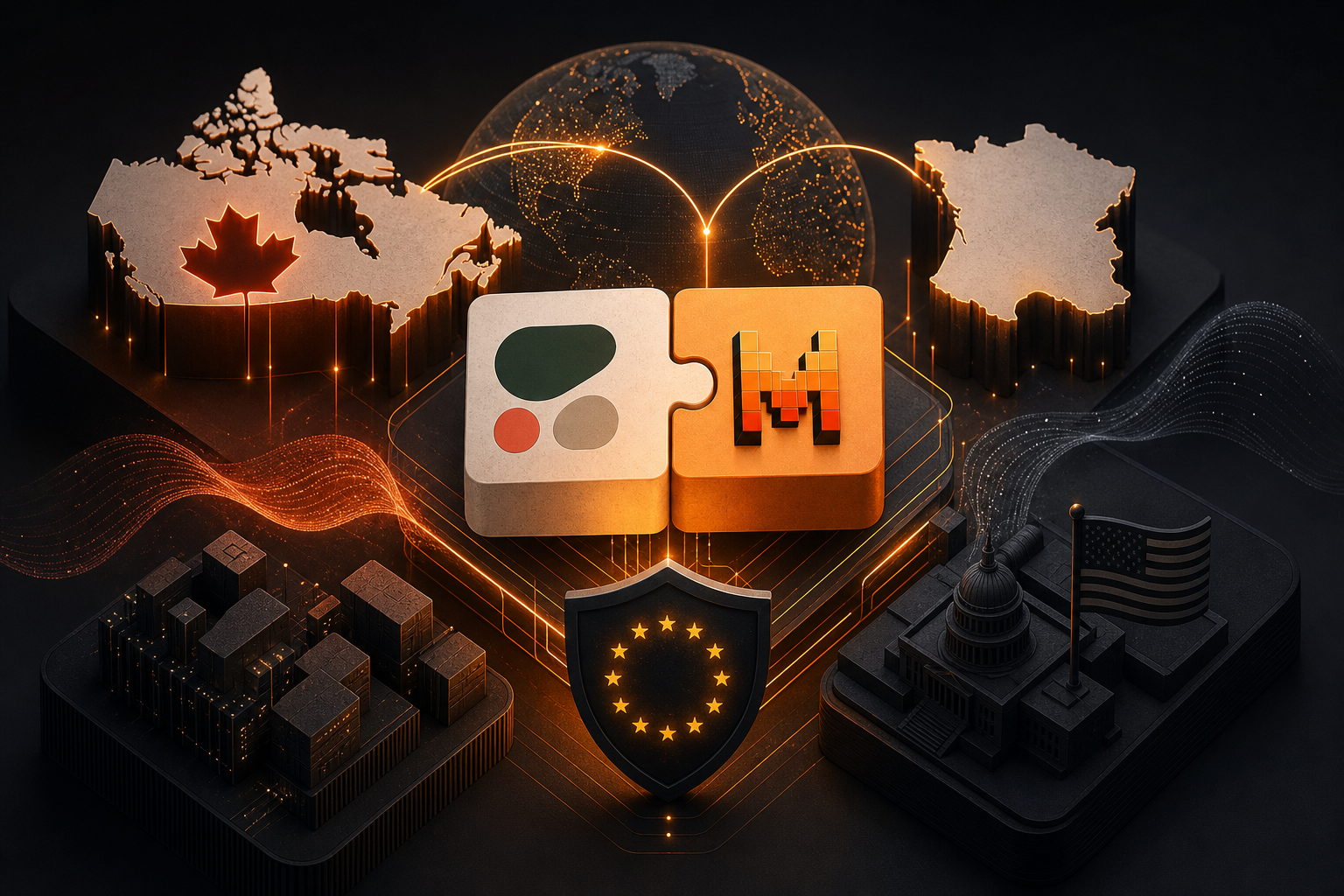
Aidan Gomez, CEO of Cohere, has indicated in an interview with The Times that his company is open to collaboration with Mistral. This brings the idea of a European-Canadian AI alliance closer to reality, one designed to counter the dominance of US giants like OpenAI and Google.
The essentials
- Cohere (Canada) and Mistral (France) are exploring a potential strategic partnership
- Both companies prioritize technological sovereignty as central to their business strategy
- Goal: reduce dependence on US-based AI providers
- Gomez does not rule out collaboration, but no formal agreement has been reached yet
Why this matters now
Conversations between Cohere and Mistral signal a growing movement to establish AI development outside the Silicon Valley ecosystem. France has already built one of Europe's strongest LLM providers in Mistral; Canada positions Cohere as an alternative to US monopolies. Both countries see coordination as an opportunity to set their own standards and maintain digital independence.
The timing is deliberate: the EU is tightening AI regulation through the AI Act, while geopolitical pressure to break free from American tech platforms intensifies.
What an alliance could mean
A formal partnership would span multiple dimensions:
| Area | Potential |
|---|---|
| Model Development | Joint research on European-Canadian LLMs |
| Infrastructure | Independent compute and cloud capacity outside the US |
| Regulation | Harmonized compliance with EU AI Act and Canadian standards |
| Market Position | Stronger negotiating power against US oligopoly |
Gomez's statements remain cautious: he does not rule out cooperation but confirms no completed negotiations. This is typical of early-stage tech sector soundings – public signals without commitment.
Context: European sovereignty as strategy
Mistral has positioned itself as a European alternative to OpenAI since its 2023 founding. The French company has attracted millions in investment and works closely with the French government. Cohere, rooted in Canada, benefits from proximity to European markets and regulatory ambitions.
Both companies share the conviction that open, decentralized AI development can counter concentration among US players. This is not merely a business model but a geopolitical stance.
What this means for German enterprises
For German AI users and developers, a Cohere-Mistral alliance could be significant: it would strengthen European alternatives to OpenAI and Google without reliance on US infrastructure. This reduces dependency risks and creates space for European data sovereignty. However, it remains unclear whether a purely Canadian-French axis is sufficient to achieve real competitiveness – or whether Germany and other EU countries must develop their own AI champions to achieve true independence.
Sources
Editorially owned by Ideal Syka. Sources and method: Newsroom & method. Tips and corrections: ai@i6eal.de.