
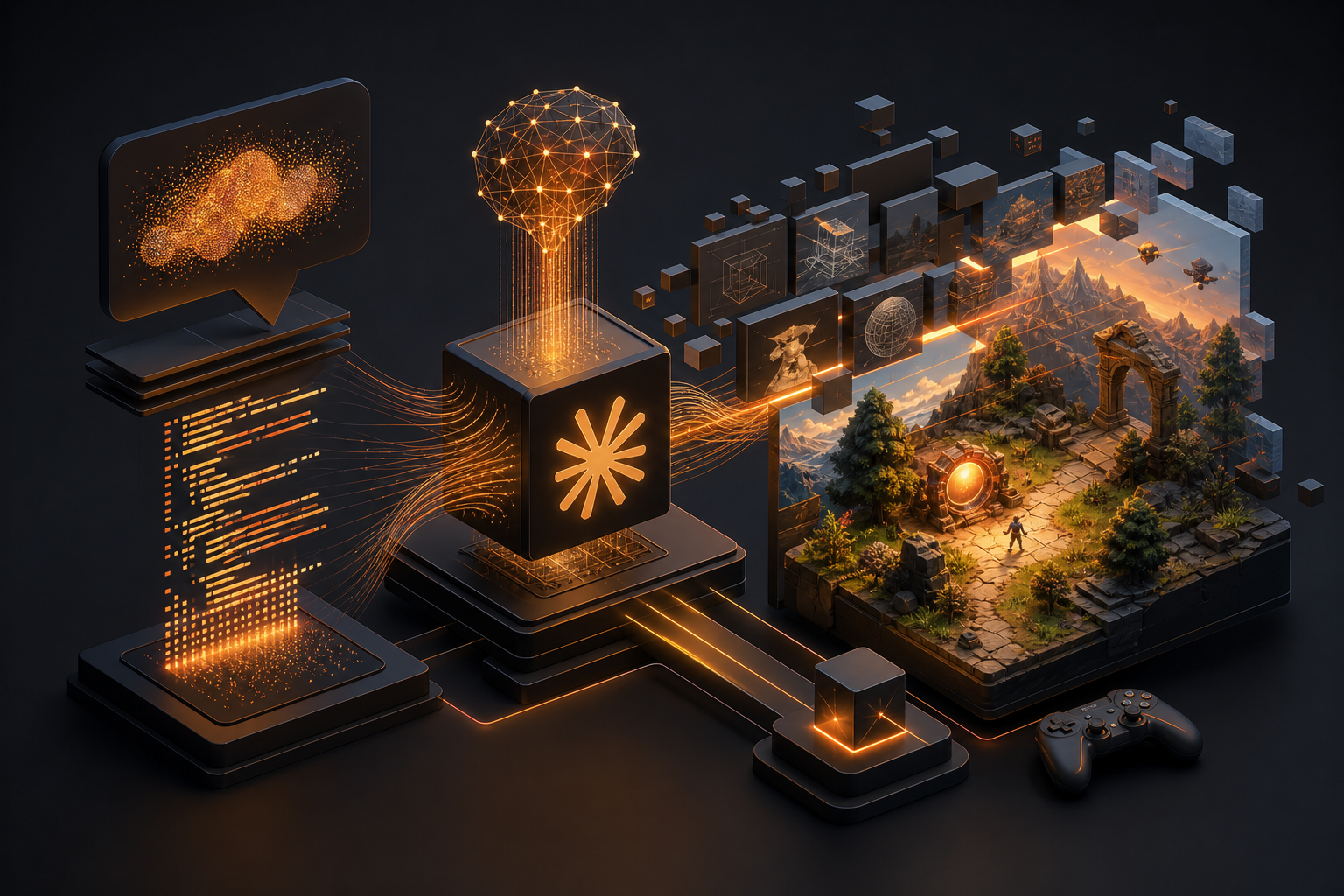
Anthropic's Claude Opus 5 has achieved a qualitative leap in code generation: the model creates complete, playable 3D games directly in the browser from simple text prompts—without a single external image or audio file. Geometry, textures, physics simulation, and sometimes even music emerge as pure code and render live in the HTML engine.
Key Facts
- Multiple working game demos generated in days: first-person shooter ("Claude-of-Duty"), submarine game, kart racer, snowboarding demo, ballista, and landscape with grass blades—all procedurally generated
- No external assets required; the model writes geometry, textures, and physics itself as code
- Significantly better quality than Claude 4 Opus (prior year) and competing models like GPT-5.6 Sol and Kimi K3 in informal community tests
- Demos are playable as editable HTML files—users can modify code directly
From Rough Color Blocks to Detailed Scenes
Progress is visible to the naked eye. User Chris compared Claude 4 Opus outputs from the prior year with current Opus 5 results: when rendering a car on a dirt road, the old version showed crude color blocks; Opus 5 produces mud tracks, vegetation, and differentiated lighting—all without explicit texture instructions.
Alex Ermolov tested a snowboarding demo and confirmed Opus 5 matches or exceeds all other tested models. Particularly noteworthy: no visual errors on the first run, and the sliding physics felt correct.
Mechanics Over Prototype
The clearest example of the quality jump is chetaslua's ballista demo: a Roman siege machine before a castle, fully controllable via interface, looks more like a finished game than a prototype. When chetaslua ran the same task on GPT-5.6 Sol and Kimi K3 earlier, both delivered a recognizable ballista but with significantly fewer mechanics and thinner environments.
Other demos showcase the range: Lentils created a landscape with millions of grass blades reacting to simulated wind currents, all in a single HTML file. Pietro Schirano built a submarine game with fully model-generated 3D objects, textures, and music. Ryan Campbell published his kart racer directly as a playable website.
What This Means in Practice
For German companies in game development, web design, and prototyping, this could have significant implications. The ability to instantly generate playable, physically plausible 3D scenes from text prompts drastically shortens iteration cycles—especially for concept work and rapid prototyping. However, key questions remain: How does this scale to complex games? How reliable is quality consistency on edge cases? What role do licensing questions play for procedurally generated assets? The coming weeks will reveal whether this stays marketing hype or becomes a genuine production tool.
Sources
Editorially owned by Ideal Syka. Sources and method: Newsroom & method. Tips and corrections: ai@i6eal.de.