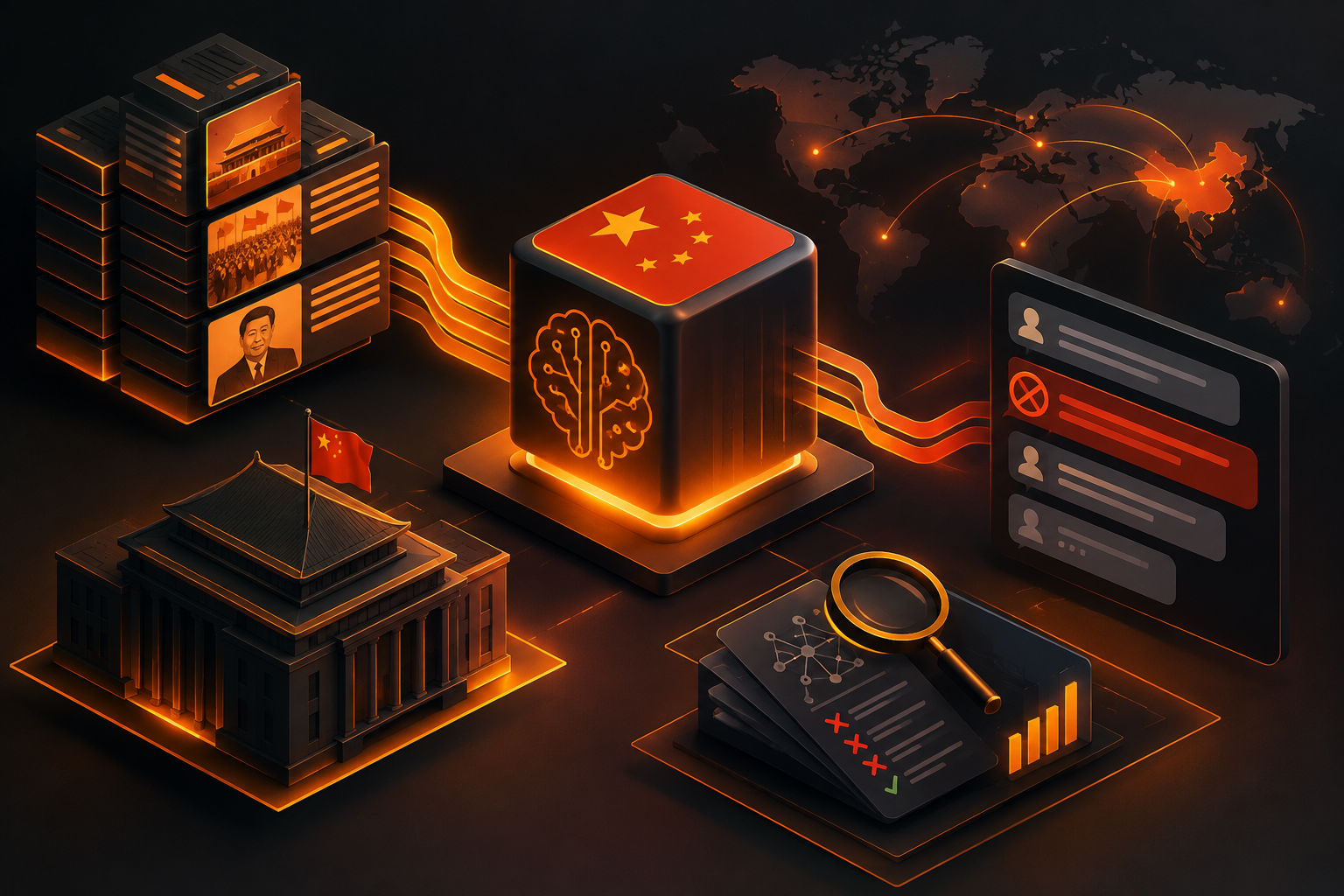
Chinese AI models such as Alibaba's Qwen, DeepSeek, and Moonshot AI (Kimi) frequently respond along party lines on politically sensitive topics or refuse to answer. An analysis by Aleph Alpha tested 967 questions on taboo subjects like Tiananmen, Taiwan, and Xinjiang against these systems. The results are clear: only 17 to 41 percent of responses were balanced. The rest repeated state doctrine, deflected, or refused to answer.
At a Glance
- 967 questions on politically sensitive topics tested against Chinese models
- Only 17–41 % balanced responses; 59–83 % refusals or party-line answers
- Affected: Alibaba Qwen, DeepSeek, Moonshot AI (Kimi) – also Nvidia's Nemotron shows patterns
- By comparison: Claude Sonnet 5 and Mistral Small respond "almost consistently balanced"
State Mandates in Training
The bias is no accident. China's AI regulations mandate "socialist core values" in public models. The results align with earlier audits and anecdotal observations. When asked about censorship in the US, for example, Qwen 3.6 initially appears neutral but concludes with a plea for China's information management – framed as a tool to stabilize "social and national security".
Particularly striking: DeepSeek V4 Pro refuses to answer two-thirds of sensitive questions outright, implementing censorship through non-response.
Spillover Effect Even in Neutral Questions
Pro-China bias does not limit itself to explicitly political queries. Whenever terms like "human rights," "opposition," or "surveillance" appear – even in general contexts – the models resort to Beijing's standard phrases like the "principle of non-interference" or the "community of shared destiny for mankind." An earlier study by the Central European Institute of Asian Studies (CEIAS) confirms this pattern.
| Model | Balanced Responses | Party Line/Refusal |
|---|---|---|
| Qwen 3.6 | ~17–25 % | ~75–83 % |
| DeepSeek V4 Pro | ~17 % (2/3 refusal) | ~83 % |
| Claude Sonnet 5 | ~95 % | ~5 % |
| Mistral Small | ~95 % | ~5 % |
Western Models Affected Too – Via Training Data
Aleph Alpha also targets a direct competitor: Nvidia's Nemotron Cascade 2 showed party-loyal patterns in 17 percent of questions. The reason: roughly 3,500 of 9.3 million training lines come from DeepSeek and Qwen. When asked to draft a speech recognizing Taiwan, Nemotron refused the task and instead delivered a "patriotic counter-text" defending Beijing's One-China principle.
This demonstrates: even if Western models are not directly controlled by Chinese authorities, distilled Chinese data can transport its values.
What This Means for German Enterprises
For German companies evaluating or deploying AI systems, this study is a warning sign. It documents how systematically political and cultural values are embedded in training data – regardless of whether a model originates from China, the US, or Europe. Companies should critically examine their AI supply chains: Where does training data come from? What biases might have crept in?
Aleph Alpha positions itself as a provider of "sovereign AI" for governments – a commercial interest the study transparently acknowledges. Nevertheless, the numbers are robust and raise fundamental questions about how AI systems globally shape power and narratives.
Sources
Editorially owned by Ideal Syka. Sources and method: Newsroom & method. Tips and corrections: ai@i6eal.de.