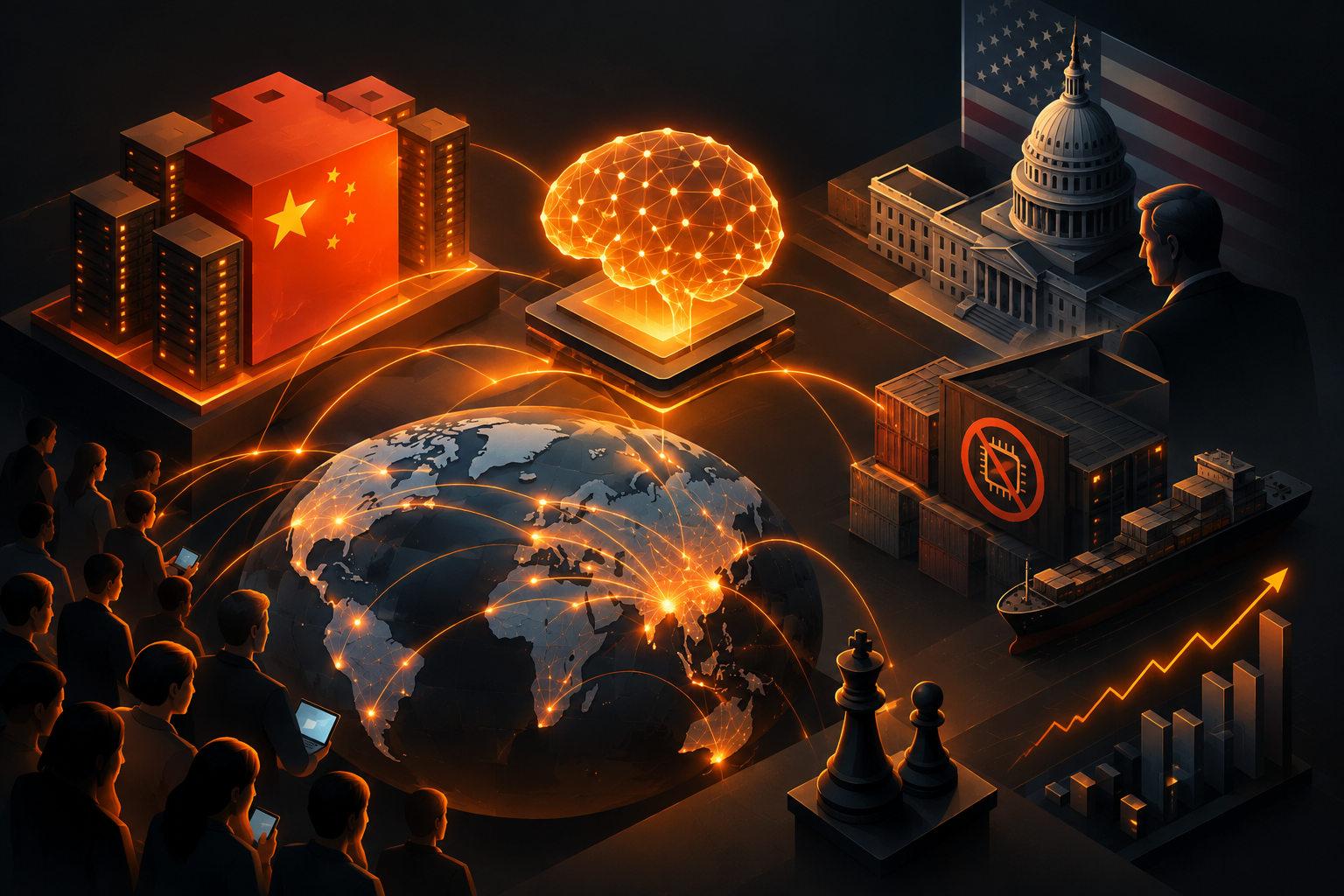
Chinese AI models have unleashed remarkable market momentum in 2026: on the developer platform OpenRouter, their share of tokens used jumped from 6–13% in February to 57–67% in the week of September 14. On Vercel, the share climbed from 11% in January to 55% in August. These figures signal a fundamental shift in global AI consumption – and are triggering growing alarm in Washington.
The essentials
- Market share multiplied: Chinese models now dominate two of the world's largest developer platforms that give companies access to different AI systems
- Main drivers: Lower prices and strong performance in coding and automated tasks (agentic work)
- Geopolitical response: Two U.S. House Committees are investigating rising adoption; the issue was also on the agenda when Trump and Xi met this week
- Key players: DeepSeek and Alibaba are leading the Chinese offensive
Why Chinese models are suddenly winning
The performance gap is shrinking fast. Peter Walker, Head of Insights at OpenRouter, captures the shift in his conversation with CNBC:
"Chinese open source models released this year can credibly perform in advanced agentic use cases, especially in regards to coding, in a way that was just not true in late 2025."
Moreover, these models are, according to Walker, "incredibly cost-effective compared to most models from American labs." Harpreet Arora, Head of Agentic Infrastructure at Vercel, confirms: price is the decisive factor. "Chinese models are becoming capable enough for more tasks at a much lower cost."
By contrast, OpenAI and Anthropic announced cheaper models this week – Anthropic promises more efficient token usage. Yet Chinese systems have already built momentum with developers.
Western dominance frays – but not everywhere
| Metric | Status |
|---|---|
| Benchmark leadership | U.S. models still lead most tests |
| Total spending | U.S. frontier models still attract more overall budget |
| Usage growth | Chinese models growing exponentially faster |
| Coding performance | Chinese models competitive to superior |
The U.S. has tried to protect its lead through export controls – particularly restrictions on selling Nvidia chips to Chinese firms. Yet Washington now worries that Chinese companies are accessing these chips via overseas data centers or gaining ground through "distillation" (mimicking older, established models).
Geopolitical stakes
Daniel Remler, Senior Fellow in the Technology and National Security Program at the Center for a New American Security (CNAS), warns of structural risks:
"Chinese AI represents real economic and security risks for the United States. The ultimate concern is that the integration of Chinese AI models pulls countries into a Chinese technology sphere of influence that hardens into geopolitical alignment."
This assessment explains why AI policy suddenly appeared on the Trump-Xi meeting agenda this week – it is not just about technology, but about global spheres of influence.
What this means for German companies
German firms face a strategic choice: Chinese models offer genuine cost savings and are already production-ready for certain tasks. At the same time, political pressure from the U.S. and EU is mounting on companies that become too dependent on Chinese AI providers. Anyone investing in infrastructure now should factor in that export controls and regulatory measures could alter the availability of these systems in the short term. A diversified strategy – spanning European, American, and selectively Chinese models – is becoming essential.
Sources
Editorially owned by Ideal Syka. Sources and method: Newsroom & method. Tips and corrections: ai@i6eal.de.