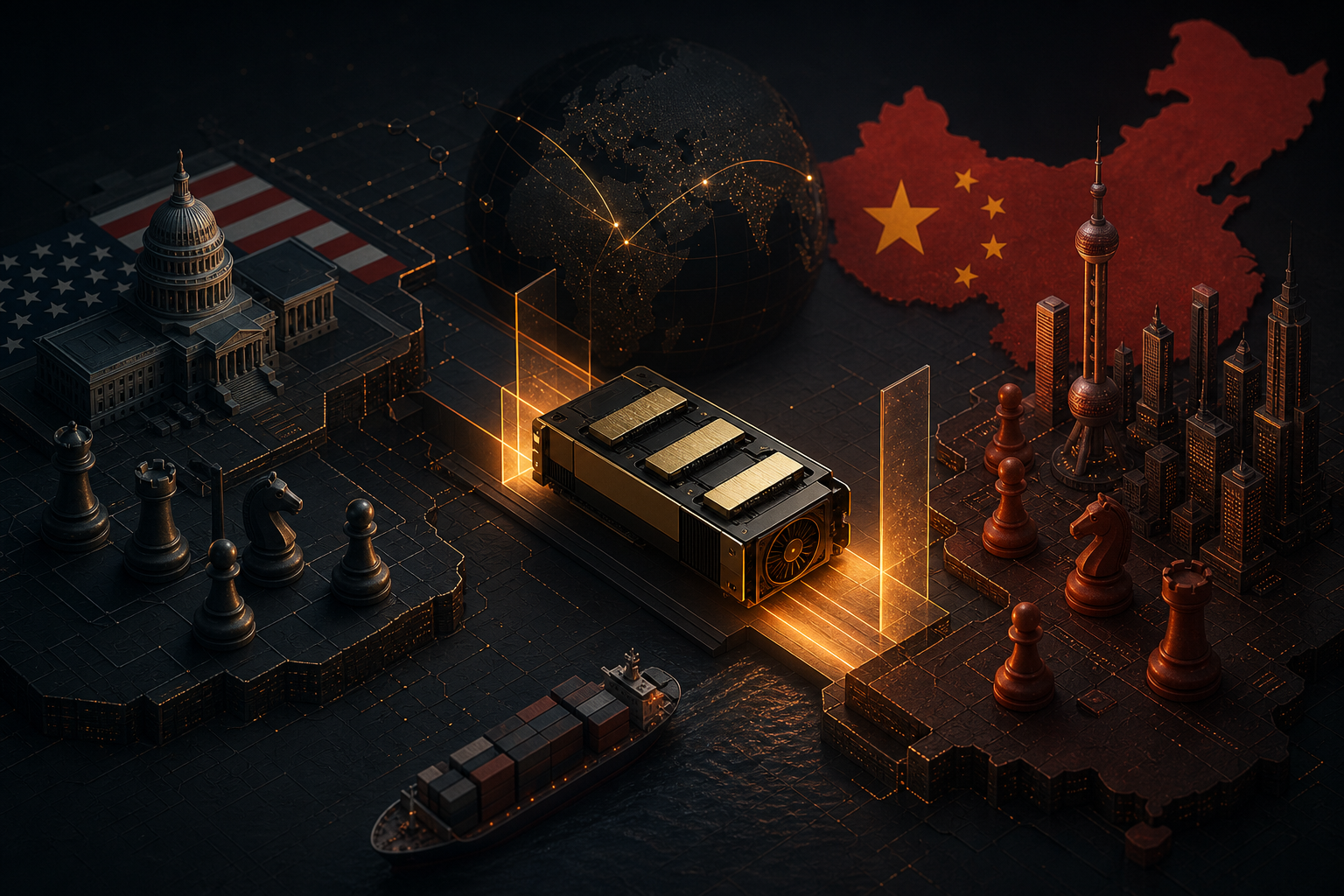
China has eased import restrictions on Nvidia's H200 chips, according to reporting by the Financial Times and Nvidia. The decision arrives at a moment when the global AI competition is accelerating and both superpowers are fighting for control over critical semiconductor infrastructure.
Key Points
- China loosens import restrictions on Nvidia's H200 chips – among the world's most powerful AI accelerator cards
- The move occurs amid escalating geopolitical tensions over AI technology
- Nvidia benefits directly from the regulatory shift; the chipmaker leads the AI accelerator market
- The step could significantly strengthen China's AI capacity and narrow the technological gap
Why China Is Easing Controls
Beijing had previously imposed strict export controls on high-performance chips in response to US sanctions against Chinese tech companies. The H200 ranks among the most sought-after components for large language models and compute clusters needed for AI training and inference. By loosening restrictions, China signals it is partially abandoning its blockade strategy—possibly to accelerate its own access to modern AI infrastructure or to avoid further US countermeasures.
The H200 is a tensor processing unit with 141 billion transistors, optimized specifically for AI workloads. It competes with chips from AMD and others but dominates the data center AI market.
Global Implications: Winners and Losers
| Actor | Position | Implication |
|---|---|---|
| Nvidia | Direct winner | Access to Chinese market expands |
| China | Technological catch-up | Faster access to state-of-the-art AI hardware |
| USA | Sanctions policy under pressure | Export controls may prove less effective |
| EU companies | Indirectly affected | Competitive pressure from Chinese AI advances rises |
The easing also demonstrates a broader reality: the US attempt to slow China's AI development through chip embargoes faces limits. China can access technology through workarounds or negotiations with suppliers like Nvidia—or invest in homegrown alternatives.
What This Means for German Decision-Makers
German companies reliant on AI infrastructure should monitor this development closely. A technologically stronger China could intensify global competition for AI talent and applications. At the same time, the episode underscores a lasting truth: geopolitical tensions over semiconductors remain volatile. Companies planning their AI strategy should factor in supply-chain risks and potential further regulatory shifts. The EU's push for sovereign AI infrastructure becomes even more urgent.
Sources
Editorially owned by Ideal Syka. Sources and method: Newsroom & method. Tips and corrections: ai@i6eal.de.