
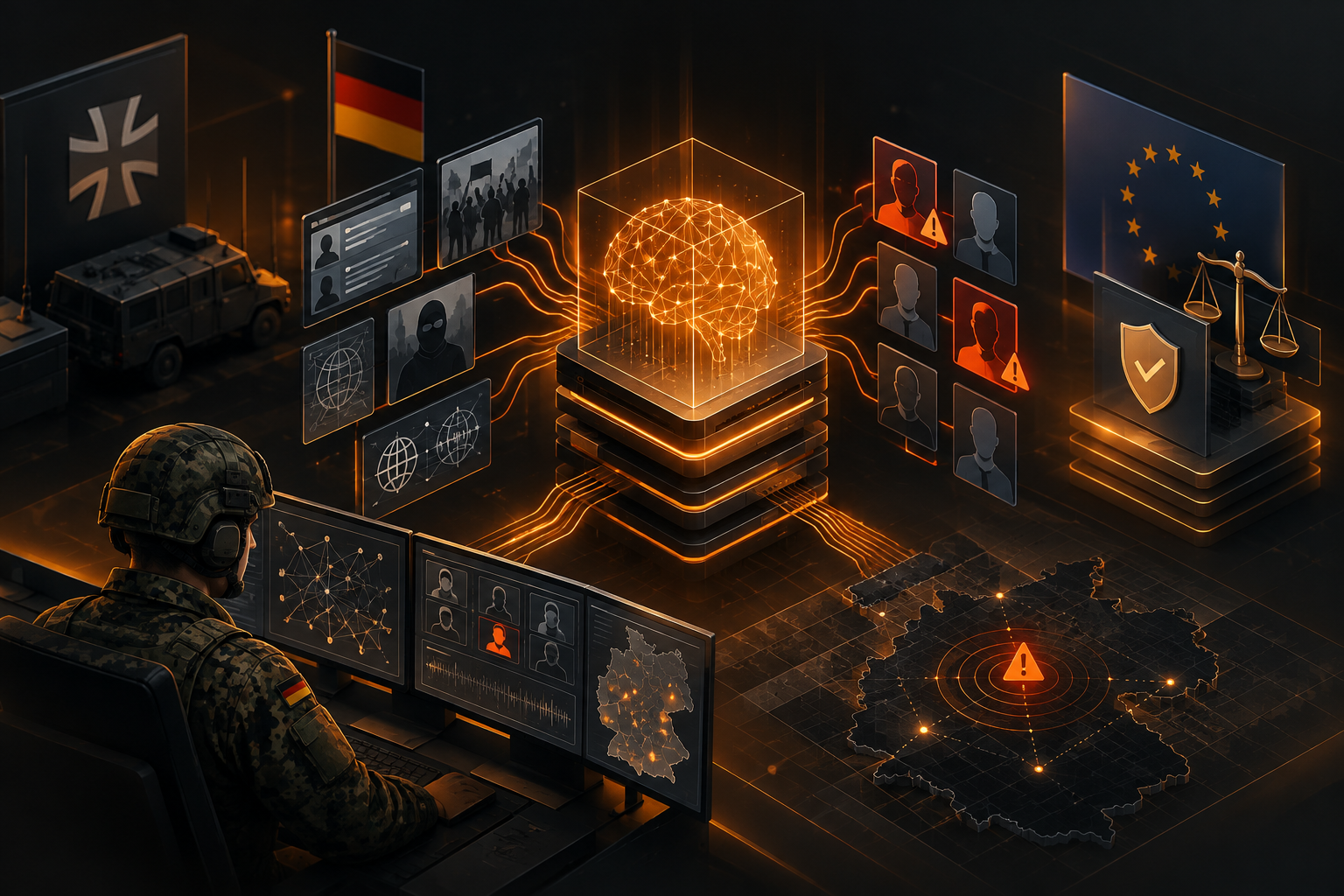
Germany's Military Counterintelligence Service (MAD) is planning to deploy AI-powered screening procedures to detect far-right extremist tendencies among Bundeswehr applicants. This marks a concrete use case for automated security surveillance within a German government agency – and raises critical questions about accuracy, discrimination risks, and legal compliance.
The essentials
- The MAD plans automated screening procedures to detect extremism early in the applicant vetting process
- Goal is identifying far-right extremist ideology before hiring into the armed forces
- The project qualifies as high-risk AI under the EU AI Act with strict transparency and control requirements
- No details yet on pilot phase, accuracy rates, or deployment timeline
Security vs. privacy: The core tension
Using AI for extremism detection addresses a genuine security concern for the Bundeswehr: infiltration by extremists threatens institutional cohesion and public trust. Automated systems promise scalability and consistency when screening large applicant pools.
However, significant risks emerge. Automated classification of ideology relies on data patterns – and these patterns can reproduce or amplify bias. Who gets flagged as "suspicious"? Which data sources feed the system – social media, communications, network analysis? How are false positives handled – applicants wrongly classified as extremist?
Regulatory framework
The project falls under the high-risk AI category of the EU AI Act (Annex III, point 6: "use of AI systems for assessing the risk a natural person poses to public security"). This mandates:
| Requirement | Implication |
|---|---|
| Transparency notice | Affected individuals must be informed that AI participated in the decision |
| Documentation | Full system traceability, training data, test results required |
| Human oversight | No fully automated rejection – humans must review decisions |
| Audit & monitoring | Regular checks for bias and error rates |
It remains unclear whether the MAD has already integrated these requirements into planning or whether they will only become relevant during implementation.
What this means for German enterprises
This case demonstrates how quickly AI systems are deployed in sensitive contexts – with minimal transparency. For companies in security tech, HR-tech, and public administration, this is a wake-up call: high-risk AI requires robust governance. Those developing or deploying such systems shouldn't wait for regulatory pressure or scandals to build in bias testing, audit trails, and human oversight mechanisms. The EU AI Act will make these requirements binding from 2026 onward – starting now provides a competitive edge.
Sources
Editorially owned by Ideal Syka. Sources and method: Newsroom & method. Tips and corrections: ai@i6eal.de.