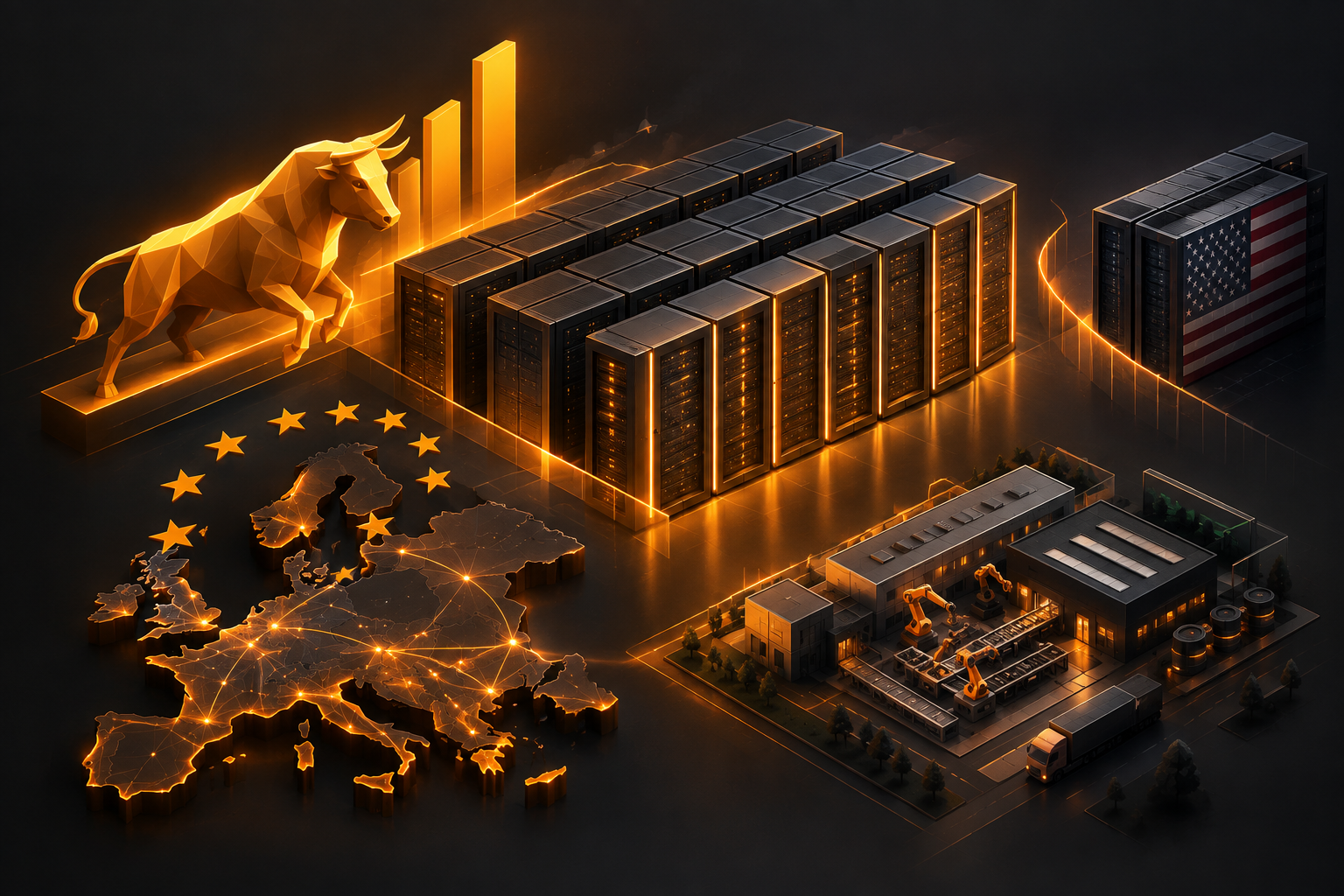
French supercomputer maker Bull reopened an expanded factory in Angers on Thursday, doubling its production capacity. The move responds to unprecedented demand for European high-performance computing systems for AI – and to the strategic need to reduce dependence on American vendors.
The essentials
- Capacity doubled: Bull increases monthly production from 6 to 12 racks, can scale to 24 racks in 2027
- Investment & success: Factory expansion cost €80 million; Bull won 15 of 18 tenders issued by EuroHPC, the EU body co-funding Europe's supercomputer network
- European components: Share of European parts rose from 20–30% five years ago to 70% today
- Strategic framework: The EU is investing €7 billion (2021–2027) in a European supercomputer network
Record orders and strategic positioning
Chief Executive Emmanuel Le Roux told Reuters that Bull has received more orders this year than ever before. The company is competing against established players like Hewlett Packard Enterprise – and winning. With 15 of 18 EuroHPC tenders secured, Bull has established itself as Europe's leading provider.
The Angers facility is currently Europe's only dedicated production site for these high-performance machines, making it both a bottleneck and a strategic asset for European sovereignty. Notably, Airbus inaugurated two Bull supercomputers in Toulouse and Hamburg – part of a five-year deal worth close to €100 million that tripled the aircraft maker's simulation capacity.
Major contracts and European supply chains
Bull is currently working on two megaprojects in parallel: France's Alice Recoque supercomputer (94 racks, €554 million total cost) and LUMI-AI for Finland (€388 million, Bull's largest contract ever). Without the factory expansion, these projects could not have been built simultaneously.
Particularly striking is the shift in component sourcing. While Bull relied 70–80% on US or Asian parts five years ago, 70% of components now come from Europe. The company uses processors from Nvidia, AMD, and Intel – depending on customer requirements – or European alternatives.
Additionally, Bull signed a partnership with Taiwan's Foxconn in June to manufacture Nvidia's NVL systems at a facility in the Czech Republic, with final assembly in Angers. This signals that European production is becoming the norm, not the exception.
What this means for German industry
Bull's expansion is more than a production milestone – it signals that European AI infrastructure is now real. For German mid-market companies and industrial firms, this opens several perspectives: First, they can train AI models on European supercomputers without relying on US cloud providers. Second, Bull's success demonstrates that European hardware makers are competitive. Third, the question remains whether German suppliers will benefit from this value chain – or whether component sourcing will remain concentrated outside Germany.
Sources
Editorially owned by Ideal Syka. Sources and method: Newsroom & method. Tips and corrections: ai@i6eal.de.