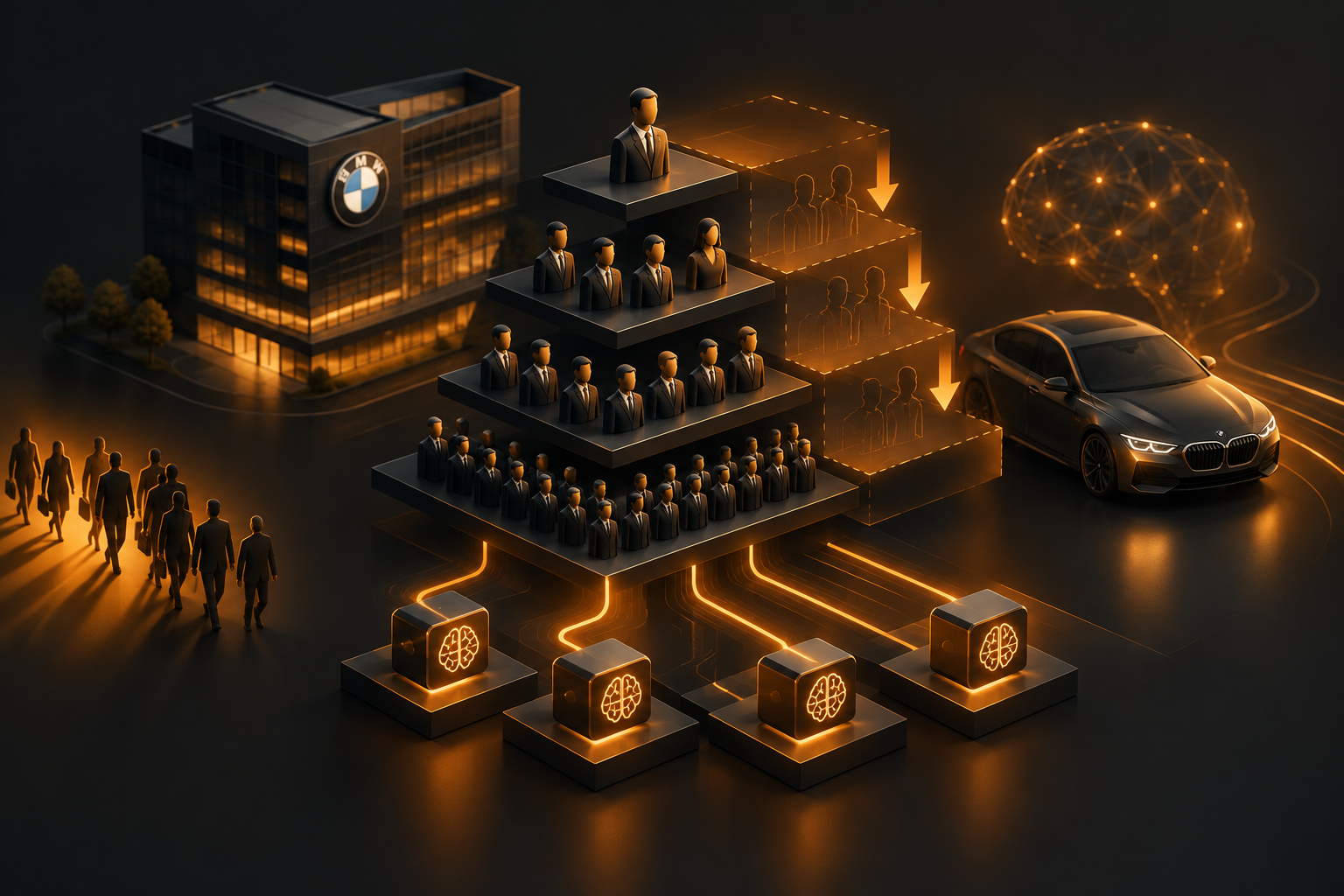
BMW will reduce the number of its business divisions and management functions by 20 percent by mid-2027. The company announced this at its Capital Market Day on September 29 and 30. Specifically affected are around 65 Senior Vice Presidents directly below the board and approximately 400 managers at the level below – in total, around 100 senior positions could be eliminated.
The essentials
- 8,000 jobs worldwide planned by end of 2027 (roughly 5 percent of around 154,000 employees); production positions explicitly excluded
- BMW investing 200 million euros centrally in AI programs with targeted value contribution of 1.2 billion euros to business processes
- No forced redundancies; Munich, Regensburg, Dingolfing, and Leipzig locations particularly affected
- Reason: Weak market environment, declining margins, pressure from China, overcapacity
What AI actually does here
The claim that AI replaces 20 percent of managers is a popular misconception. At its core, this is about consolidating business divisions, eliminating division heads, shortening reporting lines, and removing additional hierarchy levels. AI is meant to support this classic organizational restructuring by automating routine tasks and accelerating decision-making – not by independently deciding which managers leave.
BMW aims to transition from isolated AI tools to so-called agentic AI systems: specialized software agents that consolidate information from multiple systems, plan work steps, and trigger follow-up actions.
Concrete use cases
| Area | System | Function |
|---|---|---|
| Procurement | AIconic (Multi-Agent System) | Draft orders, send to suppliers, evaluate responses, approve straightforward cases |
| Vehicle Development | Mistral AI (Crash Simulations) | Specialized models based on BMW engineering data |
| Production | AIQX | Analyze sensor and image data in real time, detect errors on production lines |
According to BMW, engineers retain control over results and approvals.
Financial background
BMW is responding to a significantly tougher environment. For 2026, the company expects an EBIT margin of just 1 to 3 percent in the automotive segment – a drastic decline. By 2028, it should rise to 3 to 5 percent, with long-term targets of 8 to 10 percent again. Free cash flow in the automotive business should reach more than 5 billion euros by 2028 and more than 7 billion euros by the early 2030s.
What this means for German companies
BMW demonstrates a realistic picture: agentic AI enables flatter hierarchies, not the abolition of management. For mid-market companies, the signal is important – this is about targeted automation of routines and acceleration of decision-making, not radical disruption. Those wanting to implement such systems need a clear organizational strategy, not just the technology. And crucially: control over AI results stays with people – that's not a side issue but a prerequisite for acceptance and liability.
Sources
Editorially owned by Ideal Syka. Sources and method: Newsroom & method. Tips and corrections: ai@i6eal.de.