
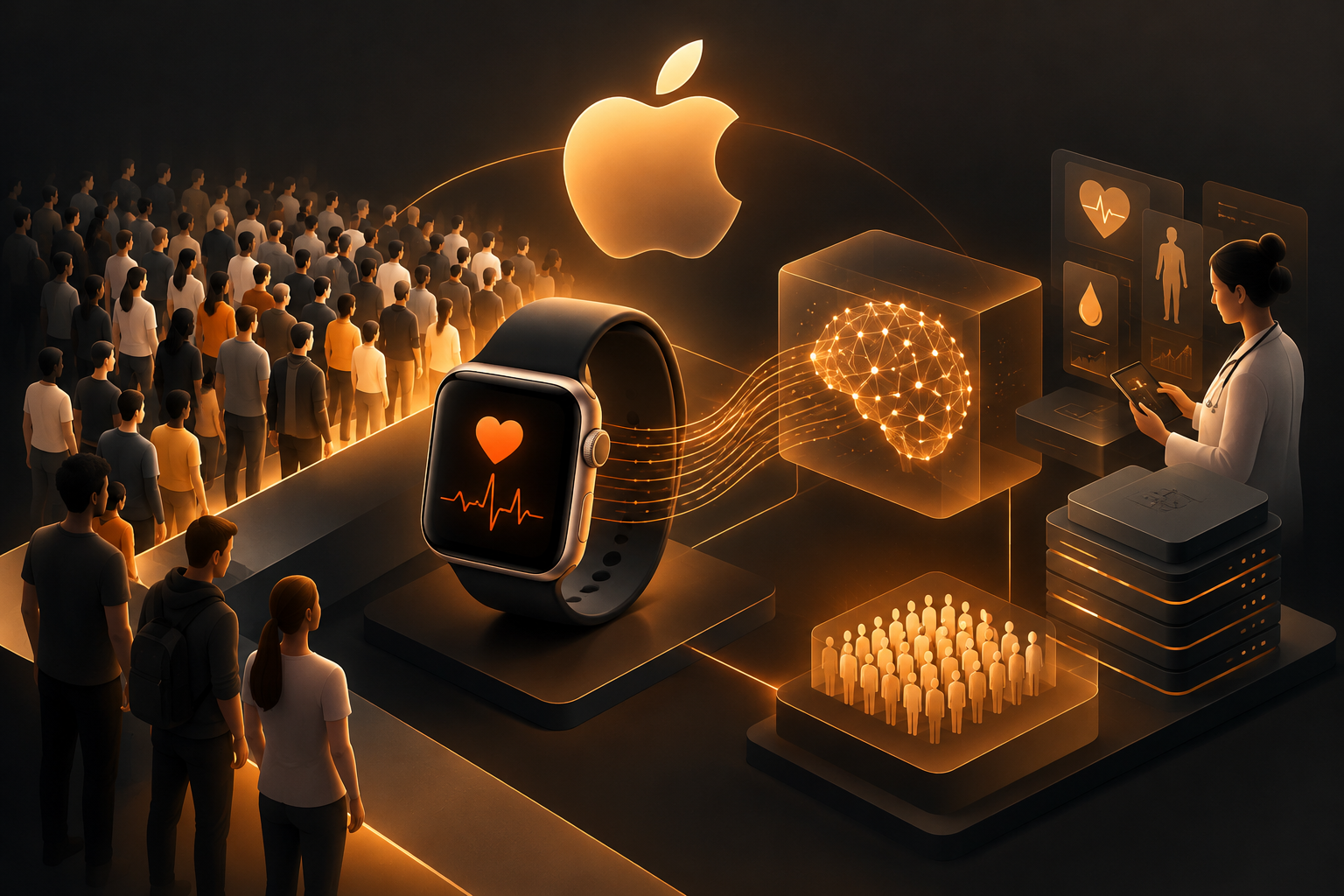
Apple has announced a new study called the Apple Health AI Usage Study. According to The Verge, its goal is to better understand how people interact with conversational AI health tools and how useful their responses actually are. The study is conducted with OpenEvidence, a clinical AI platform used by healthcare professionals.
How the study works
Participants ask medical questions through a new iOS app and rate the answers on criteria such as accuracy, detail and relevance. According to The Verge, Apple is looking for up to 200,000 people, and enrollment began on the day of publication. Participants must be 21 or older and based in the US. The Verge says the app requires an iPhone 15 Pro running iOS 26 or later. TechCrunch instead lists iPhone 15 or later with Apple Intelligence enabled; the two reports differ on this requirement.
According to TechCrunch, the study is planned to run for more than 12 months. Users rate the answers and are also asked to take part in monthly surveys.
Sources and privacy
According to reports, the answers are grounded in clinical sources such as The New England Journal of Medicine, the Journal of the American Medical Association and Nature. Participants can optionally share Apple HealthKit data such as activity, sleep or lab results. Apple states the data will not be used to train AI models. According to TechCrunch, data is anonymized before being sent to a third-party cloud provider, and OpenEvidence deletes query and response data after 24 hours.
Assessment
Unlike other AI companies that offer chatbots with health features, Apple wants first to study how clinically grounded answers can help people, according to TechCrunch. TechCrunch reports it is unclear whether Apple will later add such answers to its Health app or to Siri. For providers of health services in Germany, the study could become relevant if it shows which quality criteria are seen as reliable for health AI, but no results are available yet.
Sources
Editorially owned by Ideal Syka. Sources and method: Newsroom & method. Tips and corrections: ai@i6eal.de.