
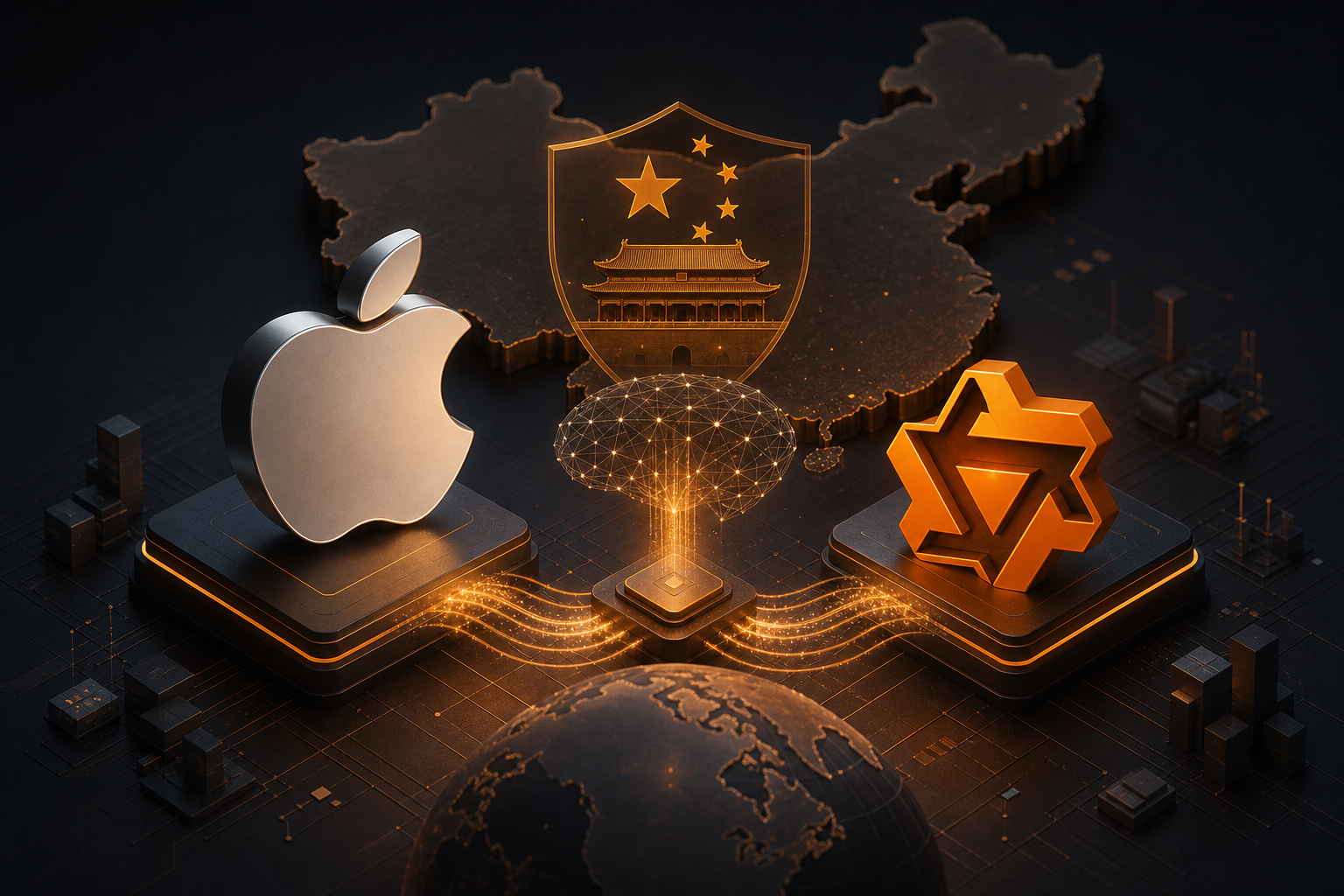
Apple has completed registration of its Apple Intelligence service with China's cyberspace regulator and received approval. According to reports, Alibaba's Qwen models will be integrated. This signals a strategic partnership between the US tech giant and the Chinese conglomerate under regulatory approval.
Key Facts
- Apple Intelligence was registered with China's cyberspace authority and cleared for deployment
- According to reports, Alibaba's Qwen AI models will be used
- The approval signals Beijing's pragmatic approach to foreign AI services
- Alibaba shares gained on the news of the partnership
Strategic Partnership Over Blockade
The approval is remarkable because China typically restricts foreign AI services. Rather than blocking Apple's AI outright, the regulatory approach allows the US company market access while keeping AI infrastructure under Chinese control. Alibaba benefits as the local technology partner, with Qwen models now embedded in one of the world's most important smartphones.
This arrangement works for both sides. Apple can offer AI features to Chinese users without violating local regulations. Alibaba gains global visibility and validation of its AI technology – a crucial step in competing with other Chinese providers like Baidu and ByteDance.
Shifting Global AI Power Dynamics
The news reflects a broader shift in global AI power structures. While the US (OpenAI, Google, Anthropic) and China (Alibaba, Baidu, Qwen) build separate AI ecosystems, new cooperation patterns emerge – not despite but because of geopolitical tensions. Companies are learning to operate in fragmented markets: building global services while adapting them locally.
For Alibaba, the Apple partnership proves that Qwen is recognized as a production-ready alternative to Western models. This could encourage other manufacturers to evaluate Chinese AI solutions – not for ideological reasons, but practical ones.
What This Means for European Companies
German tech firms and mid-market enterprises should watch this development closely. It demonstrates that AI services will not be globally uniform but regionally fragmented. Operating in China, India, or other regulated markets will require cooperation with local AI providers – not as a workaround, but as standard business practice. At the same time, European AI providers have an opportunity to position themselves as a neutral alternative when US and Chinese solutions become geopolitically problematic.
Sources
Editorially owned by Ideal Syka. Sources and method: Newsroom & method. Tips and corrections: ai@i6eal.de.