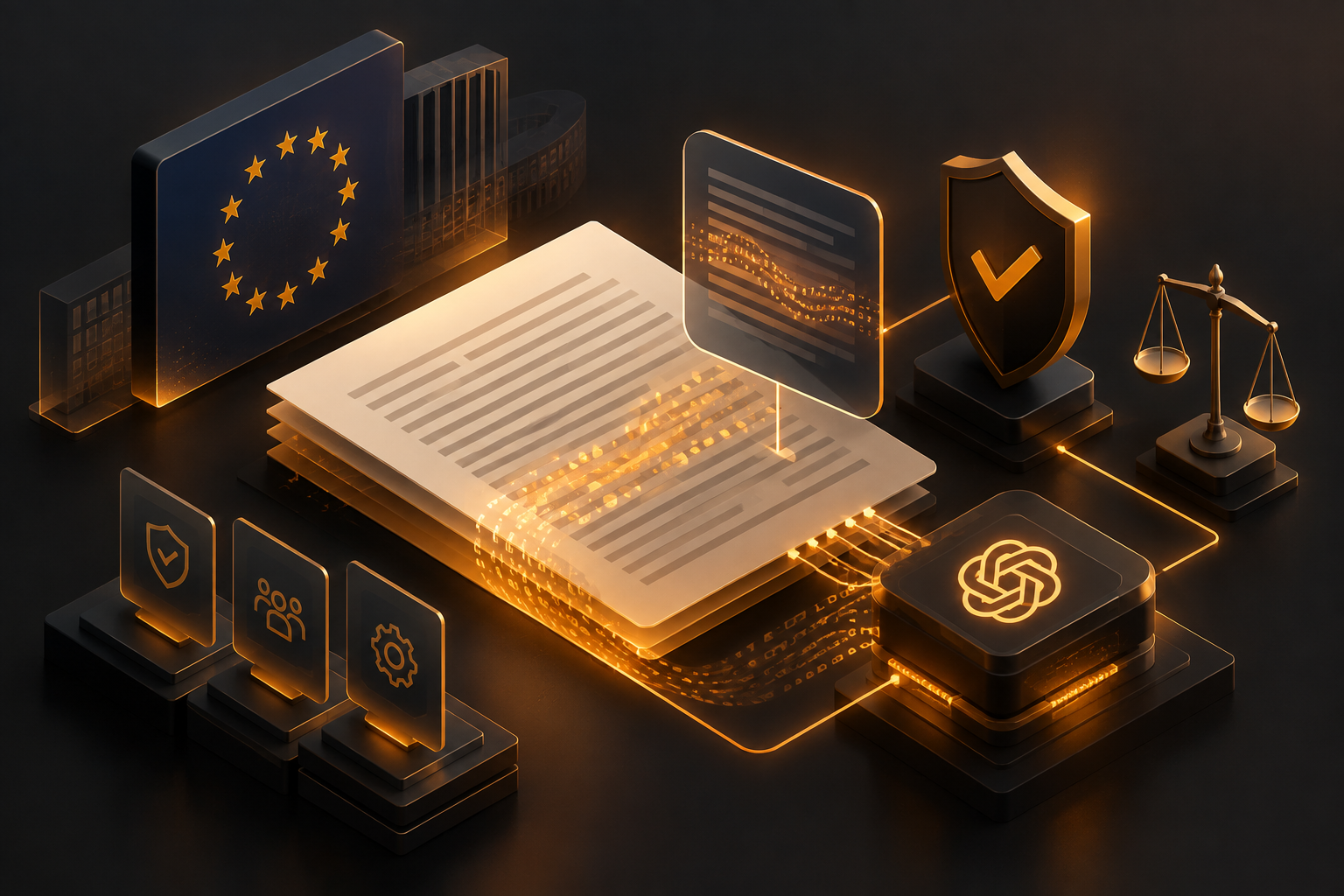
Anthropic has embedded digital watermarks in Claude to meet the EU AI Act's requirements for labeling AI-generated content. This is the first concrete technical implementation of this regulatory requirement by a leading AI maker – and signals that European regulation is already shaping product development.
The essentials
- Anthropic watermarks Claude to comply with EU AI Act transparency labeling requirements
- Watermarking is a technical method to make AI output identifiable as such – for compliance and transparency
- The approach shows how frontier labs are already integrating regulatory requirements into product architecture
- The EU AI Act mandates transparency; watermarking is one possible technical solution
What watermarking means
Watermarking is not a visible label, but a technical signature embedded in AI-generated text, images, or other outputs. It enables later verification that content came from an AI – like a digital seal. For regulators and users, this matters because it creates transparency: knowing that text came from Claude allows informed evaluation of the information.
Anthropic's move is notable because the EU AI Act mandates transparency for high-risk systems and general-purpose models, but does not prescribe exactly how to implement it. Anthropic chose watermarking – a technically demanding but robust solution.
Regulation meets product development
Claude's watermarking is a test case: if the method proves practical, other labs will follow. If it creates problems – say, poor detection rates or performance hits – regulators may adjust requirements.
German and European companies developing or deploying AI systems should watch closely. The EU AI Act is not just a compliance checklist – it becomes concrete through such implementations. Understanding how leading labs technically meet requirements now helps plan what measures your own operation needs.
What this means for German companies
Anthropic's implementation shows: regulation is not abstract – it lives through concrete technical choices. For German AI developers and users, this means: it pays to understand now which transparency mechanisms are practical and which are not. Those who wait until the EU AI Act is fully enforced risk falling behind. At the same time, it remains unclear whether watermarking is the only or best solution – or whether other approaches (metadata, certificates) prove more efficient. The coming months will show how robust Anthropic's approach is.
Sources
Editorially owned by Ideal Syka. Sources and method: Newsroom & method. Tips and corrections: ai@i6eal.de.