
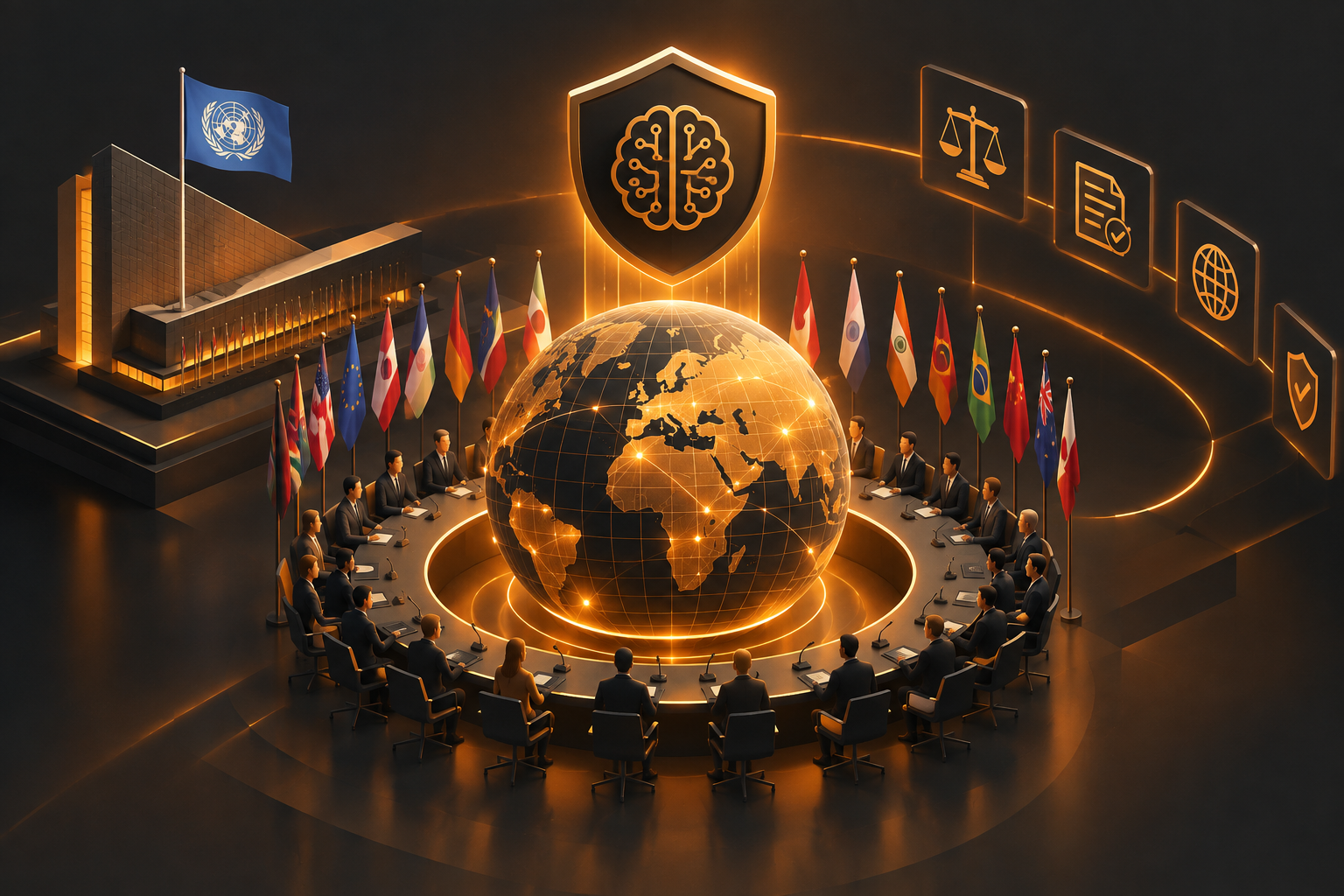
At the margins of the UN General Assembly in New York, 22 heads of state and government have called for the establishment of a global regulatory body to oversee particularly powerful artificial intelligence systems. The initiative aims to establish binding safety standards at the international level and strengthen oversight of technological development – signaling a regulatory trend that extends beyond the European AI Act.
Key Facts
- 22 heads of state and government (led by Finland and Norway) are calling for a global AI oversight body with binding safety standards
- Signatories include German Chancellor Friedrich Merz, EU Commission President Ursula von der Leyen, as well as Australia, Canada, Singapore, South Africa, and Kenya
- The three-point plan calls for independent audits before release, harmonized government standards, and mutual reporting of serious incidents
- Notable absences: USA, China, UK, France, Japan, and India have not joined
The Architecture: Three Pillars of Global AI Control
The concept rests on three foundations. First, binding safety measures and independent audits must be mandatory before new AI programs are released. Second, signatories demand harmonized government standards – unified rules rather than a patchwork of national regulations. Third, a system for mutual reporting of serious incidents should be established to ensure transparency when failures or security breaches occur.
The planned institution would be tasked with conducting regular inspections and convening the international community when defined performance thresholds of AI systems are exceeded. Central to this is the principle: Technology must always remain under human leadership, oversight, and control.
Who's In – and Who's Missing
The coalition is geographically broad. Beyond Germany and EU institutions, European countries such as Spain, the Netherlands, Denmark, and Austria have joined. Globally, Australia, Canada, Singapore, South Africa, and Kenya support the initiative. At the ministerial level, representatives from Bahrain, Turkey, and the United Arab Emirates also signed on.
Yet the absence of leading AI nations is striking: Neither the USA nor China – the two superpowers in the AI race – have joined the initiative. Other major industrial nations such as the UK, France, Japan, and India are also not involved. This significantly weakens the immediate enforcement power of the undertaking.
Criticism and Open Questions
Criticism comes from civil society. AlgorithmWatch executive director Matthias Spielkamp called the plans insufficient – a sign that even advocates of stronger AI control view the proposal as not going far enough.
Unanswered questions remain: How will such a global body be financed, staffed, and equipped with enforcement powers? How will it relate to the existing EU AI Act, or will it set its standards as a minimum?
What This Means for German Companies
As a decision-maker in a German company, this matters: If this initiative materializes, global AI standards could emerge that go beyond or complement the EU AI Act. This would mean you'd need to comply not only with European requirements but potentially also with international audits and reporting obligations. However, without the USA and China on board, practical impact remains limited. It's a first step – nothing more, nothing less.
Sources
Editorially owned by Ideal Syka. Sources and method: Newsroom & method. Tips and corrections: ai@i6eal.de.